

Mercer Island School District settles sex abuse claim for $1.5M
A former student alleged district administrators failed to intervene and protect her from being sexually abused by an English teacher
A former student alleged district administrators failed to intervene and protect her from being sexually abused by an English teacher

Despite concerns newsroom staffers shared with InvestigateWest and RANGE, the nonprofit taking over Spokane’s daily paper plans to keep Curley in a leadership role


As Klickitat County Sheriff Bob Songer retires, candidates have distanced themselves from some — not all — of Songer's most controversial positions

Advocates are pushing for a survivor justice law like those in other states, but a two-thirds legislative majority presents a major hurdle

Before she was incarcerated in Oregon, Angela Kim had grown accustomed to not being in charge of her own life.
Her husband of 15 years controlled the money, when she went to sleep and woke up, even how much toilet paper she was allowed to use. He enforced the rules through beatings, choking, locking her in the closet, and threatening to take their children. So when he murdered their business partner in December 1999 for the life insurance money, refusing to participate was “not an option,” Kim recounts.
Seven years later, Kim confessed the killing to a friend, and both she and her husband were charged with aggravated murder. Kim cooperated with prosecutors, and they agreed to a plea deal that reduced her charges to first-degree manslaughter and conspiracy to commit murder. Both charges carried a mandatory minimum sentence — so even as the judge presiding over her case acknowledged the abuse and coercion she had been subject to, his hands were tied. He sentenced her to the minimum of 17½ years.
“He was the most sympathetic and said the kindest things,” Kim said. “There was nothing they could do.”
She was incarcerated at Coffee Creek Correctional Facility until her release in September 2023.
Researchers who surveyed women inside Coffee Creek starting in 2017 found that 65% were in an abusive relationship at the time of their crime, with nearly 45% saying the relationship contributed to their conviction. The findings echoed research from around the country showing people who experience domestic violence are highly likely to face prosecution for crimes themselves.
In recent years, states including New York and Oklahoma have passed laws that allow judges to reduce a sentence based on how coercion and abuse played a role in the crime.
Advocates and lawmakers in Oregon have introduced bills mirroring these laws in three legislative sessions. Some of the bills go even further to include more crimes and adopt a lower bar for defendants to show that abuse was a contributing factor. But political opposition has defeated the bills each time.
The Oregon District Attorneys Association, a powerful lobbying group representing the state’s 36 elected prosecutors, argued that prosecutors and judges can already offer domestic violence survivors leniency and warned that the sentencing law would undermine Measure 11, the 1994 law voters passed creating mandatory minimum sentences. While Democrats, who hold a supermajority in both legislative chambers, have backed changes to other voter-approved measures — including rolling back much of a landmark drug decriminalization law in 2024 — softening mandatory minimums has proved to be a harder sell.
“The state is always talking about victims of domestic violence and wanting to provide services and protect them,” said Julia Yoshimoto, director of the Women’s Justice Project at the Oregon Justice Resource Center, a nonprofit that helped spearhead the bills in 2021 and 2023.
Survivors facing criminal charges, however, are “largely unrecognized,” she said.
 Kaylee Tornay
It can also be difficult for defendants to educate judges and juries about domestic violence at trial, so advocates have turned their focus to sentencing reforms. One Oregon woman, Deborah Albin, faces up to 30 years in prison for causing her infant daughter's death by failing to get medical care and protect her from the father's alleged abuse. Although the evidence that Albin had been choked and threatened by the father barely came up at trial, the sentencing law pushed by advocates would have required the judge to consider domestic violence at a hearing at the end of July.
It’s not clear whether anyone will bring back a bill in 2027 to give survivors sentencing relief, or whether it can overcome the obstacles that have tanked it before. Rep. Annessa Hartman, a Democrat and Gladstone lawmaker who sponsored a 2025 bill that aimed to address prosecutors’ concerns, is leaving office at the end of the year. Sen. Floyd Prozanski, chair of the Senate Judiciary Committee who carried advocates’ competing bill that year, said he doesn’t know if he will bring it back in the future.
Prozanski is a longtime municipal prosecutor. He said the bill was a high priority and believes minimum sentences should be “presumptive” rather than mandatory — meaning a defendant would receive the minimum unless a judge decides otherwise. But the survivor justice law just didn’t end up in his top priorities in 2025, he said.
Hartman said she expects a continued uphill battle. Even with significant concessions to prosecutors’ objections, her bill received minimal support from Democratic leaders last year.
“It's heartbreaking to have worked for months on this … and then basically get the rug pulled out from underneath us,” she said. “I think that there's a lot of growth within (the Capitol) building, within both chambers, for people to understand what life is truly like, after the fact of abuse or assault.”
Kim, who is now a legal assistant at the Oregon Justice Resource Center, thinks the true share of women in prison at least in part because of an abusive relationship is much higher than what researchers found.
“There was hardly a woman that I met that hadn't experienced that in their background,” Kim said. “It's a very common story.”
Domestic violence experts and incarcerated people say the criminal justice system often fails to take into account how a partner’s coercion, threats or physical violence can push people into committing crimes. People experiencing domestic violence may turn to drugs to cope with the trauma, which can lead to drug-related charges or property crimes. Some are financially extorted by their abusers and commit identity theft or fraud to survive. Some victims kill or assault their abusers — and while they feel they’re doing so in self-defense, the circumstances may not align with the legal defense.
In 2019, the New York Legislature passed the Domestic Violence Survivors Justice Act, which had failed to pass four previous times. It required judges to consider the impacts of domestic violence in sentencing, while also allowing those already serving time to petition for a lighter sentence. Five years later, Oklahoma passed a similar law.
Oregon advocates introduced a bill modeled after the New York law in 2021 but more expansive. While New York’s law excluded crimes like first-degree and aggravated murder, along with sex offenses, Oregon’s bill didn’t exclude any crimes from being eligible for relief.
Crystal Magaña, who has testified in support of the Oregon bill, was 20 when she was charged with aggravated murder and other charges for killing a man who picked her up while she was being sex trafficked in Portland. Magaña said he had threatened to kill her and she acted in self-defense. Though she considered fighting the charges, she was dissuaded because the prosecutors had indicated they would seek the death penalty. She also had a young daughter.
Magaña instead pleaded guilty to first-degree manslaughter in 2002. Her judge, too, was sympathetic to the years of abuse and exploitation she had experienced from the man who trafficked her when she was just a teenager. Magaña was sentenced to 16½ years, receiving good time for only six months.
“It's unfair, and what happens is, you get sentenced under a Measure 11 charge, and then you qualify for no programming, you qualify for nothing that can help you heal from your trauma,” said Magaña, whose history of physical and sexual abuse stretches back to her childhood.

Oregon advocates knew their bill was going to be a tough sell, since it would introduce more flexibility in sentencing than the voter-approved mandatory minimums law allowed. Altering that law requires a two-thirds majority vote in both chambers.
“We went into this in 2021 maybe a little naively,” Yoshimoto said. “Or not really understanding how little the domestic violence advocacy organizations recognize this population, and how against any sort of changes to Measure 11 legislators would be.”
Still, advocates were encouraged by the initial show of support from lawmakers and some organizations such as the Center for Hope and Safety, a domestic violence service provider. The district attorneys association opposed it, but at least two individual district attorneys supported it, saying they had seen instances when judges wanted to give lighter sentences to domestic violence survivors but were bound by sentencing guidelines. Survivors testified about their experiences during a public hearing, and then-Rep. Anna Williams, a former social worker and the bill’s sponsor, talked about what she had learned about survivors who committed crimes.
“While challenging to understand from the outside of the relationship, a person wrapped in that constantly reinforced threat of violence does not necessarily have the ability to tell their partner, ‘No, I’m not going to commit a crime just because you told me to,’” Williams, a Democrat, said in her written testimony. “Because they know with certainty what sort of consequence they will face.”
In the end, however, it was less the merits of the bill that sunk it in 2021 than Democrats prioritizing another issue that also needed a two-thirds majority vote. For the first time in Oregon history, House leaders wanted to expel a member, Republican Mike Nearman, who had held a Capitol door open to violent far-right protesters seeking to disrupt an emergency session to deal with the economic fallout of the COVID-19 pandemic.
Democrats successfully voted out Nearman — but advocates for the domestic violence sentencing bill were told there wasn’t enough political will to muster another two-thirds majority vote. The bill never made it out of committee.
The district attorney’s association has raised a host of concerns about the domestic violence sentencing bills each time they’ve been introduced.
Prosecutors say abusers could exploit the law by arguing their victim had verbally abused them, forcing victims to defend themselves. They warn that victims could be retraumatized if those serving time can petition to reduce their sentence. The association also contended some versions of the proposal set the bar too low, requiring that domestic abuse only be a “contributing factor” in the crime compared to laws in other states that require the abuse be a “significant” factor.
And prosecutors argue judges can already consider abuse when handing down punishment.
“I am sure one could find instances where someone could argue the criminal justice system failed the accused individual,” said Chris Parosa, district attorney for Lane County, in an email declining InvestigateWest’s interview request. “I would simply state that in my experience judges and prosecutors are quick to identify evidence of prior abuse as a mitigating factor that should be considered in both charging and sentencing.”
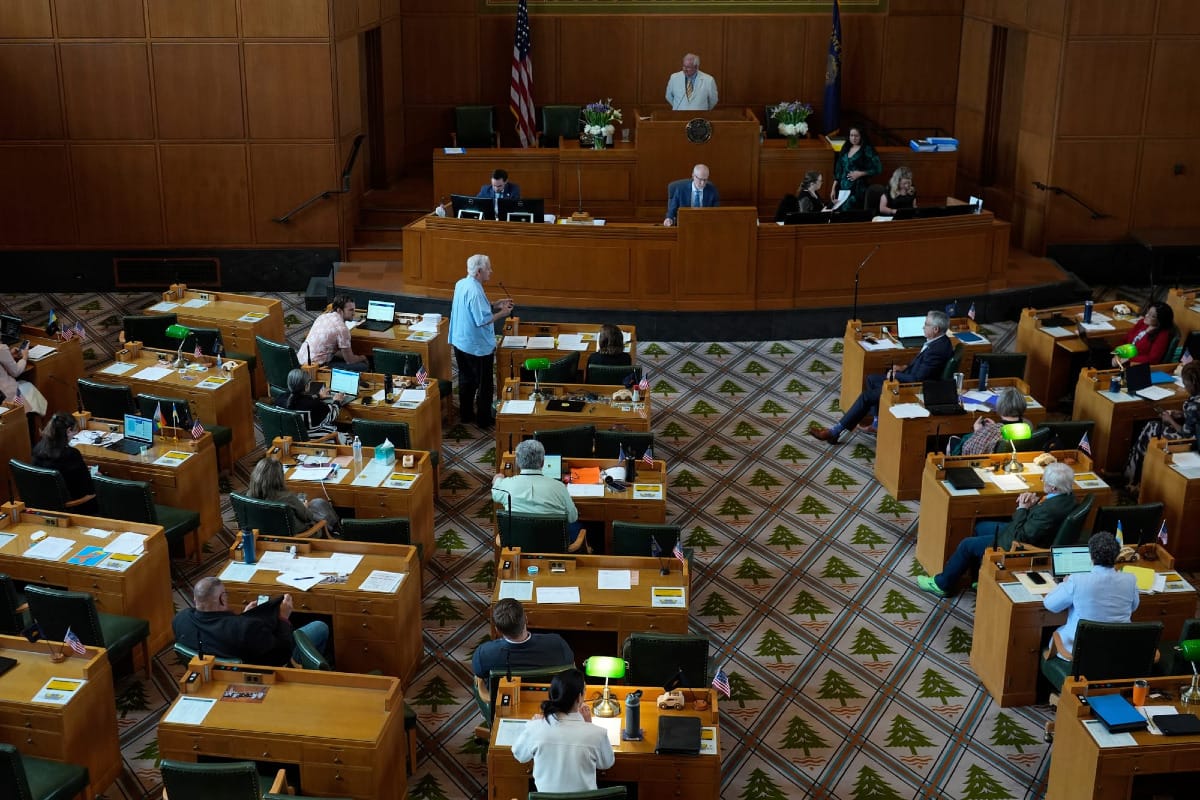
Of the 25 violent crimes covered in Measure 11, judges can give less than the mandatory minimum for eight of them. They’re all lower-level felony offenses, and the criteria to depart from the minimum varies. To qualify for a reduced sentence for a second-degree assault conviction, for example, the crime cannot involve a deadly weapon or cause significant injury to the victim.
District attorneys also argued that aspects of the sentencing bill would open the door for lawmakers to keep tinkering with the minimum sentences established by voters. If lawmakers wanted to make changes to the sentencing law in the future, they would only need majority support instead of the two-thirds majority required to change a voter-approved law. Lawyers from the nonpartisan Legislative Counsel Office opined that the law would not have this effect on Measure 11, but Democratic leaders remained skeptical and kept the bill shelved.
InvestigateWest contacted the district attorneys association’s leadership to better understand its objections. Its president, executive director and two members of its board of directors all declined or did not respond to interview requests.
Survivors and advocates push back on the idea that judges can already take abuse into consideration if they really want to. Two prosecutors who wrote a letter supporting the bill in 2021 — John Hummel, then Deschutes County district attorney, and Matt Ellis, then district attorney for Wasco County who now holds that role in Hood River County — said that they had witnessed instances when judges wanted to reflect a survivor’s trauma in a felony sentence, but found “their hands are tied by Oregon’s sentencing guidelines.”
Yoshimoto, from the Oregon Justice Resource Center, says the narrow exceptions to Measure 11 still preclude many people who have experienced significant abuse from finding relief. Those convicted of first-degree manslaughter, for example, are ineligible. Albin, the Corvallis mother convicted in her 2-month-old daughter’s death, faces a minimum 10-year sentence for that conviction, though the judge could add even more prison time because of her daughter’s young age.
 Kaylee Tornay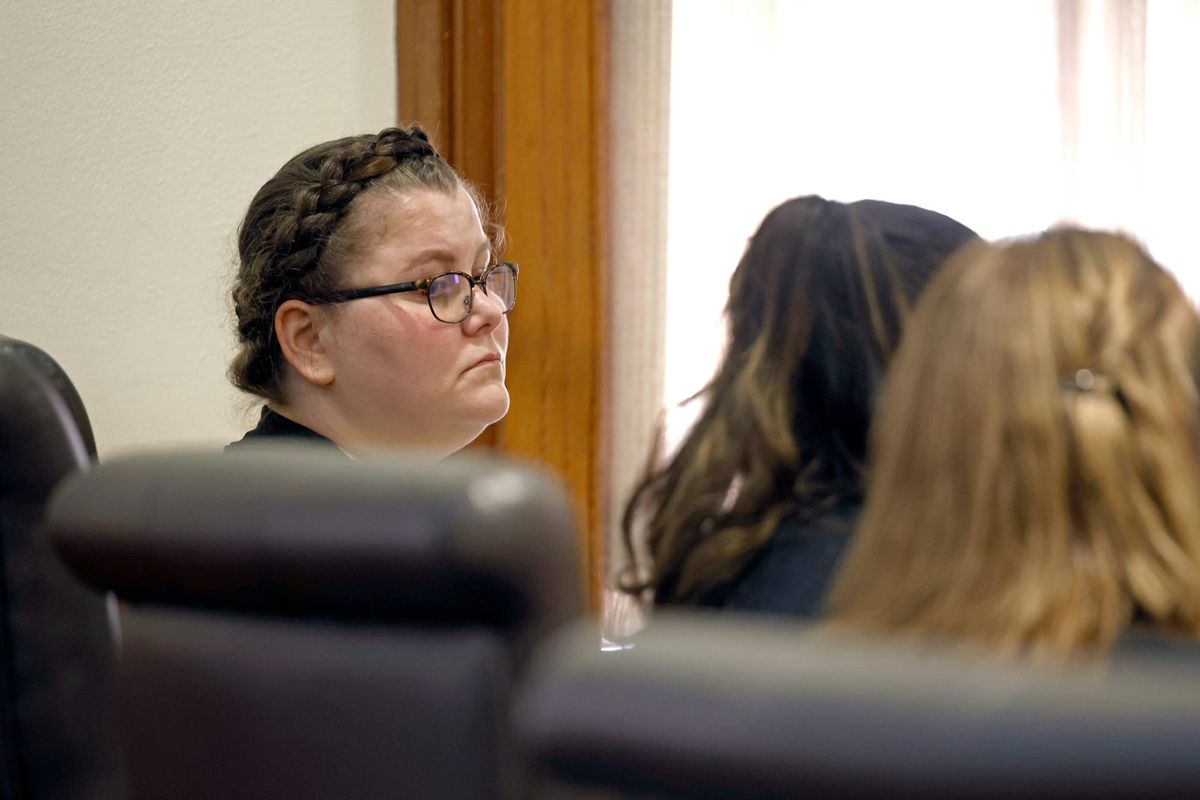
Without more explicit guidance requiring judges to consider how abuse contributed to the crime, defense attorneys have little incentive to fully investigate their clients’ histories of domestic violence or bring it up, Yoshimoto said.
Hartman, the Gladstone Democrat who brought the 2025 bill in the House, made significant concessions to prosecutors’ concerns. Her bill no longer allowed survivors who were already serving time to petition for resentencing, and it limited the eligible crimes only to those where the victim was the alleged abuser.
Hartman called it a “good faith effort” to meet opponents in the middle. It never got a hearing in the House Judiciary Committee.
The bill’s original proponents were not all pleased about Hartman’s bill, however. The Oregon Justice Resource Center wasn’t planning to reintroduce the legislation in 2025, because they didn’t have the resources that year to launch an effective campaign, Yoshimoto said. But after learning about the changes in Hartman’s bill, Yoshimoto, Kim and their colleagues rushed to get a version introduced in the Senate that was more like the original concept.
Hartman’s bill “was just too watered down,” Yoshimoto said.
So far, the worst-case scenarios predicted by prosecutors have not played out in other states that passed survivor sentencing laws: They’ve seen no widespread sentence reductions or a loss of judicial discretion.
Research on New York’s Survivors Justice Act shows around half of all petitions for resentencing have been rejected by judges. Alexandra Harrington, a professor from the University at Buffalo Law School, found that prosecutors’ postures toward petitions greatly influence the outcomes of cases — when prosecutors are opposed, judges are more likely to reject the petitions.
As of 2024, 64 incarcerated people had received reduced sentences upon review, while another 73 were denied.
In Oklahoma, where the law has been in effect for less than two years, only one woman, Lisa Rae Wright, has received a sentence reduction so far. At least five other resentencing petitions have been rejected.
Wright had been serving a life sentence without the possibility of parole for a first-degree murder conviction in the death of her abusive husband. Her brother shot the man, but a jury found her responsible, too, for soliciting the killing.
In a hearing on her petition for a reduced sentence in January 2025, Wright recounted how her husband threatened her with a gun, raped her and beat her throughout their marriage. The judge who heard her petition reduced her sentence to 30 years — because she had already served nearly 35 years, she was freed from prison the day of her hearing.
Wright, who was incarcerated under her married name, Moss, called that day in court a “miracle.” But since then, she’s seen at least four of her friends, each of whom presented evidence at their petition hearings of horrific abuse by their partners, be denied relief under the Survivors Act.
“This law means to me, ‘We hear you, we see you, we believe you,’” Wright, who now works as a survivor justice coordinator for the Oklahoma Appleseed Center, told InvestigateWest. “It's created a passion and a need to go forward and to be a voice for so many others that don't have a voice.”
For now, it’s not clear what the future of this legislation looks like in Oregon.
Hartman, the legislation’s most recent sponsor, did not run for reelection to the House in order to run for a Clackamas County commissioner seat, a campaign she suspended because of a cervical cancer diagnosis. Democratic leaders and senior lawmakers aren’t as convinced about the law’s merits, let alone how expansive the scope should be.
Supporters are continuing to organize, though. Magaña wants to see more survivors tell their stories and share how their experiences of abuse affected their actions. And she wants lawmakers to listen.
“I know that it can pass, but it's going to take getting the courts and the district attorneys, those groups of position of power, to change their mindset on stuff,” Magaña said. “All we need is the door to be cracked open, and then it can keep moving more and more open from there.”

The story you just read is only possible because readers like you support our mission to uncover truths that matter. If you value this reporting, help us continue producing high-impact investigations that drive real-world change. Your donation today ensures we can keep asking tough questions and bringing critical issues to light. Join us — because fearless, independent journalism depends on you!
— Jacob H. Fries, executive director
DonateCancel anytime.

The board of 5Rock Ranch nearly shut it down more than a decade ago, but former residents say harmful practices continue

A judge said the alleged domestic violence Deborah Albin experienced did not meet Oregon law’s strict criteria to avoid a mandatory-minimum sentence

Parents in eight states can be acquitted if they can show “reasonable fear” of escalating violence

As Washington reduces public defender caseloads, prosecutors say that's forced difficult charging decisions

A former student alleged district administrators failed to intervene and protect her from being sexually abused by an English teacher

Despite concerns newsroom staffers shared with InvestigateWest and RANGE, the nonprofit taking over Spokane’s daily paper plans to keep Curley in a leadership role

As Klickitat County Sheriff Bob Songer retires, candidates have distanced themselves from some — not all — of Songer's most controversial positions

State agencies don’t know how many inmates face more prison time because they couldn’t access programs prescribed by parole commissioners
Subscribe to our weekly newsletters and never miss an investigation.