


Some states offer domestic violence defenses to parents charged with failing to prevent child abuse. Should Oregon?
Parents in eight states can be acquitted if they can show “reasonable fear” of escalating violence

When a child is abused, it’s not only the abuser who can be criminally charged. Across the country, a parent can also be prosecuted for not doing enough to stop it.
But what if the parent was also being targeted by the abuser, and feared that going to police would put them and their child in an even more dangerous situation?
Some states, recognizing how “failure to protect” laws can punish domestic violence victims for their abusers’ actions, have ensured that a parent can raise evidence in court that they were under threat through what’s known as an affirmative defense. If a parent can prove they feared intervening would escalate the violence, they could be acquitted, even if a jury had also found they had failed to act.
That’s not the case in Oregon, where parents are accused of failure to protect under a law called criminal mistreatment, which includes few exceptions. This month, a jury in Corvallis found 30-year-old Deborah Albin guilty of manslaughter and criminal mistreatment in the death of her 2-month-old daughter, Opal, in part for failing to protect the baby from alleged abuse by her father. The court limited the evidence of domestic violence that Albin could bring to trial. She could face up to 30 years in prison.
Some say it’s a good thing that Oregon doesn’t have a domestic violence related defense the way Minnesota, Hawaii and at least six other states do. Joshua Marquis, former elected district attorney for Clatsop County who has been prosecuting felonies for decades, said he would be opposed to Oregon adopting an affirmative defense. Allowing parents to potentially escape criminal charges because of domestic violence lets them off the hook for their legal duties as parents, he said.
“What we're saying, I believe, if there's an affirmative defense, is, ‘OK, well, there are circumstances when you just don't have to protect that child, or you don't have to do anything that would disrupt your lifestyle or cause this man to be angry at you,’” he said.
But some domestic violence experts say that enshrining a domestic violence defense in state law can be a legal lifeline, protecting parents’ ability to argue that they were acting in their child’s best interest in an unpredictable and dangerous environment. Survivors already face harmful misconceptions about domestic violence, such as the belief that leaving the home or relationship is always feasible or the safer option, said Joan Meier, director of the National Family Violence Law Center at the George Washington University Law School.
“There's enormous difficulty for women in terms of leaving and leaving with their children,” Meier said. “Often, the batterer will not let them leave with the children and will threaten to kill either the mother herself or her own family members, or the dog. There's 1,000 threats that are not unrealistic.”
 Kaylee Tornay
Around 40 years ago, states began passing laws criminalizing a parent’s or caregiver’s failure to protect a child from abuse. While Oregon doesn’t have such an explicit law, parents like Albin can still be charged with criminal mistreatment, which covers caregiver failures from abandonment to withholding food.
While research into these laws is limited, analyses of cases and appeals in some states have found mothers are prosecuted more frequently than fathers for failure to protect in child abuse cases. And they are often victims of violence, too — a 2014 Buzzfeed News analysis of failure to protect cases in 29 states, for example, found that nearly 40% included evidence of domestic violence against the prosecuted mother.
In Oklahoma, being convicted of “permitting child abuse” can put a parent in prison for life. An analysis by the nonprofit Oklahoma Appleseed Center for Law & Justice found that those convicted of failing to protect receive more prison time on average than those who abused the child.
In Oregon, however, it’s difficult to establish how often these prosecutions happen, or how sentences shake out, because the criminal mistreatment statute is so broad.
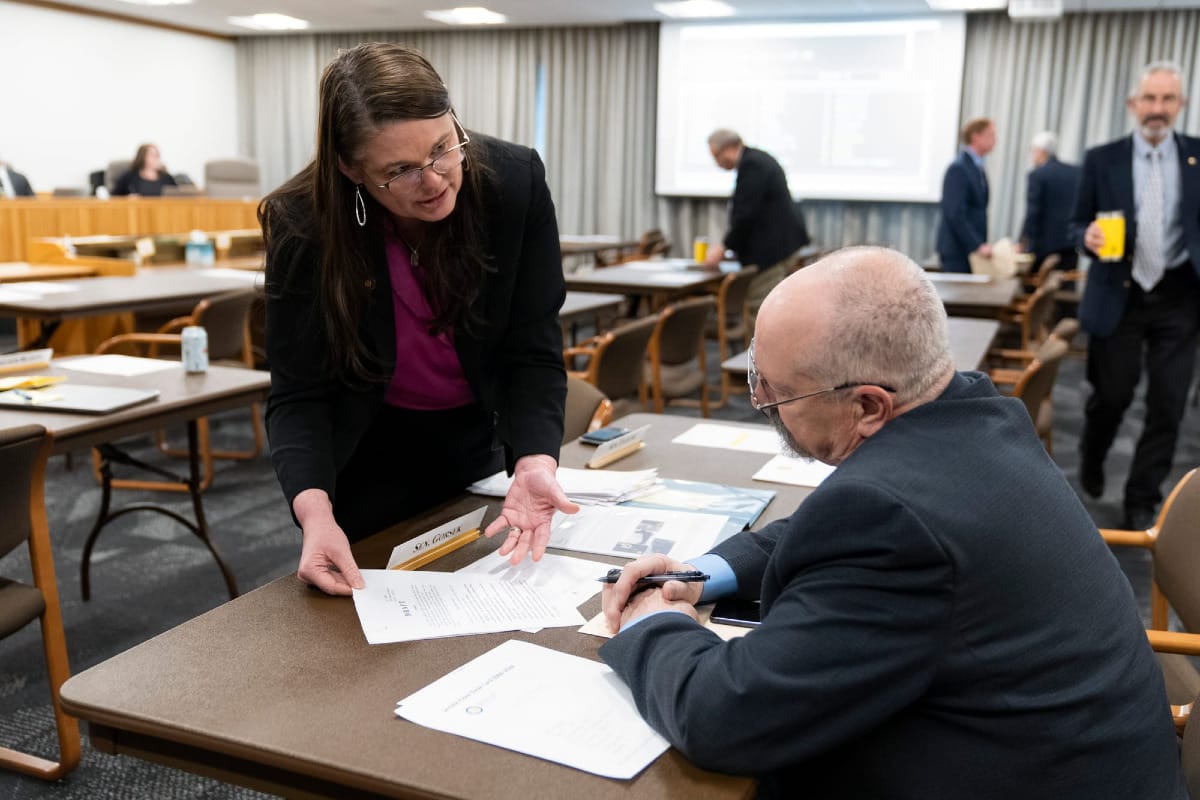
InvestigateWest contacted five state lawmakers who have brought recent legislation addressing how domestic violence survivors are treated in the criminal justice system. State Sen. Sara Gelser Blouin, the only lawmaker who offered her opinion, said state law generally allows people to bring up evidence showing they acted reasonably. She was skeptical that adopting an affirmative defense would make it any easier for a domestic violence victim to be acquitted in a “failure to protect” case, because the burden is on the defendant to prove an affirmative defense.
“You’ve definitely raised my curiosity, and I will be looking further into this,” she said.
In Albin’s case, Benton County prosecutors alleged she failed to seek medical care for Opal and to protect her from abuse. Albin was home caring for Opal alone when the 2-month-old infant stopped breathing. She called 911, and an ambulance rushed Opal to the hospital, where the baby later died.
After an autopsy found Opal died of complications from multiple rib fractures and acute methamphetamine toxicity, prosecutors alleged Opal’s father, Andrew Oaks, used meth around her and broke her ribs. Oaks, who has denied hurting his daughter or Albin, is scheduled to go to trial on second-degree murder, manslaughter and criminal mistreatment charges in April 2027.
Benton County prosecutors sought to block evidence of domestic violence from Albin’s trial, arguing it was “irrelevant” to her defense. The court ultimately limited Albin to mentioning only acts of domestic violence from her pregnancy forward — essentially an 11-month window of a seven-year-long relationship. Before Opal was born, the couple had at least seven interactions with police, including in 2019 after a neighbor reported overhearing Oaks threaten to kill Albin and himself during an argument. Text messages also show Albin accused him at least three times of choking her and once that he tossed Opal “like a ragdoll.”
At trial, Deputy District Attorney Matthew Ipson referenced the text messages about Albin being choked more than the defense did, pointing to it as evidence that Albin knew Opal’s father was “not somebody who is safe to be around children.” Albin’s defense attorneys, meanwhile, presented little evidence related to alleged domestic violence or Albin’s mental health, a change from pretrial filings indicating they planned to argue that Albin had complex post-traumatic stress disorder as a result of her partner’s alleged abuse. The condition affects emotions, decision-making and self-worth and is commonly diagnosed in survivors of long-term abuse.
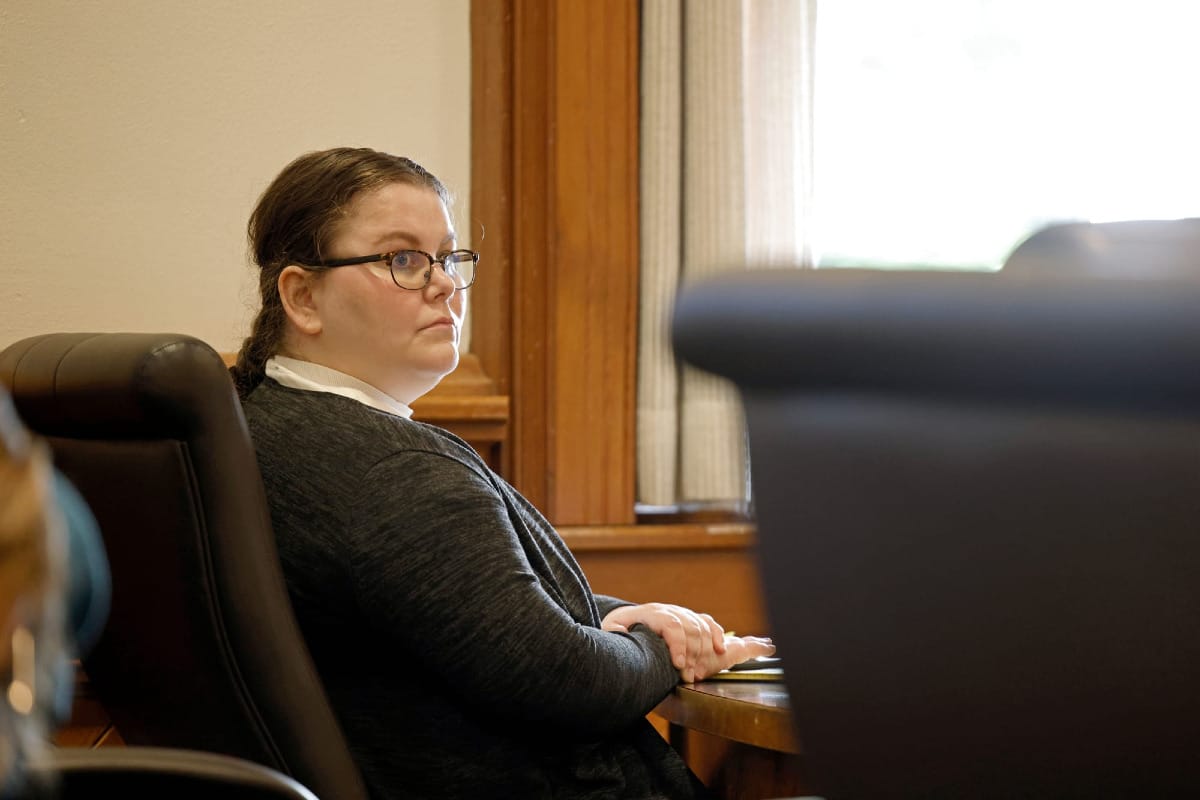
Rina Morales-Holmes, Albin’s lead defense attorney, said she decided not to focus on domestic violence after the limitations on evidence were imposed. Instead, during trial, she asked a psychologist who examined Albin more general questions about the effects of domestic violence and common misconceptions.
Those misconceptions and stereotypes are why some researchers are skeptical that affirmative defenses actually lead to acquittals.
Leigh Goodmark, director of the Gender, Prison and Trauma Clinic at the University of Maryland Law School, said criminal defendants usually aren’t seen as victims, particularly when their experience is being weighed against the harm their child suffered.
“Even in trying to use the defense, you are taking an enormous risk,” Goodmark said. “You're going to open yourself up to accusations that you are manipulative, that you are unfeeling, because you want to be seen as the victim and not your child. It's an impossible situation.”
Among the states that offer an affirmative defense to their failure to protect laws, most require defendants to show they had a “reasonable” fear or belief that intervening when the child was being abused would escalate the violence. The language is meant to create an objective standard for juries to consider, but domestic violence experts say it’s easy for prosecutors to cast a victim’s actions as unreasonable, even when they align with what experts recognize as typical responses to intimate partner violence. For example, it’s common for an abuse survivor to deny the abuse to police, or leave and then return to the relationship.
It’s “not the case in any state” that a parent can be excused from failure to protect charges simply by proving they experienced abuse, said Cindene Pezzell, director of the National Defense Center for Criminalized Survivors, a consulting and training center focused on domestic violence victims accused of crimes.
Invoking an affirmative defense requires people to “A, prove that they're victims, and B, prove that they did this analysis and took the safer option, whatever that was,” she said.
Even though some of these defenses have been in place since the 1980s, there’s little research tracking their impact, making it unclear whether they actually help domestic violence victims defeat failure to protect charges.
Michal Buchhandler-Raphael, a law professor at Widener University Commonwealth Law School in Pennsylvania, searched legal databases for published appellate decisions in seven states with “reasonable fear” affirmative defenses. In a forthcoming paper, she said she couldn’t find examples in which courts have analyzed use of those defenses.
Buchhandler-Raphael said the dearth of examples surprised her, but hypothesized that it likely reflects how many cases resolve through plea deals.
She believes more states should pass similar affirmative defenses. While the success of such defenses in court depends on how effectively a defense team presents evidence of abuse and fear, without enshrining them in statute, she said, many victims may not get an opportunity to talk about the abuse.
“(Passing an affirmative defense) is the beginning, not the end,” Buchhandler-Raphael said.
Even Goodmark, who doubts their effectiveness, said she would rather see affirmative defenses adopted into law than not.
“I want any tool at my disposal to try to use to keep this from happening to somebody,” she said.

The story you just read is only possible because readers like you support our mission to uncover truths that matter. If you value this reporting, help us continue producing high-impact investigations that drive real-world change. Your donation today ensures we can keep asking tough questions and bringing critical issues to light. Join us — because fearless, independent journalism depends on you!
— Jacob H. Fries, executive director
DonateCancel anytime.
Criminal Justice

Washington has few paths to early prison release. Advocates fear Gov. Ferguson has closed off a critical one
Gov. Bob Ferguson has rejected everyone the state board recommended for commutation

She brought fentanyl to the hospital to save her son. Idaho treated him as a trafficker.
After Isaac Berger overdosed, his mother gave hospital staff the pills she found in his room. She says it became the biggest regret of her life.

A 2021 law expanded Washington’s power to decertify police officers. Records show cops still avoid consequences
An InvestigateWest review shows how Washington police agencies keep hiring cops accused of serious misconduct

Oregon woman opens up about alleged domestic violence before receiving 10-year sentence over baby's death
A judge said the alleged domestic violence Deborah Albin experienced did not meet Oregon law’s strict criteria to avoid a mandatory-minimum sentence
Latest
What happens when local news disappears? Polluters pollute more. Governments become less accountable. Entire communities are left in the dark.
Since 2009, InvestigateWest has been building something the Pacific Northwest desperately needed: a nonprofit investigative newsroom — and the civic infrastructure to spread accountability journalism across the region.
Washington has few paths to early prison release. Advocates fear Gov. Ferguson has closed off a critical one
Gov. Bob Ferguson has rejected everyone the state board recommended for commutation

Washington is fighting to limit its duty to protect vulnerable adults
At the same time, Adult Protective Services workers say they’re under growing pressure to close investigations quickly.
She brought fentanyl to the hospital to save her son. Idaho treated him as a trafficker.
After Isaac Berger overdosed, his mother gave hospital staff the pills she found in his room. She says it became the biggest regret of her life.