Newsroom staffers tell InvestigateWest and RANGE that concerns about Curley’s leadership festered until his August suspension — weeks before the paper was set to transfer to his nonprofit
Under the banner of “Dig, Baby, Dig,” the Trump administration is supercharging an already powerful mining industry. What will happen to vulnerable plants and animals?
In May, a southwestern Idaho probation officer emailed immigration authorities about a man she would meet the next day for his regular check-in.
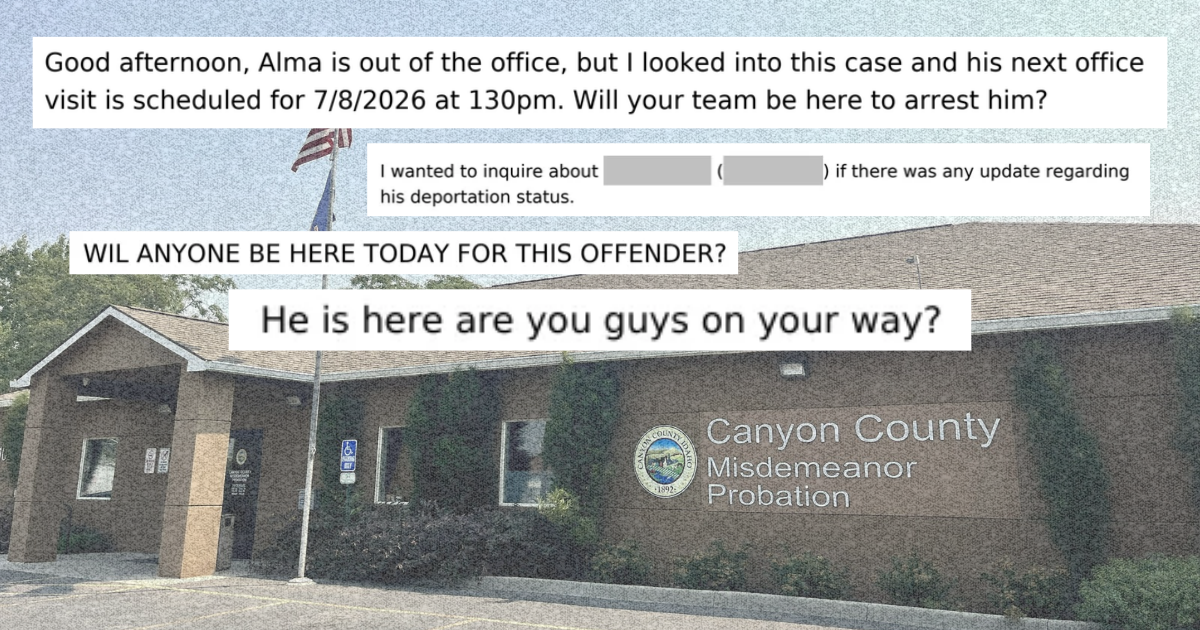
“His meeting has not changed and he is expected to be here tomorrow morning at 7:30 am,” Norma Naranjo, a senior probation officer for Canyon County’s misdemeanor probation department, wrote in a May 13 email to six Immigration and Customs Enforcement agents.
The following day, the man arrived a few minutes early to his appointment, and Naranjo sent another email to the agents.
“He is here are you guys on your way?” she wrote.
It is unclear from the emails, which are heavily redacted, if ICE agents detained the man at his probation appointment.
Naranjo’s messages are among over 140 emails between Canyon County probation officers and ICE agents, obtained by InvestigateWest, from May to July 2026. They show how the probation department has recently coordinated with ICE’s Boise office, including by combing through its case files to compile a list for ICE of foreign-born people on probation, apparently without validating that those people are in the country illegally. People born outside the U.S. include individuals with green cards or pending asylum applications and naturalized U.S. citizens.
While Idaho law enforcement agencies have long worked with federal immigration agents to detain undocumented immigrants who are in jail or serving their sentence on probation, immigration attorneys and advocates are concerned that Canyon County’s “foreign born list” could lead to probationers with legal status getting detained, at a time when ICE agents have arrested U.S. citizens, people with pending green card applications and people with pending asylum claims.
Jeff Breach, the director of the county’s Misdemeanor Probation Department, declined to be interviewed for this story. In an email response to a list of questions, he said the list includes “individuals whose place of birth is a foreign country — and can also include individuals that have been previously flagged with an immigration hold.”
“Verifying and determining legal presence/status, along with any related enforcement, is within the purview of federal authorities,” Breach added.
ICE has requested a list of people that could be in the country without authorization “typically on an annual basis and across administrations,” Breach said. Steve Cushman, director of constituent services for Canyon County, said he didn’t know exactly when “those lists were first requested and provided, but it is my understanding that it goes back as far as the Obama administration.”
Breach said the probation department, which supervises misdemeanor offenders within the county, cooperates with ICE the same as it would any local or state law enforcement agency, by providing them “information to carry out their lawful duties.”
The county has faced criticism before for its efforts to help ICE detain people. In 2019, the Idaho Press, a local newspaper that covers the Boise area, reported the Canyon County Sheriff’s Office had a policy where staff were instructed to notify immigration officials of “all foreign born inmates” who were booked into the jail. Some of the people they flagged were U.S. citizens, according to the Idaho Press. The sheriff’s office is also facing a lawsuit from the ACLU of Idaho alleging the county and other agencies that participated in an October 2025 ICE raid racially profiled Latinos at a horse race track for immigration enforcement when they detained them, regardless of their immigration status.
Nikki Ramirez-Smith, an immigration attorney with Ramirez-Smith Law in Nampa, Idaho, said the county’s decision to compile and send ICE a list of foreign-born people on probation is “an invasion of privacy.”
“It’s one thing to know that someone is undocumented, it’s another thing to just start targeting every single person who was born in another country,” she said.
The “foreign born list”
On June 3, Naranjo emailed five ICE officers that she would speak to Breach about “the foreign born list.”
“We are working on a procedure to keep a list current for your agency,” Naranjo wrote. “I will get back to you on this as soon as we figure something out.”
Two days later, Breach sent an email to his staff:
“ICE has requested a list of offenders who are in the country illegally,” he wrote. “I need you to go through your caseload this month and send me a list of names of offenders who you believe are in the country illegally. I’ll review the names and put together a list that can be sent to ICE so that they can look into if the person is in the country illegally and if they want to take any action.”
Although most of the over 400 pages of emails obtained by InvestigateWest from May 1 to July 10 are heavily redacted — emails from immigration authorities appear to be redacted entirely — they show how probation officers used information in their case files to compile the list.
“That’s everyone in my cabinet that filled out [an] intake form and stated not born in US,” wrote Brandon Black, a Canyon County probation officer, in an email back to Breach on June 8.
Another officer, Justin Donovan, told Breach that he only identified one person under his supervision who “may be here illegally.” That man “only had an ID from Mexico during his last arrest,” Donovan said.
Naranjo, Black and Donovan did not immediately respond to requests for comment.
An illustration shows excerpts of emails, sent between May and July 2026, in which Canyon County, Idaho probation officers coordinate with federal immigration authorities. InvestigateWest obtained the emails through a public records request.
Canyon County released to InvestigateWest a redacted version of the list, which contains information for 82 people on probation in Canyon County. It identifies the charges that people were placed on probation for, but blacks out names, addresses and dates of birth. Over half, or 54%, of the people on the list were on probation because of driving under the influence. Five people were on probation for drug-related crimes and nine people for disturbing the peace. Only seven people were identified as having an ICE hold, meaning ICE had already identified them for potential deportation.
Between May and July, the emails show probation officers were regularly notifying ICE agents about the dates and times that certain probationers would be at their office. In some instances, probation officers asked ICE if a person who had missed check-ins was in their custody. On two occasions, officers emailed agents right before and during the appointments to verify they were coming to apprehend a probationer. One probation officer also gave ICE agents the home address and make, model and license plate of a probationer’s car.
Breach estimated that in the last three months, ICE agents have “been present” at one or two probation appointments per month.
“All the law enforcement agencies we work with prefer to meet with offenders up in the office due to it being a controlled environment, which means it is safer for the offender, the officer, and the public,” he wrote. “There is an expectation from law enforcement agencies and the public that probation officers work cooperatively with law enforcement to ensure the safety of all parties involved.”
Asked whether the department is concerned that citizens or others with legal status might be included in the list, Breach referred to a previous statement that verifying a person’s status “is within the purview of federal authorities.”
Alycia Moss, an immigration attorney with Fennemore Law in Coeur d’Alene, said ICE agents should know if someone on the list is deportable or not, but she is still concerned they could mistarget someone on the probation department’s list.
“ICE may still target someone if they think the conviction is a deportable or removal offense even if they [have legal] status,” she said. “Sometimes, ICE doesn’t get that right.”
The U.S. Department of Homeland Security recently formed a new unit dedicated to reexamining immigrants who have green cards, according to the New York Times.
Ramirez-Smith, whose law firm is located in Nampa, Canyon County’s largest city, wasn’t surprised by how closely the Canyon County probation department was working with ICE. In previous years, Ramirez-Smith said she could often negotiate and get her client out of detention. But now ICE is quickly moving detainees out of state, leaving her little time to get clients out of detention.
“I’m getting a lot of people picked up from probation to the point now where if they have probation, I just prepare a habeas [petition] just to get ready,” Ramirez-Smith said, referring to the process to challenge the legality of someone’s detention.
Canyon County has been a recent target for immigration authorities
Canyon County is Idaho’s second-largest county by population, where Latinos make up about 27%. The county is an agricultural hub and one of the top five seed-producing regions in the world. Farms there rely heavily on an immigrant workforce.
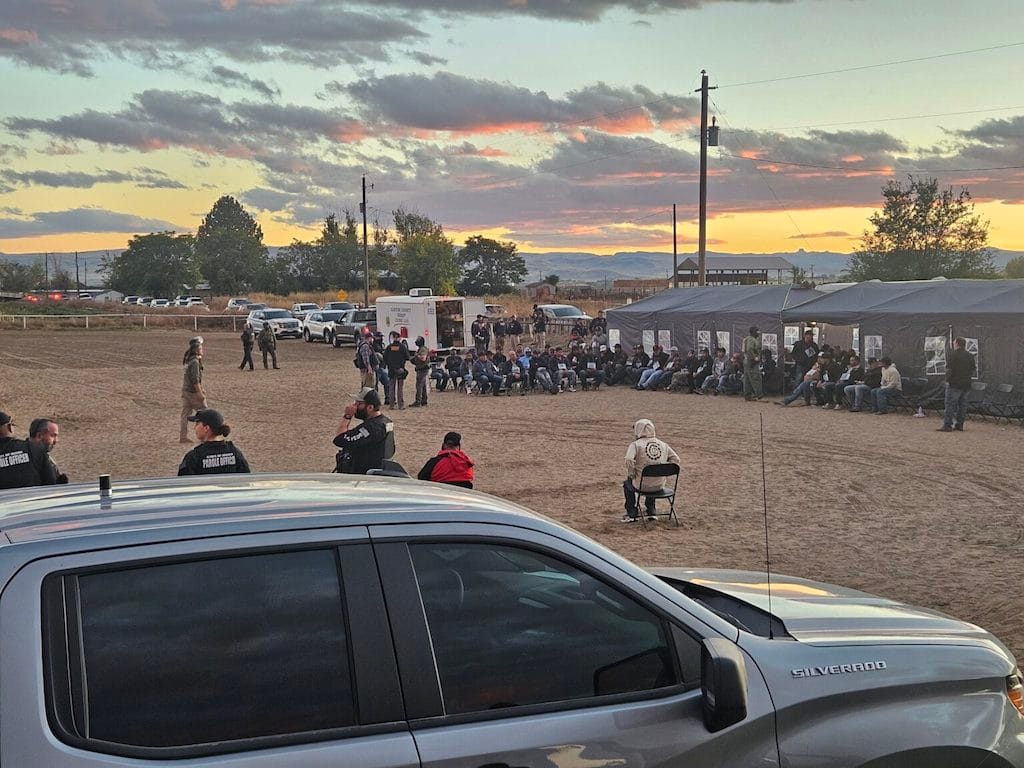
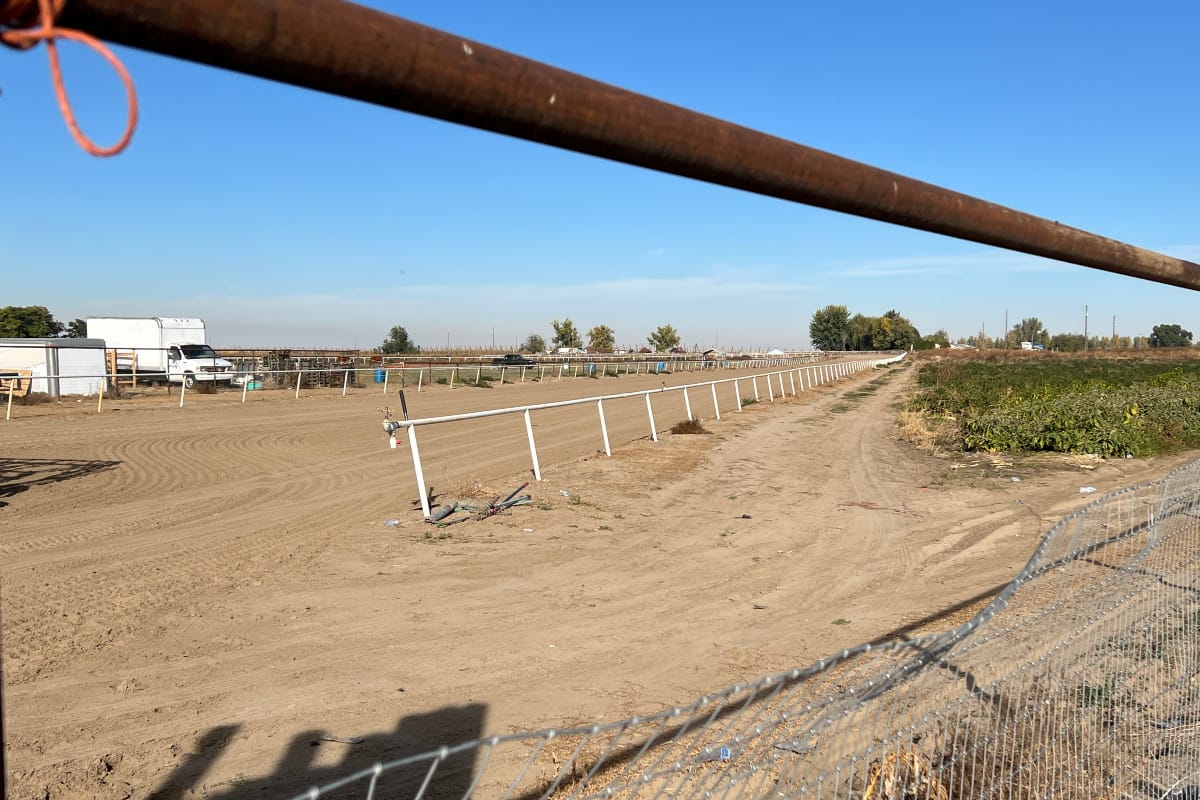
The county was also the location of a high-profile immigration raid in Wilder last October, where over 100 people were detained at a horse racetrack, a popular gathering spot for Latino families in the area. According to witnesses of the raid, local police and Canyon County sheriff’s deputies assisted ICE agents by zip-tying children and detaining people without asking about their immigration status.
People attending horse races at the La Catedral Arena in Wilder, Idaho are detained during an Oct. 19, 2025 raid that the FBI said targeted an alleged illegal gambling operation. More than 100 people were detained by immigration authorities. (ACLU of Idaho)
The raid shocked the community, leading to low attendance at the Wilder School District the day after the raid, according to reporting from the Idaho Statesman. The ACLU of Idaho also filed a lawsuit on behalf of three Latino families and their children, who are U.S. citizens and legal permanent residents, who were detained for four hours, alleging federal and local law enforcement racially profiled them during the operation.
Beyond the raid, Canyon County law enforcement has for years helped ICE by agreeing to hold people in jail for up to 48 hours past their release date. In 2019, the Idaho Press reported that Canyon County jail staff emailed ICE agents when they had booked someone into jail who they suspected was undocumented — in several cases flagging people who were U.S. citizens and holding them after they had posted bond. If inmates served jail time and posted bond, staff were instructed to contact immigration officials, the newspaper reported.
That year, Canyon County faced three lawsuits from people who alleged they were illegally held in jail, despite posting bond, because the county refused to release them due to their undocumented immigration status. The county settled with at least one man for $13,000.
In an email, Breach said the probation department does not have a written policy addressing how to interact with ICE, but instead follows a “long-standing practice” of cooperating with federal law enforcement agencies. He said the department has worked with immigration authorities since at least 2008.
ICE has relied on county and state probation departments across the country to coordinate arrests of undocumented people, according to the Immigrant Legal Resource Center. Many states have passed laws barring this type of cooperation between probation departments and ICE, including Colorado and New Mexico, after probation departments were found to be flagging ICE agents about the appointment times for undocumented people.
Idaho Gov. Brad Little encouraged state and local law enforcement to cooperate with federal immigration agents in an executive order last year. Eleven Idaho law enforcement agencies have signed up to participate in a program to help with immigration enforcement, known as the 287(g) program, with some agencies receiving tens of thousands of dollars in incentive payments for their cooperation.
In neighboring Washington and Oregon, immigration lawyers say the level of coordination happening in Canyon County would never fly, because of the states’ sanctuary laws barring local and state law enforcement from working with federal immigration agents to detain and deport people.
“In Washington, this would never be allowed because the state has protections in place to prevent this kind of information sharing,” Aaron Korthuis, an attorney with the Northwest Immigrant Rights Project, said in an email. “In Idaho, it’s permitted (and likely even encouraged). I think it is simply another tactic ICE has developed to identify easy and low-risk environments for the agency to detain people.”
Rachel Spacek is an investigative reporter covering migrant labor for InvestigateWest through Report for America. She is based in Boise and has covered Latino affairs in Idaho for the last five years.
The story you just read is only possible because readers like you support our mission to uncover truths that matter. If you value this reporting, help us continue producing high-impact investigations that drive real-world change. Your donation today ensures we can keep asking tough questions and bringing critical issues to light. Join us — because fearless, independent journalism depends on you!
Newsroom staffers tell InvestigateWest and RANGE that concerns about Curley’s leadership festered until his August suspension — weeks before the paper was set to transfer to his nonprofit
Under the banner of “Dig, Baby, Dig,” the Trump administration is supercharging an already powerful mining industry. What will happen to vulnerable plants and animals?