


Oregon prosecutors said she didn’t protect her baby. She says she was surviving abuse.
Even in states like Oregon without an explicit “failure to protect” law, abused mothers can face prison time

In September 2023, Deborah Albin found herself sitting in jail in Corvallis, Oregon, listening as a prosecutor told a judge why she should be held responsible for her 2-month-old baby’s death.
The Benton County prosecutor, Matthew Ipson, was blunt.
Opal had died with multiple rib fractures in various stages of healing and a high level of methamphetamine in her system. But no one in the courtroom was suggesting Deborah, a 27-year-old new mother with no criminal history, had beaten or drugged her baby. Instead, Ipson said, Deborah knew Opal’s father had done it — but she didn’t step in.
“She chose her significant other, Andrew Oaks, over Opal Oaks,” Ipson said.
Ipson’s brief synopsis left some details out, however. He didn’t mention that, in the weeks before Opal’s death, Deborah had accused Andrew in text messages of repeatedly choking and punching her. Or that police had been called seven times before Opal died, documenting disputes in which Andrew had reportedly threatened to kill Deborah and shattered her car window when she tried to leave.
Nearly three years later, Andrew is facing a second-degree murder charge saying he caused his daughter’s death by neglect. And even though prosecutors dropped separate charges alleging he abused Opal, they’ve continued to accuse Deborah of failing to stop it. Along the way, they’ve tried to block Deborah’s defense that she was abused by Andrew — arguing she was not a victim, but a co-conspirator.
This pivot often happens to mothers facing “failure to protect” charges: criminal prosecutions in which a parent is accused of enabling a partner or co-parent to abuse or even kill their child. Many defendants are also victims of that same partner’s abuse, as Deborah claims to be, but courts don’t always allow them to raise that as a defense or explain how it affected their parenting.
These prosecutions overwhelmingly target women, according to analyses of cases in other states that specifically criminalize a parent’s or caregiver’s failure to protect a child from abuse. And while Oregon has no specific failure to protect law, Deborah’s case, which goes to trial on May 18, shows how prosecutors can still charge abused women under a felony law known as criminal mistreatment and chip away at their defense that they, too, were victimized along with their children. Yet tracking how often women are prosecuted under these circumstances can be more difficult in states such as Oregon that charge failure to protect under a much broader law.
District attorneys say prosecuting parents is important to hold them accountable for their duties to protect children.
“Our entire system is based on the idea that adults have autonomy … to decide to live with people or not live with people, get married, get unmarried,” said Joshua Marquis, who served as Clatsop County’s district attorney for nearly 25 years and is now prosecuting homicide cases in Albany. “Children don't have that right. They’re utterly dependent.”
But critics and researchers are skeptical that these cases promote safety or accountability. The lack of uniformity in failure to protect laws makes them difficult to research, but there’s little evidence to show that they make kids safer or spur victims to file abuse reports, seek criminal charges, or separate from an abusive partner. Instead, experts say these cases often rely on unrealistic stereotypes about mothers facing domestic violence, including casting abusive relationships as predictable and easy to leave. In some cases, parents accused of failing to protect are held equally culpable as the abuser. Some even get more prison time.
“A lot of times … it ends up being women who end up criminally liable for the acts of abusive men,” said Cindene Pezzell, director of the National Defense Center for Criminalized Survivors, a consulting and training center focused on domestic violence victims accused of crimes.

Three years after Opal’s death, there remains a lot the public doesn’t know about her short life and the circumstances leading up to her death. In addition to claims that Deborah did not shield her child from Andrew’s abuse, she’s also facing another criminal mistreatment count and a manslaughter charge that both allege she withheld needed medical care. With both parents’ criminal cases still pending, the district attorney’s office blocked several public records requests InvestigateWest filed seeking access to police records, 911 call audio and child welfare records.
But prosecution tactics common in other failure to protect cases have also popped up in Deborah’s, including Ipson’s argument that Deborah’s experience of domestic violence was irrelevant. She can now only discuss allegedly abusive behavior by Andrew once she became pregnant with Opal, meaning jurors will get a limited snapshot of a more than seven-year romantic relationship.
She could face up to 30 years if convicted on all charges.
Opal’s death triggers abuse alarms
It was a Sunday afternoon in February 2023, and Deborah was worried about Opal.
The baby had a low-grade fever the night before, and today she was gassy. Andrew had left their home a couple of hours earlier, and Deborah told InvestigateWest she thought he had taken her car keys, which she said he’d done before. She searched for gripe water, an herbal supplement believed to help soothe gas and colic, calling and texting him over and over. He wasn’t responding.
“I’m worried. Please,” she texted. “Drew, we should take her in.”
As Deborah later told police, she then called Andrew’s mother, Barbara, a registered nurse, and asked her to take them to the hospital. But minutes later, the baby stopped breathing.
Barbara told Deborah to call 911.
In an ambulance with siren blaring, paramedics rushed Opal to Good Samaritan Regional Medical Center. As she and Barbara waited in the emergency room, Deborah prayed.
The medical team was able to revive the infant once — but her heart stopped beating again. Two hours after Deborah called 911, Opal was pronounced dead at 4:38 p.m. Hospital staff swaddled her in a blanket so her mother and grandmother could say their goodbyes.
“I was just so, so lost and so shocked,” Deborah said in a phone interview from the Benton County Jail. “Those are the last moments I really got to hold, to sit with her. I really wish that I was longer in the room with her.”
Deputies with the Benton County Sheriff’s Office immediately began looking into the infant’s death, prompted by concerns from the medical team about bruises on Opal’s body. That same evening, they asked to interview Deborah and look through her phone, and she agreed. She also went back with them to her three-bedroom house on the northeastern edge of town, where she showed deputies the bassinet by the bed and walked them through the nursery. Using a replica baby doll, she showed deputies how she had checked on Opal and taken her temperature in the minutes before she stopped breathing. One deputy later wrote that Deborah “responded appropriately with emotions I would expect to see from a mother who lost their child.”
Deborah had taken Opal to her pediatrician just 10 days earlier, according to a sheriff’s report. She told deputies the doctor hadn’t alerted her to anything unusual about Opal’s health besides a potential issue with how her spine and legs were growing. Law enforcement records show that when investigators followed up, the doctor confirmed she hadn’t noted any signs of injuries or abuse at the appointment.
But officials suspected that Opal had indeed been abused. In addition to the bruises, medical staff documented that several of her ribs were injured on both sides of her chest. A sheriff’s investigator who examined her body also suspected her rectum was injured, raising the possibility of sexual abuse. According to the state’s court filings, an autopsy later determined the rectum was intact.
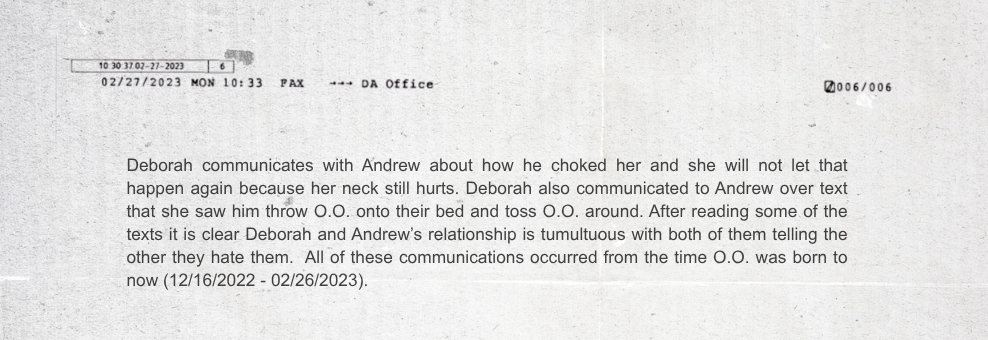
Deputies combed through texts on Deborah’s phone. In one, sent about two weeks earlier, Deborah accused Andrew of tossing Opal around “like a rag doll” and said that she wanted him “gone.” In another, she demanded that he stop using drugs, saying she had “quit because of Opal.” She said that he had recently choked her hard enough that her neck still hurt.
Andrew returned home around 8 p.m. to find officers posted outside his door. They brought him to the sheriff’s office, where Andrew told them his phone died shortly after he left the house around noon, and he didn’t have a charger. At one point during questioning, officers left him alone in the room with a camera running. According to a transcript submitted in his case, Andrew checked his phone and seemed to react to something he saw. A string of expletives followed.
“Oh, my God,” he said. “Motherf— sh-–. Oh, my God. Why? Why?”
A few minutes later, officers confirmed to him that his daughter had died.
“What are you thinking?” an officer asked.
“I don’t know,” Andrew said. “That I hate my f—- phone battery, number one. I don’t know.”
Though it still wasn’t clear what had happened to Opal, deputies arrested Andrew that night on a charge of first-degree criminal mistreatment, a broad felony charge alleging he failed to fulfill his legal duties to care for Opal. The arrest affidavit detailed Opal’s injuries, the text messages and his interview with deputies as evidence of possible physical and sexual abuse.
But the criminal case against Andrew was short-lived. Prosecutors dropped the charge two months after Opal’s death, citing an incomplete investigation. The autopsy report wasn’t finished. Law enforcement couldn’t get Andrew’s and Deborah’s family members to speak with them, and even a public callout for information from anyone who saw Opal with her parents or Andrew’s mother wasn’t enough.
The investigation stretched through the summer with neither parent charged. In July, Opal’s full autopsy report revealed chronic injuries: Eighteen ribs on both sides of her body had been broken at different times. On her right side, the fractures had caused an infection that reached her lungs and spread throughout her body. Dr. Nicole Stanley, the medical examiner, determined her death was a homicide, caused by complications from multiple rib fractures as a result of blunt force trauma. She listed acute methamphetamine toxicity as another significant condition contributing to the death.
It’s not clear what other information prosecutors may have gathered. But on Sept. 27, 2023, a grand jury indicted Deborah on two felony counts of criminal mistreatment and manslaughter.
The picture Ipson painted of Deborah at her arraignment had changed from months earlier, when he had asked a judge to prohibit contact between the parents. Back in March, Ipson had pointed out signs that Deborah had been abused. He cited the texts about Andrew choking her and one where she said he abused her when she disagreed with him. He cast it as “very concerning.”
Now, Ipson characterized Deborah as a negligent mother who knowingly chose to withhold lifesaving care from her infant daughter. Deborah had been complicit in Opal’s death, he said, because she cared more about protecting Andrew than her baby.
She needed to be held accountable, he said, for Opal’s sake.
“Opal had no voice ever in her life,” he said. “She was completely vulnerable. And Miss Albin was aware that she was being physically abused, and was further aware of drug use that was happening … and (she) chose not to protect Opal.”
In court, Andrew has since suggested Deborah was the one who exposed Opal to meth through breast milk and law enforcement should have tested a sample kept after Opal’s death before it spoiled. Prosecutors said the breast milk wasn’t tested because blood test results showing methamphetamine in Opal’s system didn’t come back for several weeks. They have not accused Deborah of using meth around the baby.
His attorney has also proposed another theory, that the baby’s ribs were broken during delivery, a rare occurrence that usually happens in conjunction with other injuries. But the autopsy showed Opal’s ribs had been broken at different points in her life.

Another grand jury later indicted Andrew on six felony charges, including second-degree murder and manslaughter charges alleging he had caused his daughter’s death by neglect or maltreatment. Additional murder and manslaughter charges alleged he did so by “engaging in a pattern and practice of assault.”
But once again, the case didn’t fully stick. In response to a judge’s order last year to specify how the alleged abuse was committed, Ipson dropped the charges alleging abuse. He did not explain further in court filings or in response to a detailed list of questions from InvestigateWest, citing ethical guidelines.
But he said the prosecution’s theory about what happened to Opal has never changed.
“The State is consistent in both cases that the evidence shows that Mr. Oaks physically abused Opal,” he said in an email.
A wave of ‘failure to protect’ laws
Around 40 years ago, children like Opal sparked a wave of new laws targeting parents who fail to stop neglect or abuse.
Starting largely in the 1960s, research began exposing the prevalence and impacts of child abuse, prompting advocates to push for new reporting laws and interventions. Across the U.S., at least 29 states explicitly name a parent’s or caregiver’s failure to protect a child from abuse as a criminal offense. Oregon isn’t one of them, but parents like Deborah can still face prosecution under the same rationale, typically under the criminal mistreatment statute, which was adopted in 1973.
Another catalyst was the high-profile case of Hedda Nussbaum, a New York woman whose 6-year-old daughter was beaten to death in 1987 by her father. Nussbaum, who stayed with the dying child for nearly 10 hours without calling 911, was also charged with murder, but prosecutors dropped the case against her after experts testified that Nussbaum, too, had experienced chronic and near-deadly abuse by the girl’s father, which had incapacitated her from intervening.
Her dropped charges “led to a very, very robust debate in the national media about what should the responsibility of a domestic violence victim be in this context,” said Merle Weiner, founder of the domestic violence clinic at the University of Oregon Law School. “You had survivors and advocates saying, ‘This person couldn’t have done anything if you understood her situation,’ and others saying, ‘No, morally she still was in a position where, even though she was so badly abused, she still had responsibility (to the child).’”
Prosecutors’ arguments in failure to protect cases echo this line of thinking today, often leaning on expectations for how parents should have responded to child abuse. A good mother would know it was happening, would seek immediate medical care and would take immediate steps to prevent their child from experiencing further abuse.
“It’s almost impossible for me to imagine a situation where the non-offending parent sees (abuse) happening and is legitimately afraid, but has absolutely no other option than to just remain in the situation,” said Marquis, the former Clatsop County district attorney. “There’s so many things they can do. They can leave. They can anonymously report it to the police or other authorities.”
Domestic violence experts push back on that, however.
“The idea that you can protect your child by simply leaving, and then everything’s fine, is a myth,” said Joan Meier, director of the National Family Violence Law Center at the George Washington University Law School. “It’s just not tied to reality.”
Financial instability, increased threats of violence toward the victim or their loved ones, custody battles, and lack of transportation or stable housing can all present enormous challenges. If a mother flees with her children, the other parent can sue for custody or press charges for parental kidnapping or custodial interference. Reports to the police don’t always trigger action that keeps victims safe. Even if the abusive partner is arrested, they can be out of jail within a day by posting bail or being released.
Prosecuting mothers for failure to protect, meanwhile, can prompt similar outcomes; their children can wind up in foster care or are sometimes relinquished to the custody of the abusive parent.
Analyses by news organizations also suggest that mothers are far more likely to be charged with failure to protect than fathers. In 2022, Mother Jones examined cases in Oklahoma since 2009 and found 2 of every 3 people charged with failure to protect in the state were women. The gender disparity increases to 9 women out of every 10 people charged who weren’t also charged with child abuse. Buzzfeed News also analyzed cases over a decade and found 28 cases across 11 states where the mother received at least a 10-year sentence, despite evidence that she had also been abused. Many women take plea deals, according to Pezzell from the National Defense Center for Criminalized Survivors, so data on abused women convicted of failure to protect are almost certainly an undercount. In those cases, the details of domestic abuse sometimes aren’t discussed at all.
InvestigateWest reviewed a case from 2018 that accused a mother living on the Oregon coast of criminal mistreatment for failing to properly care for her baby, who was abused by the father. Court records show the mother took the child to the doctor multiple times, but prosecutors said doctors repeatedly “missed” the baby’s rib fractures due to the lack of “external” signs. But the mother, who may have also been abused, pleaded guilty and spent 90 days in jail.
Oregon’s criminal mistreatment law covers a range of abuse and neglect crimes, including failures to care for dependent adults, such as elder abuse. That makes it harder to analyze trends in failure to protect prosecutions in the state; between 2014 and 2023, almost 3,500 people faced a criminal mistreatment charge, InvestigateWest found after analyzing data from the Oregon Criminal Justice Commission. The half-dozen prosecutors, criminal defense and family law attorneys InvestigateWest spoke with couldn’t say how often mothers are prosecuted for failure to protect across the state.
Experts in domestic violence and family law expressed doubt that the threat of prosecution or jail time provides motivation or meaningful opportunity for vulnerable parents dealing with threats and abuse to leave safely.
Julia Yoshimoto, director of the Women’s Justice Project at the Oregon Justice Resource Center, has worked with hundreds of women incarcerated at Coffee Creek Correctional Center, Oregon’s women’s prison, many of whom are domestic violence survivors.
“Every mother I’ve talked to, their kids are at the forefront of why they made the decisions that they made,” Yoshimoto said. “They’re calculating all the time: What is the impact of this going to be, what if I do this? What will he do if we leave now? What is the consequence going to be like? Do I even have the resources?”
Failure to protect convictions can carry harsh sentences — sometimes as severe as sentences for committing abuse. In Arkansas, being convicted of “permitting child abuse” requires registration as a sex offender. In Oklahoma, a conviction carries the possibility of a life sentence.
Some states, such as Minnesota and Iowa, have enshrined affirmative defenses in their failure to protect laws, which ensure parents have the opportunity to present evidence about domestic violence. It shifts the burden to parents to prove their victimization, but protects them from attempts by prosecutors to get that evidence thrown out, and can help parents defeat a charge before trial.
Oregon, however, has no such provision in its law.
Threats, bruises, and a broken window
Nothing physical had happened during the argument. Andrew had only broken her car window as she tried to leave their house. That’s what Deborah told the sheriff’s deputy who showed up at her father and stepmother’s house to investigate a domestic disturbance call in April 2022.
“Deborah stated she did not want to press charges for the damage to the vehicle windows, however she did want to return to the residence so that she could retrieve personal items so that she could stay elsewhere,” the deputy wrote in his report.
The window-smashing incident, which happened just a couple of weeks into Deborah’s pregnancy, was one of seven times law enforcement responded to reports of a conflict between the couple before the day Opal died. Each time Deborah spoke with police, she denied any physical violence occurred.
But concerns about abuse popped up repeatedly throughout the years that Deborah and Andrew were together.
In November 2019, a neighbor told Corvallis police she heard “a lot of screaming” while the couple was arguing, including threats from Andrew that he was going to kill himself and bury Deborah “six feet underground,” according to a police report. When an officer contacted the pair, they both denied any violence or threats occurred, and they separated for the night.
After Opal’s death, two of Deborah’s coworkers at the Toyota dealership where she worked as an internet sales manager until her arrest told detectives they had seen her with bruises on her arms, face and neck. When asked by a detective if she had concerns about domestic violence in the relationship, one colleague said “one hundred percent.”
Andrew, who has been in jail since July 2024, has denied that their conflicts were ever physical, and he has not been charged with any domestic violence crimes. He did not respond to multiple interview requests for this story, including two made through his attorney, Zachary Stern.
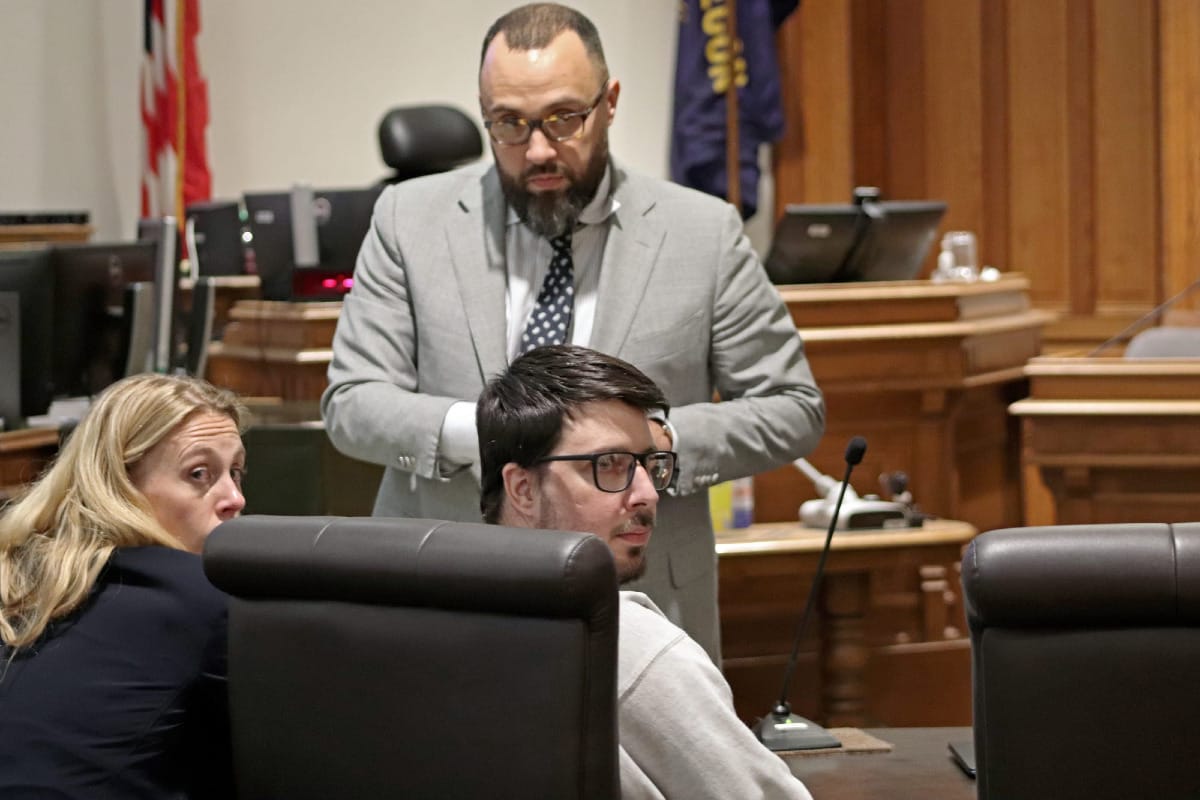
Deborah continued to deny she felt unsafe around Andrew after Opal’s death. Even after her release from jail pending trial, police found she remained in touch with Andrew in violation of a no-contact order. Her bail was revoked in July 2024 after police said she had warned Andrew he was going to be arrested. She was charged with hindering prosecution, an additional felony.
Today, after nearly two years in the Benton County Jail, Deborah said she’s had time to process her relationship with Andrew. She wouldn’t discuss her relationship or Opal’s death in detail before the trial, but said she saw her own experiences reflected in a bestselling book she read while incarcerated: “Why Does He Do That? Inside the Minds of Controlling and Angry Men” by Lundy Bancroft.
“I’m not a person who likes to say I’m a victim,” she said. Reading the book and speaking with her attorney “really made me kind of come to terms with what truly was happening to me.”
Many people who experience domestic violence don’t acknowledge it for different reasons. Some people don’t feel safe enough to confront the abuse until long after they leave. Telling people about the abuse or filing an official report can be risky, and can prompt retaliation from an abuser if they find out. Research shows that separating from an abuser is no guarantee that abuse will stop. In some cases, it can even escalate the danger, as in the case of Shari Knutzen, an Alabama woman killed by her husband in May 2025 just hours after filing for divorce.
In court, however, a prosecutor could argue that a survivor’s previous denials of abuse are a sign of dishonesty.
Yoshimoto, who’s worked with domestic violence survivors at Oregon’s women’s prison, said the challenge for defendants like Deborah is to find an expert who can educate jurors about what domestic violence looks like and the psychological effects on victims.
“And they’re going to be judging: Does this look like an abused person? Does this person seem too smart? Does this person seem too strong? Does this person not seem passive enough?” Yoshimoto said. “There’s just so many challenges with getting the domestic abuse to matter in the outcome of the case.”
Deborah, who turned 30 in March, has been diagnosed with complex post-traumatic stress disorder by a licensed psychologist, who will likely testify that the abuse impaired her judgment, according to court filings. She can also introduce evidence of any abuse that occurred after she became pregnant. But that excludes the lion’s share of her history with Andrew, which stretches back to the eighth grade when the two first met.
Meier said any history of abuse between the couple could be critical to understanding what happened during Opal’s life.
“The abuse is not incidental,” Meier said. “It’s not irrelevant. It’s part and parcel of the whole situation.”
An end to the wait
After Opal’s death, Deborah said she started rituals to keep her memory alive. For every holiday or Opal’s birthday, she would decorate her urn in tribute.
Her family has kept up those rituals while she’s been in jail.
Family members declined or did not respond to interview requests. In court, however, her grandmother described Deborah as loving and caring, “an awesome young lady who would never, ever hurt her baby, or knowingly allow anyone to hurt her baby.”
As her case goes before a jury on May 18 and despite the prospect of a long prison sentence, Deborah sees it as her opportunity to finally talk about Opal’s death.
She wants people to know more about her daughter: how Opal didn’t cry when she was born, how she had a big appetite and Deborah’s nose and “scrunchy eyebrows.” Deborah said getting pregnant wasn’t easy, and she had saved money from her job before Opal was born so she could stay home with her as much as possible.
“I have wanted to be a mother my entire life,” she said. “It’s hard to put into words. I just was so looking forward to those moments and watching her just explore and really see what life is about.”
Andrew and Deborah have not seen each other for nearly two years. Andrew, 30, faces a life sentence if convicted for second-degree murder, with the possibility of parole after 25 years. He denies having hurt his daughter.
His family also declined interview requests, but have shown him support by attending his court hearings.
“The state can’t even identify what they think my guy did,” said Stern, Andrew’s lawyer. “They see a really bad result, and they want someone to blame.”
Meanwhile, Deborah is learning to live with the reminders of Opal.
They often come out of nowhere, like when she spotted a children’s coloring book in the grocery store checkout line years ago, broke down, and left without buying anything. Her nephew, just a few months older than Opal, hits developmental milestones that Deborah knows her daughter never will. Younger family members have graduated high school.
Then there are the sirens. The jail is in downtown Corvallis, making the scream of police cars and ambulances coming and going a daily soundtrack.
Each time she hears one, she’s transported right back to the day her daughter died.

The story you just read is only possible because readers like you support our mission to uncover truths that matter. If you value this reporting, help us continue producing high-impact investigations that drive real-world change. Your donation today ensures we can keep asking tough questions and bringing critical issues to light. Join us — because fearless, independent journalism depends on you!
— Jacob H. Fries, executive director
DonateCancel anytime.
Criminal Justice

Washington has few paths to early prison release. Advocates fear Gov. Ferguson has closed off a critical one
Gov. Bob Ferguson has rejected everyone the state board recommended for commutation

She brought fentanyl to the hospital to save her son. Idaho treated him as a trafficker.
After Isaac Berger overdosed, his mother gave hospital staff the pills she found in his room. She says it became the biggest regret of her life.

A 2021 law expanded Washington’s power to decertify police officers. Records show cops still avoid consequences
An InvestigateWest review shows how Washington police agencies keep hiring cops accused of serious misconduct

Oregon woman opens up about alleged domestic violence before receiving 10-year sentence over baby's death
A judge said the alleged domestic violence Deborah Albin experienced did not meet Oregon law’s strict criteria to avoid a mandatory-minimum sentence
Latest
What happens when local news disappears? Polluters pollute more. Governments become less accountable. Entire communities are left in the dark.
Since 2009, InvestigateWest has been building something the Pacific Northwest desperately needed: a nonprofit investigative newsroom — and the civic infrastructure to spread accountability journalism across the region.
Washington has few paths to early prison release. Advocates fear Gov. Ferguson has closed off a critical one
Gov. Bob Ferguson has rejected everyone the state board recommended for commutation

Washington is fighting to limit its duty to protect vulnerable adults
At the same time, Adult Protective Services workers say they’re under growing pressure to close investigations quickly.
She brought fentanyl to the hospital to save her son. Idaho treated him as a trafficker.
After Isaac Berger overdosed, his mother gave hospital staff the pills she found in his room. She says it became the biggest regret of her life.