

Washington has few paths to early prison release. Advocates fear Gov. Ferguson has closed off a critical one
Gov. Bob Ferguson has rejected everyone the state board recommended for commutation


Gov. Bob Ferguson has rejected everyone the state board recommended for commutation

At the same time, Adult Protective Services workers say they’re under growing pressure to close investigations quickly.

After Isaac Berger overdosed, his mother gave hospital staff the pills she found in his room. She says it became the biggest regret of her life.

Gov. Bob Ferguson has rejected everyone the state board recommended for commutation

Joelene Keen was overjoyed when she checked her phone on May 11 and saw an email from her husband’s lawyer asking them to call him.
She knew her husband, Tomas Keen, wouldn’t see the message until later that night. He was incarcerated at the Airway Heights Corrections Center outside of Spokane, and, like most days, he’d left the prison to lead a wildland firefighting crew clearing trees and brush from fire-prone areas.
He and Joelene had waited nearly a year for news about his commutation petition — a relatively rare form of clemency that, if approved by the governor, would allow his early release from prison. In 2010, in the depths of drug addiction, Tomas had stolen a car and fired a stolen firearm a dozen times at a man, who was not injured. He received a 20-year sentence.
They had reason to believe it would be good news. There had been indications that Gov. Bob Ferguson might follow in the footsteps of his predecessor, Jay Inslee, who had increased the number of clemencies approved during his tenure compared with prior governors. Ferguson had signed a bill into law in 2025 to increase access to the clemency process and expand the state’s governor-appointed clemency and pardons board — the same board that unanimously voted in favor of Tomas’s clemency petition in June 2025.
Tomas, now 37, worked hard to turn his life around during his 15 years behind bars: He earned two college degrees and an advanced paralegal certificate. He completed violence prevention and substance use programs, some of which he went on to teach. He longed to reunite with his mom and sisters outside of the prison walls, and to continue building a life with Joelene and his three stepchildren, whom he’d done his best to mentor from afar.
For 11 months, Joelene had obsessively checked the state’s website, hoping to see that Tomas had received the governor’s final stamp of approval.
“I have bad news,” Jeffrey Ellis, a post-conviction attorney with the Seattle Clemency Project, told Joelene over the phone.
Gov. Ferguson had denied six people’s commutation petitions, including Tomas’s. Four had received positive recommendations from the clemency board.
The news was a blow not only to Tomas and Joelene, but to others serving life or long stints in prison, hoping for relief in a state that provides few avenues for it. While other states offer more pathways for early release, Washington abolished its parole system in 1984 for most prisoners and restricted earned “good time,” while other resentencing reforms meant to address harsh or excessive prison sentences are limited. Clemency has become a small yet critical relief valve for those behind bars — one that Ferguson has thus far shut off entirely.
Since Ferguson took office in January 2025, the five-member governor-appointed board has recommended early release for 15 of the 23 people who received commutation hearings. The governor hasn’t approved a single one.
Ferguson’s office did not respond to requests for comment.
“(Tomas) is out in the public every day. He goes into restaurants, he goes into stores, he grabs food for his crew,” Joelene said. “They fight fire all summer long, protecting the community. But he’s not safe enough to be released from prison?”
“That goes against everything that clemency is supposed to be,” she added.
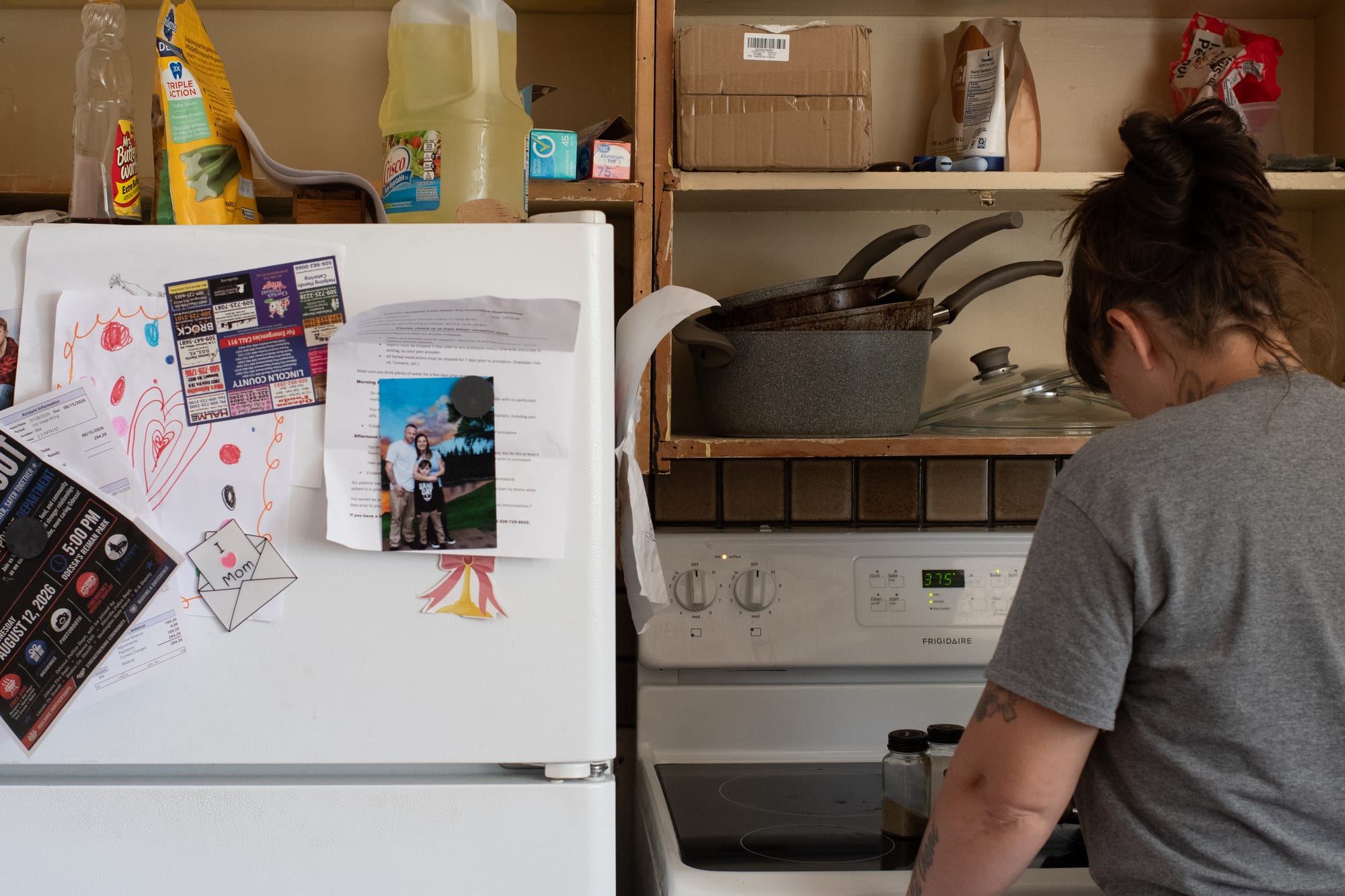
Joelene’s days revolve around Tomas’ prison schedule. She works nights as an EMT to support herself and three kids, and she moved to Washington from Montana to be closer for their weekend visits. An app on her phone alerts her when there’s a wildfire nearby, which helps her predict when she might hear from her husband or if he’ll miss their weekly video call. They get four free video calls a month, though she will pay the $5 on special occasions.
Tomas and Joelene both grew up in Kelso, a small rural city in southwest Washington that sits near the confluence of the Cowlitz and Columbia rivers. She had a crush on him in middle school. A few years later, as teenagers, they saw each other at a popular meetup spot for street racers. Tomas asked her if she wanted to go bowling. “We hit it off,” Joelene said with a smile. “We were inseparable.”
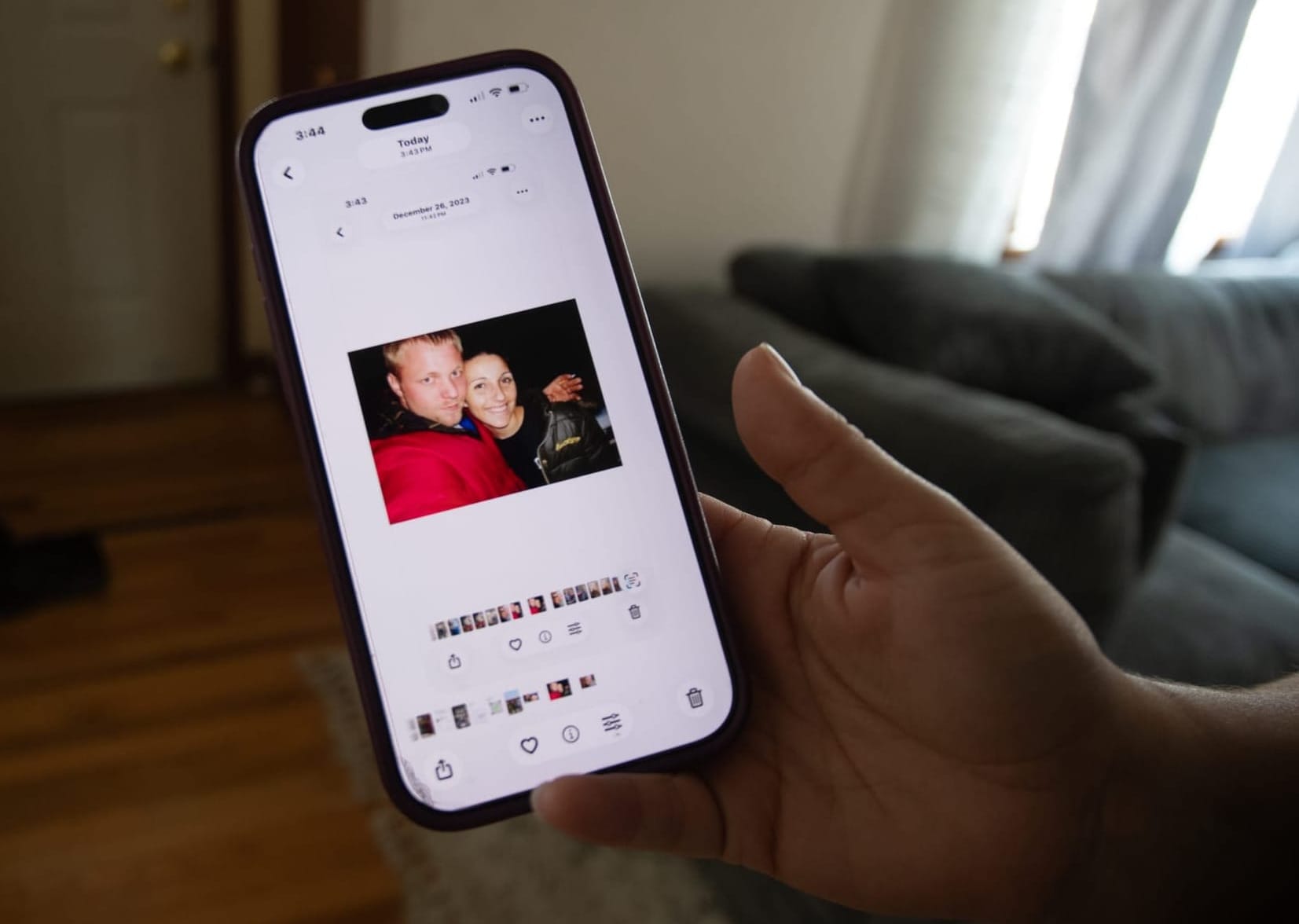
In the early years of their relationship, they both struggled with addiction and were in and out of juvenile detention and jail. They married in 2009, a year before he was incarcerated.
For many years after Tomas went to prison, he and Joelene lost contact. “There was just too much hurt,” Joelene said. Then in 2023, Joelene’s daughter emailed Tomas in prison. She was worried about her mom, who was in an abusive relationship. It led to Tomas and Joelene reconnecting. They got remarried three years ago.
Tomas first submitted a commutation petition in 2020, but his application was rejected by the board. He had to wait three years before he could apply again, then waited over a year and a half for a hearing. The board members, although appointed by the governor, are unpaid volunteers and conduct hearings four times a year.
In Washington, an incarcerated person can submit a commutation petition typically after serving 10 years of their original sentence. Under state law, it can be granted if the prison sentence no longer serves “the interest of justice.” But the law doesn’t define what that means.
Two other forms of clemency exist: a pardon, which is typically granted after a person has completed their sentence and removes any lingering legal consequences stemming from a conviction; or a reprieve, which temporarily delays a sentence, typically in death penalty cases.
The U.S. Supreme Court has referred to clemency as the “fail-safe” of the judicial system: When courts have failed to do justice, governors and presidents can step in to provide relief. But its use is relatively rare.
Meanwhile, Washington’s prison population has continued to balloon in recent decades, increasing by nearly 166% between 1984 and 2014. The state’s 1984 Sentencing Reform Act, which abolished parole and established fixed prison sentences in lieu of judges’ discretion — as well as other tough-on-crime policies such as the Three-Strikes law, mandatory minimums and sentencing enhancements — led to significantly harsher and longer sentences and fewer opportunities for early release.
Recent sentencing reforms enacted by lawmakers and courts in Washington have sought to provide more pathways out of prison. Still, those opportunities apply to a very limited number of situations and are often difficult to access. A 2024 analysis conducted by two University of Washington researchers found that only 321 people had successfully been resentenced and released following recent reforms meant to curtail life or long sentences.
Washington incarcerates about 14,000 people in state prisons, costing taxpayers approximately $1.1 billion annually, or about $81,000 per year for each person in 2025.
In the absence of comprehensive reforms, there’s been a renewed focus among researchers and advocates on clemency as a tool to help unwind mass incarceration.
“There’s no opportunity to go back in Washington state to your judge and say, ‘Hey, Judge, remember I’m the guy you sentenced 15 years ago. I’ve done really well. Will you reduce my sentence?’” said Ellis, Tomas’ lawyer who has worked on post-conviction cases for over 30 years. “Clemency is that opportunity.”
In recent years, some governors have granted more commutations as part of efforts to unravel the consequences of tough-on-crime laws that led to harsher and longer sentences.
In 2019 and 2020, Oklahoma Gov. Kevin Stitt, a Republican, approved 774 commutations following a new law that created an expedited commutation process for low-level drug and property crimes. Later, he approved 450 more in an effort to limit overcrowding in the state’s prisons during the COVID-19 pandemic.
Former Oregon Gov. Kate Brown also issued over 1,000 commutations and pardons during the same period and later granted approximately 45,000 pardons for convictions involving simple possession of marijuana. In 2020, Washington Gov. Jay Inslee issued emergency orders that allowed the early release of over 1,000 people in response to the COVID-19 pandemic, with 422 being commutations for those with nonviolent offenses.
“There was a lot of hope going on in that specific window,” Tomas recalled. “If you got a unanimous recommendation for clemency, Governor Inslee was signing off on it.”
Inslee approved significantly more commutations and pardons than his predecessors, though that wasn’t a hard feat given how infrequently the executive power has been utilized: Former Govs. Gary Locke and Christine Gregoire, both Democrats, approved 92 clemencies combined in the 16 years before Inslee took office, the vast majority being pardons.
Katherine Beckett, a professor in the Departments of Sociology and Law, Societies and Justice at the University of Washington, said that clemency is “not enough in and of itself as a release valve for cases of injustice.”
“But the fact that it exists, it’s like this glimmer of humanity in a system that otherwise feels totally oppressive and overwhelming,” said Beckett, who has been doing research and teaching about issues related to mass incarceration for nearly 30 years. “And if you take that away, the prison sentence becomes something completely different. You can’t even fantasize that there’s a way out.”
Modern governors have tended to be cautious when it comes to granting commutations to those convicted of violent offenses out of concern a person might reoffend after release.
At least one person who received clemency under Inslee was later indicted on drug charges in 2025. Another person, released on clemency in 2021 by former Oregon Gov. Kate Brown, is awaiting trial for allegedly killing multiple women. He was granted clemency in 2021 while serving a four-year sentence. Current Oregon Gov. Tina Kotek has revoked over 120 commutations granted under Brown at the request of district attorneys, though some have faced legal challenges.
In 2020, Inslee granted a commutation to Eugene Youngblood, who was convicted of murder as a juvenile and spent nearly 30 years behind bars. He received a unanimous recommendation from the clemency and pardons board.
“It was a brave thing that Inslee did, to grant someone who was convicted of homicide clemency,” said Beckett, who had brought her students to sit in on Youngblood’s clemency hearing.

The majority of the commutation cases heard under Ferguson are for people who received lengthy or life sentences for violence they committed as juveniles or young adults, many for murder, attempted murder or robbery.
Since Ferguson took office in January 2025, 80 people have appeared before the board requesting a pardon or commutation, with 52 of them receiving positive recommendations from the board. As of Sept. 14, the governor has approved 10 pardons and no commutations. Thirty-two people are still awaiting the governor’s decision. Ferguson, an attorney, previously served as Washington’s attorney general for 12 years.
The governor declined an interview request from InvestigateWest, but in an interview with KOMO News, he said his recent denials were due to a difference of opinion with the current board members.
“One of those 10 that I said no to was for an individual who murdered an individual for racial reasons, shot three times, I believe an Asian man on the bus, who I think was 72 years old, after earlier that day, shooting someone in a grocery store,” Ferguson told KOMO News. “That person has served, I think, about a third of their sentence. Do I think that person should be released now? No, I do not.”
The person he was referring to was Albert Spears, who was sentenced to a de facto life sentence in 1997 at 21 years old following a mental health crisis. Spears, now 51, received a unanimous recommendation from the board in March 2026 based on his rehabilitation behind bars.
Advocates stress that the focus shouldn’t be on the one rare case of re-offending. For many middle-aged or elderly prisoners, research shows their risk of committing violence once released is low, with crime rates being highest when people are in their late teens or early 20s.
Of the 98 people released from prison under Washington's 2014 “Miller Fix” law — which makes those sentenced as juveniles eligible for release after serving 20 years — only two people have been convicted of a new felony crime, according to a 2024 University of Washington analysis. The law was enacted after the U.S. Supreme Court ruled in Miller v. Alabama that sentencing a juvenile to life without parole violated the Eighth Amendment’s ban on cruel and unusual punishment.
“We’re talking about people who are elderly, who’ve got the best behavior in prison, and who are at the lowest risk possible,” Ellis said.
In his denial letter to Tomas, the governor wrote that while Tomas’ accomplishments behind bars were commendable, “the interests of justice do not require a commutation of the sentence.”
Ellis, who has worked on dozens of clemency cases throughout his career, said Tomas is “as rehabilitated as anyone I’ve represented.” Tomas was the first client he’s ever offered a job.
“He should have been an easy case,” he added.
Going into his remote clemency hearing on June 12, 2025, Tomas’ palms were sweaty, and there was a pit in his stomach. The stakes were high. It was his last opportunity to show the board his rehabilitation behind bars.
By the time he’d appeared before the board, they’d already reviewed his 30-page petition providing context about his original crime, programs he’d completed behind bars, and his extensive release plan. His petition also included additional statements of support from teachers, employers, friends and family members.
The hearing was an opportunity for the board to ask him questions and to hear testimony from Tomas’ loved ones, victims impacted by his crime and the prosecutor’s office that pushed for his lengthy sentence. In Tomas’ case, no victim appeared before the board, and the prosecutor from Cowlitz County was neutral on his potential release.
Tomas told the board he’d been the “captain of my own ship” and that he takes responsibility for his decisions that led to incarceration.
He explained that he endured physical and sexual abuse before the age of 10. He started smoking meth in middle school and within a few years had dropped out of school.
“I pushed everything down under the haze of drug smoke, and predictably, things slid downhill pretty quickly after that,” he said during his remote hearing.
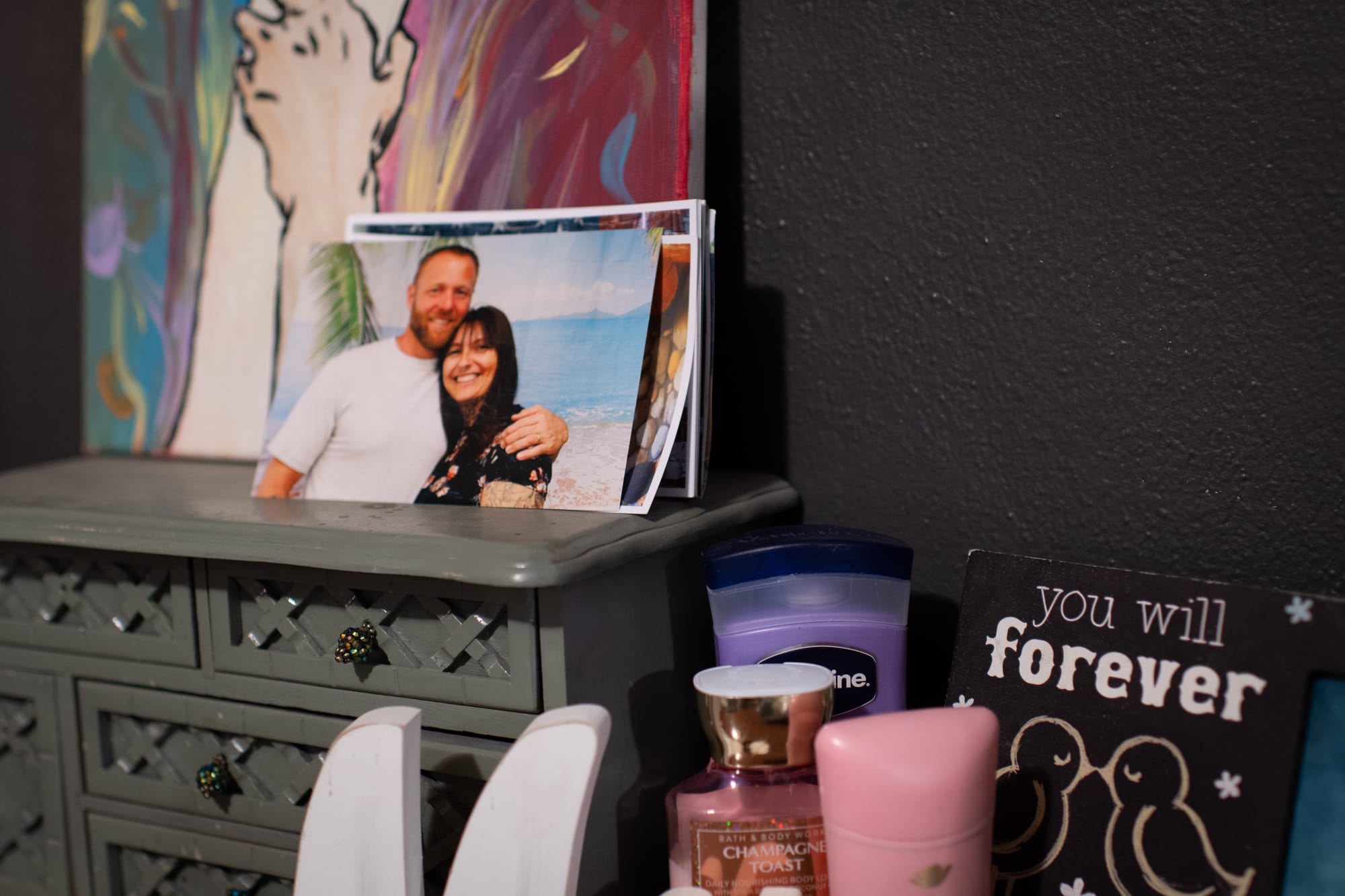
He told them that he’d been sober for 15 years, since the first day he was booked into jail.
He also told them how his first few years in prison haunt him in the same way his crime does.
“I got involved with a gang, and I started believing horrible things,” Tomas said, his cheeks becoming visibly red. “I marked my body with horrible tattoos, and I relied on violence to impress the people around me.”
Things started to change in 2015, after he was moved to the Washington State Penitentiary in Walla Walla. His sister Shana sent him books to try to deradicalize him from the white supremacist views he’d absorbed behind bars. He was later transferred to a minimum-security prison because of good behavior, and he enrolled in college.
“Everything during that period kind of stacked up to help me change,” he said.
Doug Baldwin, a philanthropist and former Seattle Seahawks wide receiver who has served on the clemency board since 2022, was skeptical of Tomas’s evolution. He asked bluntly if he’d reformed himself to better his future job prospects.
Tomas said that he didn’t learn racism and hate until he entered prison as a young adult. Being in diverse college classrooms helped him challenge his thinking, he said. “The type of community we were able to build within a prison, that showed me the fallacy of racist ideology,” he said. “You don’t get that unless all that other ideology is BS.”
His response moved Baldwin.
“You are expressing what I know to be true about life in general, especially as a Black man in this world and also as a father of three daughters of mixed race,” Baldwin responded. “Children are born into this world, and they do not know hate in that way. It’s taught, and it’s seen.”
Tomas said the exchange shifted the mood of the hearing. “Everybody kind of pivoted to ‘OK, let’s talk about what you want to do when you get out.’”
He just needed three “yes” votes to receive a positive recommendation. “I certainly never imagined a 5-0 vote,” Tomas said.
When he got back to the prison, he called Joelene. They were both crying.
Maybe he’d be home before summer ends, he remembers thinking. Definitely before both of their birthdays in November and December, he thought.
In May 2026, Ginny Parham, the executive director of the nonprofit Families Shoulder to Shoulder, sent a letter to the governor encouraging him to announce his clemency and pardon decisions, especially the ones that had received unanimous recommendations from the state’s board.
It had been nearly a year since Tomas’ hearing, and dozens of other families were also anxiously awaiting Ferguson’s decisions. Forty other organizations and groups signed onto the letter.
The letter also called on the governor to provide more transparency regarding the decision-making process and requested clearer communication with petitioners and their families.
The response from the governor’s office focused on the impact clemency can have on victims of crimes and overall public safety.
“Clemency decisions can have profound impacts, not only on individual petitioners and their families, but also on victims of crimes who may have suffered pain, fear, loss, and trauma,” the letter reads. “Though your letter does not acknowledge this full spectrum of interests, Governor Ferguson carefully weighs each of them when considering any request for clemency.”
When the denials were announced a few weeks later, Parham said she was gutted for the families that had held out hope. For many, the denial meant their loved one would likely die behind bars.
She knows the feeling. In 1997, her son was sentenced to 96 years in prison for a crime he’d committed when he was 18. He’d been one of the lucky ones, she said, being able to access resentencing relief after the Washington State Supreme Court ruled that a sentence of life without parole for 18 to 20 year olds was unconstitutional. He was released in 2020, after nearly 25 years behind bars.
She questioned the point of having a clemency and pardons board to review applications and conduct hearings if the governor isn’t going to listen to them, she said.
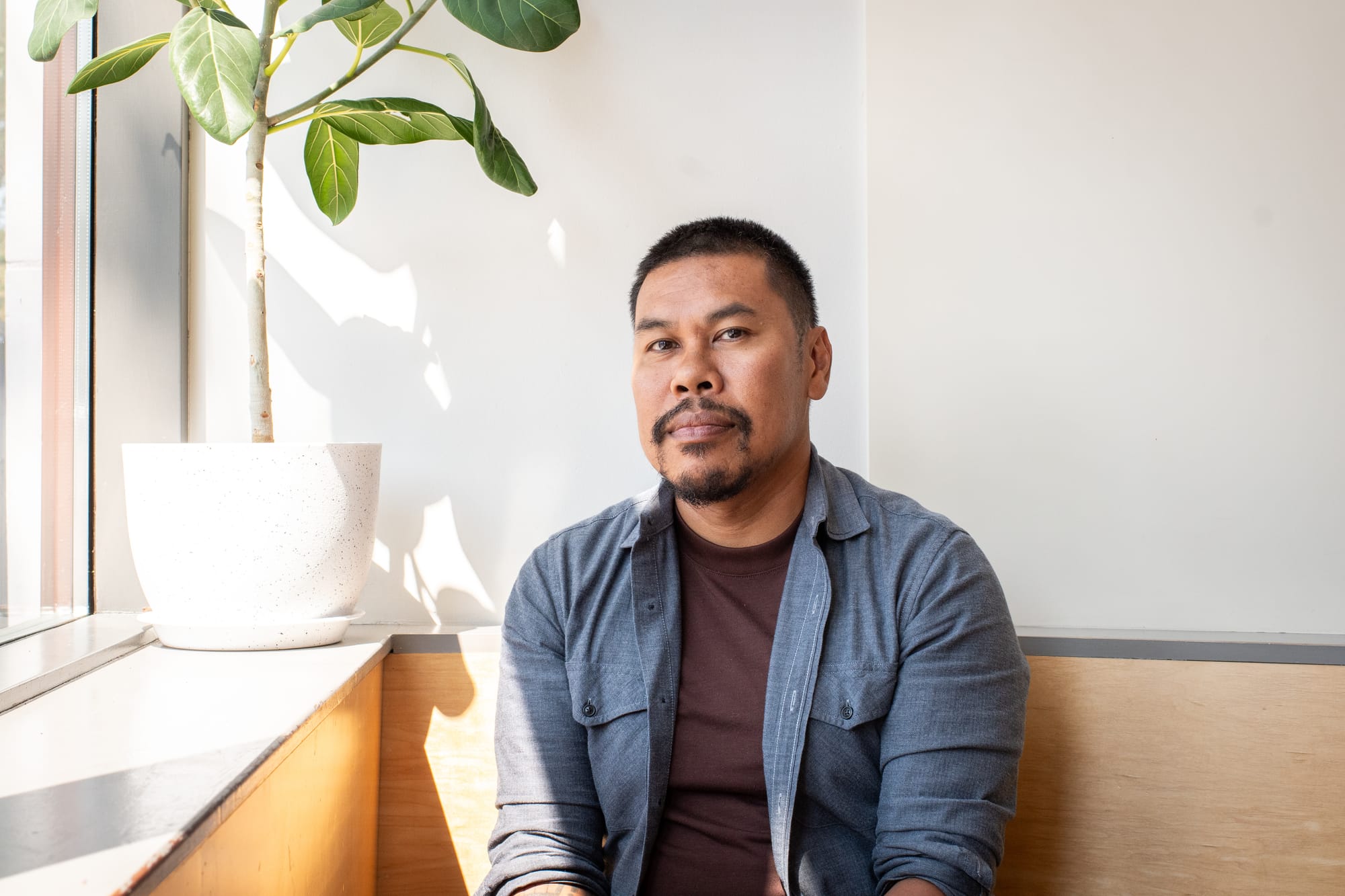
Raymond Delos Reyes, the chair of the Washington Clemency and Pardons Board, learned that Gov. Ferguson vetoed all of the board’s commutation recommendations at the same time the petitioners did.
A Seattle-based attorney, Delos Reyes had met with the governor’s office in October 2025 to try to better understand why Ferguson had been consistently disagreeing with the board’s recommendations and to see if his office wanted the board to do anything differently. The answer was no, he said.
The board members spend hundreds of hours reviewing clemency applications, preparing and conducting the hearings, and making recommendations. He said it’s been frustrating to see the governor’s office redoing their work.
He said while the current members of the clemency and pardons board strongly believe in a “redemption arc,” they aren’t “rubber stamping” applications. “Sometimes, someone’s release is not in the interest of justice,” he said.
Out of the 23 people who received commutation hearings since Ferguson took office, the board has denied seven of them, with one hearing being postponed.
Delos Reyes said some of the most meaningful hearings are the ones in which a family member of a victim comes and speaks in support of a person seeking to be released because they see the person has changed, he said. “At its core, clemency is the biggest demonstration of grace that our system can show,” he said.
He said there have been several hearings where he’s had to turn off his camera to cry.
“You can’t sit there and be stoic when you hear somebody acknowledge the trauma they put another family through and do it in a way that is just so raw and sincere,” he said. “There are things that don’t ever come out quite right on paper, but when you sit face to face, it’s a whole different beast.”
On particularly hard days, Joelene goes to her backyard and looks at two kayaks she has leaning up against a small white shed. She bought them in April 2026, shortly before the governor denied Tomas’ petition.
“I daydream all the time about going kayaking with my husband,” she said at her kitchen table in Odessa. “I’m most excited for the mundane things, just doing the normal stuff.”
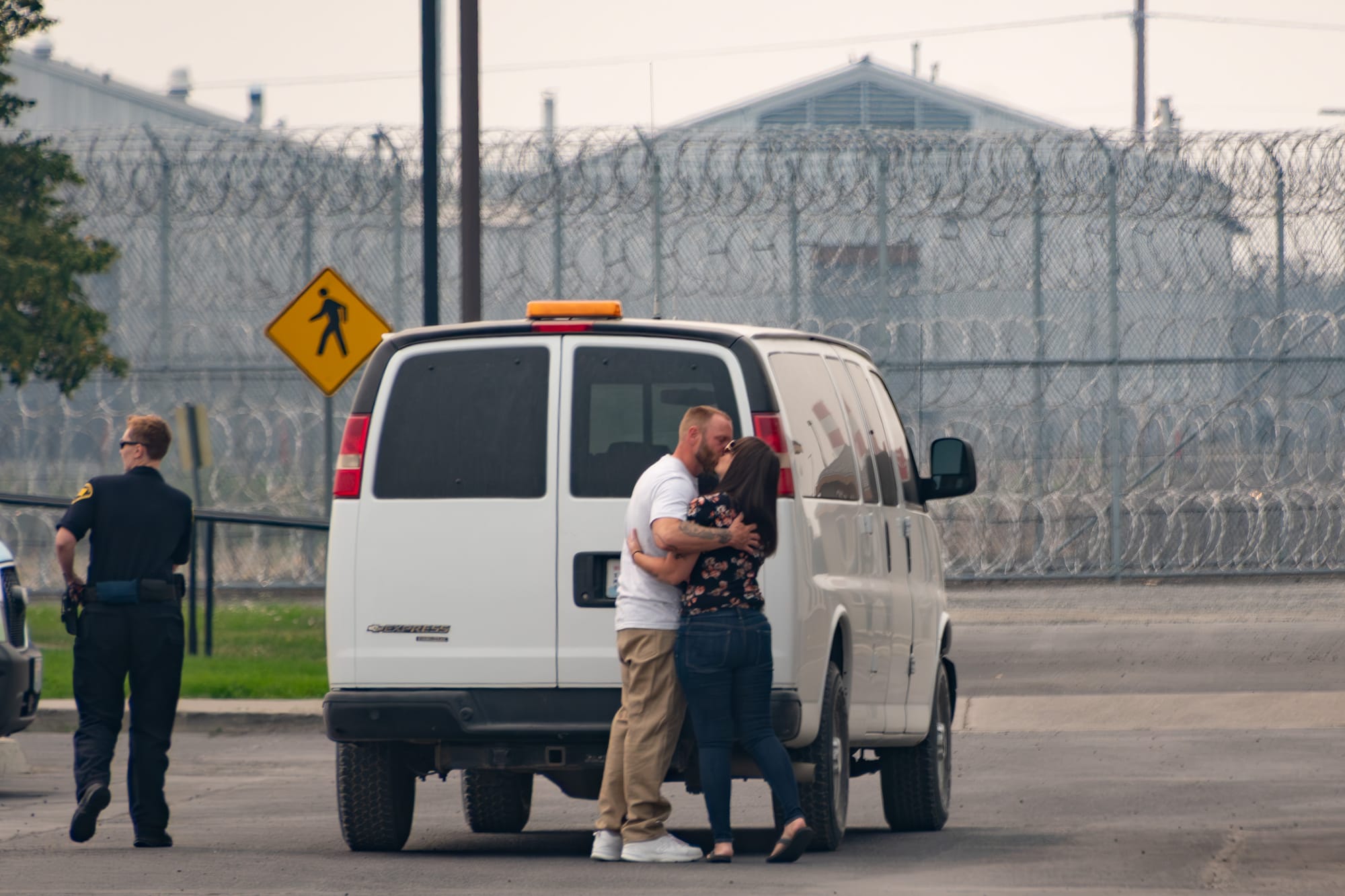
Joelene and Tomas Keen kiss outside the Airway Heights Corrections Center in Spokane, Washington, on August 8, 2026. (Moe K. Clark/InvestigateWest)
In early August 2026, Tomas and Joelene were approved to spend two days together for what’s called an extended family visit. It had been over a month since their last visit because Tomas was out fighting wildfires.
In a small duplex located on the prison grounds, they did “normal” couple things: They barbecued the New York steaks and Brussel sprouts Joelene got approved to bring in, discussed their 401(k), and watched “Avatar” on a small creaky couch.
They talked about their plans for when he got out. In August 2027, he’s set to go to a work release program, meaning he will be permitted to leave the facility during the day but required to return to sleep — not too different from his current setup as an incarcerated wildland firefighter. In 2029, if all goes well, he will complete his 20-year sentence.
When Tomas got back to the main prison on Monday morning, he could still smell his wife’s shampoo on him.
“The first day back is always a shitty day,” he said. Taking a shower feels like “washing the freedom off.”
The story you just read is only possible because readers like you support our mission to uncover truths that matter. If you value this reporting, help us continue producing high-impact investigations that drive real-world change. Your donation today ensures we can keep asking tough questions and bringing critical issues to light. Join us — because fearless, independent journalism depends on you!
— Jacob H. Fries, executive director
DonateCancel anytime.

After Isaac Berger overdosed, his mother gave hospital staff the pills she found in his room. She says it became the biggest regret of her life.

An InvestigateWest review shows how Washington police agencies keep hiring cops accused of serious misconduct

A judge said the alleged domestic violence Deborah Albin experienced did not meet Oregon law’s strict criteria to avoid a mandatory-minimum sentence

Advocates are pushing for a survivor justice law like those in other states, but a two-thirds legislative majority presents a major hurdle

At the same time, Adult Protective Services workers say they’re under growing pressure to close investigations quickly.
After Isaac Berger overdosed, his mother gave hospital staff the pills she found in his room. She says it became the biggest regret of her life.

Advocates and experts say that reflects the challenges rural families have getting health and social safety net services

The school board said state law limits the district from taking action against the former principal, despite community demands to fire him.
Subscribe to our weekly newsletters and never miss an investigation.
Our work has inspired new state laws, exposed government failures and impacted local communities in powerful ways. These stories wouldn't be told without InvestigateWest, and we couldn't do it without our generous supporters.
Cancel anytime.