

Washington has few paths to early prison release. Advocates fear Gov. Ferguson has closed off a critical one
Gov. Bob Ferguson has rejected everyone the state board recommended for commutation


Gov. Bob Ferguson has rejected everyone the state board recommended for commutation

At the same time, Adult Protective Services workers say they’re under growing pressure to close investigations quickly.

After Isaac Berger overdosed, his mother gave hospital staff the pills she found in his room. She says it became the biggest regret of her life.

An InvestigateWest review shows how Washington police agencies keep hiring cops accused of serious misconduct

In 2021, Washington lawmakers expanded the state's power to strip cops of their certification. In an effort to keep officers fired for certain types of misconduct out of law enforcement, they passed a law requiring police agencies across the state to quickly report officer separations and misconduct to the state’s Criminal Justice Training Commission and strengthened the agency’s ability to investigate and revoke certifications.
But an InvestigateWest analysis of state employment records since 2000 raises questions about the law’s potency. Even since the 2021 law, Senate Bill 5051, took effect, law enforcement agencies in Washington — blaming unclear language in the law — have kept hiring cops accused of serious misconduct, who often manage to avoid a state investigation altogether.
One officer who was repeatedly accused of misconduct still earned a promotion to police chief, where he allegedly defrauded taxpayers. Another was charged with driving under the influence and fled the scene of a car accident but was never formally investigated by the state commission. A third remained certified in Washington years after another state revoked his certification amid a felony conviction.
“I’m surprised and uncomfortable that law enforcement executives accused of misconduct are staying in place despite the protections we put in place,” said Rep. Roger Goodman, D-Kirkland, who spearheaded a 2026 law mandating elected sheriffs maintain an active certification with the state. “I’ve got to keep working on this.”
In some cases, the state commission has declined to exercise its power to conduct independent investigations. Other cases identified by InvestigateWest highlight how the law curtails the state certification agency’s enforcement abilities toward local agencies that either fail to report misconduct to the state or retain officers with troubling employment histories.
“Law enforcement agencies have the primary responsibility for ensuring they hold all ranks accountable,” said Anne Levinson, a retired Seattle judge and former auditor of the city’s police accountability system who helped to write the 2021 certification law.
The commission must revoke an officer's certification for certain types of “disqualifying misconduct”: felony convictions, some misdemeanor convictions, and certain severe and illegal instances of excessive force. For uses of excessive force, an officer must also be separated from the agency where the misconduct occurred. That gives the commission discretion in cases where officers who commit excessive force but are not fired or who maintain their positions through a settlement with the Criminal Justice Training Commission.
Even in instances where an officer is convicted of a disqualifying offense, their certification can remain active until the state commission conducts its official investigation, which sometimes happens years after a conviction due to a backlog of more than 1,500 cases.
 Melanie Henshaw
Police accountability critics also point to how the commission is interpreting certain provisions in the law for disqualifying misconduct in the statute, like how an officer can lose their certification over “unsafe use of vehicles.” But state commission records show multiple officers arrested for driving under the influence and crashing their cars have not been investigated.
Critics say that agencies that hire officers with firings in their employment history, also known as wandering officers, are exposing citizens to increased risk of officer misconduct and their jurisdictions to increased liability.
“We know that wandering officers are far more likely to be fired from their next jobs, far more likely to receive complaints for misconduct, including violent and sexual misconduct,” said Anita Yandle, a Seattle-based attorney with New York University’s Policing Project. “These are the kind of people we want to make sure aren’t in positions of power in the community.”
In March 2008, less than two years into his time as a Washington State Patrol trainee cadet, Ryan Cox was suspected of stealing $100 from a fellow cadet’s locker. Later, he was caught lying to his training officer about a separate incident and resigned to avoid termination, records show.
But it was just the beginning of Ryan Cox’s career in law enforcement in Washington. Over the next two decades, he moved from agency to agency, leaving a trail of alleged lies and misconduct before somehow landing himself a job as a police chief in Soap Lake, about two hours north of Yakima in Grant County — where he was fired again amid accusations of fraud and misuse of taxpayer dollars. His career demonstrates the risks that communities face when hiring an officer with known misconduct in his history, and how officers with disqualifying misconduct from before SB 5051 went into effect can keep their jobs, even though the law is supposed to be retroactive. (When reached for comment by phone, Cox referred questions to his lawyer, who did not respond.)
Once he left the state patrol, the Colville Tribal Police Department hired Cox in September 2008. The department requested an exemption from the Criminal Justice Training Commission to allow him to be certified as a tribal police officer, despite his failure to complete his training with the state patrol. Tribal police departments hire a disproportionate number of fired cops in Washington, InvestigateWest has found.
Cox achieved the rank of corporal at Colville before he was fired in April 2013 for using excessive force while searching a family’s home based on false evidence. A scathing report on the incident authored by then-Suquamish Police Chief Mike Lasnier said Cox “endangered the lives of the residents and his fellow officers.” Cox wanted to teach his trainee how to execute a search warrant, and for an “unknown reason,” Cox “fixated” on a particular family’s residence, falsely asserting in a warrant application to a judge that a crime suspect lived there, despite no evidence to support that, the report found. Lasnier, who wrote the report, called it “a horrific example of incompetence.”
Cox then led a team of six officers there and kicked down the door with his boot after only a few seconds of knocking, the report found. The officers swarmed the home and handcuffed two elderly people, including a woman sleeping and groggy from medication. They left a little girl in the home “frightened.”
“His actions showed contempt for the laws and rights of the community,” Lasnier wrote in the report.
“I could not in good conscience even consider demotion as a viable option; he’s far too risky of an employee for a police agency to retain,” Lasnier said.
At the time, the state commission rarely revoked a police officer’s credentials, and the Colville Tribal Police didn’t report his conduct to the state commission, according to public records. As a result, Cox went on to work at two more departments, including the Soap Lake Police Department, where he ascended the ranks and became chief in 2017 and even twice served as an interim city administrator for the small city of 1,600 people — but public records obtained by InvestigateWest show that the city was aware of his prior issues at the state patrol and Colville.
And just a few years went by before there were again accusations that Cox was abusing his position.
After receiving a hotline complaint, the state auditor’s office found that in 2020, Cox had used city resources to buy an inoperable police vehicle — a 2012 Dodge Charger sedan — for $1 from the city of Brewster, in what was supposed to be a government-to-government transaction. Using city resources, he fixed up the car and sold it to neighboring Oroville Police Department while pocketing the cash — $7,500 — for himself. The audit found Cox misused city assets for personal benefit and recommended the city recoup the costs of the $6,279 audit from Cox personally.
By the time of the audit, the 2021 police reform law had passed, resulting in a new provision allowing the Criminal Justice Training Commission to decertify officers for using their positions for financial gain through fraud or misrepresentation. But despite the audit’s conclusion that Cox had done just that, records show that in 2023, the Criminal Justice Training Commission determined the accusations against Cox didn’t merit a revocation, saying at the time that the landmark reform law lacked a provision specifically against Cox’s conduct.
Later, a separate February 2024 report by the Washington State Patrol recommended that Cox be charged with theft in the first degree, and trafficking stolen property in the first degree, a felony — a disqualifying offense for a peace officer that results in certification revocation upon conviction.
But Grant County prosecutors didn't file charges, and Cox remained employed — his certification unchallenged. When the Soap Lake Police Department finally fired him in February 2025 it wasn’t for the alleged fraud or pocketing the $7,500 — but for accepting gifts against department policy. According to state commission records, a different Soap Lake officer had let a citizen off with a warning for speeding, purportedly in exchange for packages of beef steaks as a thank you for Cox, which the Soap Lake mayor saw the citizen drop off.
Cox, whose conduct is now under investigation by the commission, has denied wrongdoing. His certification remains active.
Washington law requires hiring agencies to conduct a thorough background check on an officer candidate, but it doesn’t preclude them from hiring an officer with a history of misconduct. And sometimes background checks may not show misconduct in another state, since it can take years for an officer who commits misconduct to get decertified, like in the case of Leighton Cox, a former Washington officer who has no direct relation to Ryan Cox.
Records show how, within the span of eight years, Leighton Cox bounced between nine departments in Washington, Alaska and Hawaii. In February 2018, he was fired on the same day from two Washington police departments where he worked part time, records show. He then ended up at the Chickaloon Tribal Justice Department in Alaska, where he separated from the agency in November 2018 after stealing a department-issued shotgun.
According to the Chickaloon Tribal Justice Department’s investigation, Leighton Cox had sold the shotgun to a local pawn shop, where it was later recovered, and lied about its whereabouts. He left Alaska without paying for the weapon or disclosing its location. Cox did not respond to a request for comment.
Leighton Cox returned to Washington, where in April 2019 he found a job with the Palouse Police Department in southeastern Washington. His old boss in Alaska immediately reached out to the then-Palouse Police Chief Jerry Neumann to inform him about potential charges against the officer. Cox then flew back to Alaska where he “got the Chickaloon Tribal Council” not to press criminal charges, according to public records.
But his stint with the Palouse Police Department lasted just 10 weeks, until he was fired for using a city credit card to purchase personal groceries and pay his bills and for driving a police cruiser on his day off.
“Ten weeks of fraud and deceit,” Neumann wrote in an email to the state commission.
Only months later, in September 2019, was Leighton Cox decertified in Alaska, losing the ability to work at any law enforcement agency in that state, records show. Later, he pleaded guilty to a felony theft charge for taking the shotgun.
It took Washington even longer to decertify him. Working under a backlog of more than 1,000 cases, the state’s Criminal Justice Training Commission took more than three years to issue a final order revoking Leighton Cox’s certification over his misconduct at the Palouse Police Department.
In an effort to flag problem officers in the hiring process, the 2021 reform law requires agencies to consult the National Decertification Index, a national database that allows law enforcement agencies to search if an officer has been decertified in another state. But Leighton Cox’s case is an example of the often lengthy timelines to decertify an officer, which make the National Decertification Index insufficient — especially when law enforcement agencies choose to retain problem officers despite awareness of their history.
The Chickaloon chief’s informal warning to the Palouse Police Department about Leighton Cox was the only notification of his conduct in Alaska that the department received before the state commission’s proceedings three years later. Instead of heeding the warning, Neumann chose to retain Leighton Cox as an employee in 2019, despite it being during a probationary period when officers can be fired for a broad swath of reasons.
Not all states participate in the National Decertification Index, and the database is not available to the public. Even states that do utilize the database are not always thorough in uploading all decertifications to it, says Ben Grunwald, a professor of law at Duke University and author of prominent research on wandering police officers.
“Even if an officer does get decertified, it might not always be in the database,” Grunwald said.
Grunwald says that states like Florida go further and spend significant resources to collect data on police officer employment and separations.
“Probably the best way to make sure agencies are fully aware of officers’ complete professional history is for the state to manage and collect information on employment, including high-quality data on the cause of separation,” Grunwald said.
But Washington has limited employment data from before the early 2000s, due to issues with document retention and staff turnover, the state commission told InvestigateWest.
SB 5051 contains few mechanisms to penalize agencies that don’t report officer misconduct. The state commission can impose a discretionary fine of up to $10,000, but there are no mandatory fines, and no escalating enforcement mechanism for repeat violations.
Recent audits have shown that law enforcement agencies aren’t in full compliance with state law that requires them to report misconduct to the state commission. A 2025 audit by the state found the Des Moines Police Department, located just outside Seattle, failed to report three misconduct allegations to the state, while a fourth incident wasn’t reported within the timeframe required by law. But the commission has so far declined to impose fines on noncompliant agencies, saying it is focused on educating agencies about the law’s requirements. The Des Moines Police Department criticized the agency for unclear language on their responsibilities.
Further, InvestigateWest’s employment record review shows police agencies are not always using the Criminal Justice Training Commission’s official notice of separation form, which contains a section to indicate whether a resignation was voluntary or occurred while an officer was under investigation for misconduct. When agencies don’t report separations or misconduct, the state commission won’t know what happened in each case.
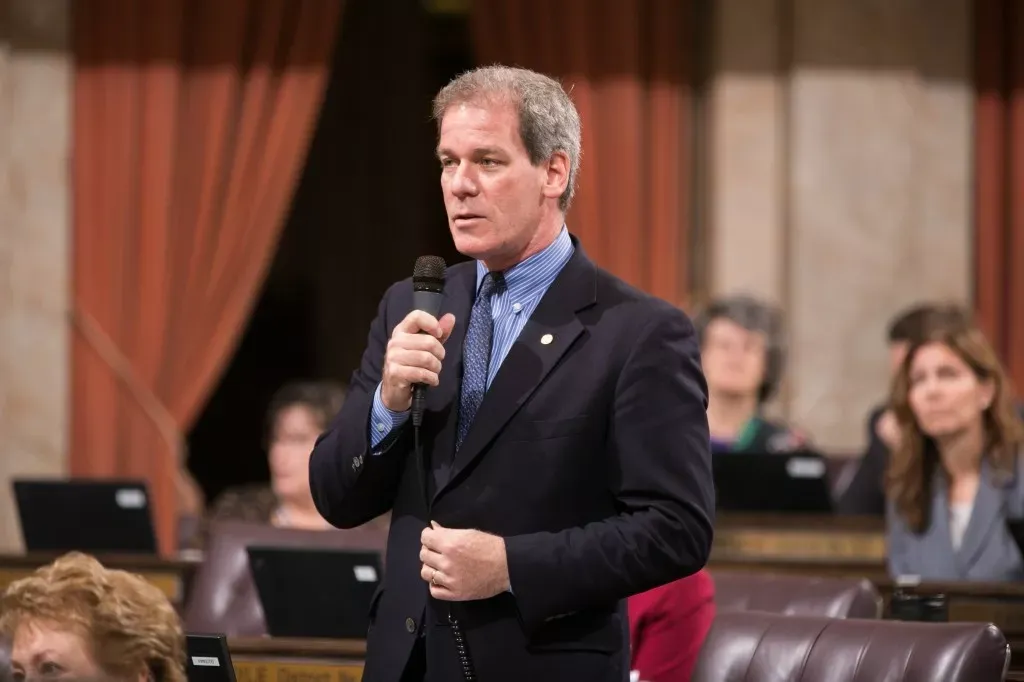
Rep. Roger Goodman, the Kirkland Democrat, says that law enforcement agencies have in the past evaded scrutiny during their officer separations by failing to report the full circumstances of an officer’s separation from a department, allowing the officer to quietly resign in lieu of triggering an investigation, which provisions in SB 5051 prohibit.
“I don’t know if the process we put in place to prevent that has stopped that, or whether that continues as well,” Goodman said.
While some cases of misconduct should trigger an automatic disqualification of an officer’s certificate, the state has even more discretion in other cases.
When the Seattle Police Department fired officer Duane Goodman in November 2019, it was because he used “threatening and malicious language” on his Instagram toward former President Barack Obama and former Secretary of State Hillary Clinton — insinuating they should be blown up by a package bomb — and he derided “illegal immigrants.” He was not fired by the department when he’d been arrested for drunken driving 15 months earlier, or for a previous suspension after he had “used threatening and malicious language” and made another officer “feel unsafe.”
In March 2021, he pleaded guilty to reckless driving for the drunken driving arrest. But he was able to find another job as a cop, and less than a year later, Goodman — then working at the Long Beach Police Department in southwest Washington — totaled his truck in the middle of the night along a rural Oregon highway, injuring himself. But Goodman didn’t call 911. Instead, he called a friend to come pick him up, and left the scene of the accident. Six hours later, Goodman returned to the scene and called 911.
The Long Beach Police Department, which had publicly defended its decision to hire Goodman prior to the wreck, then fired him. He was not criminally charged in the Oregon wreck, and records show Goodman asked the commission to drop its initial inquiry into his conduct.
Ultimately the Criminal Justice Training Commission declined to take any action in Goodman’s case, despite provisions in SB 5051 that allow for decertification if an officer “engaged in unsafe practices involving firearms, weapons, or vehicles which indicate either a willful or wanton disregard for the safety of persons or property.”
The statute also allows for the state commission to consider decertification for conduct that “fails to meet the ethical and professional standards required of a peace officer” or “disrupts, diminishes, or otherwise jeopardizes public trust or confidence in the law enforcement profession” — standards which SB 5051 does not clearly define and which the commission has not fulfilled a commitment to more clearly define after law enforcement agencies complained.
Goodman does not appear on the state’s public-facing database that the law requires catalog information “describing the names of officers and employing agencies [and] all conduct investigated.”
Though he is currently employed at a private security firm, Goodman retains the ability to serve as a police officer in Washington.
A 2026 law strengthened the rules surrounding certification for sheriffs and police chiefs — but lawsuits have halted major provisions of the law. Levinson, the former judge who helped write the 2021 and 2026 policing laws, says when misconduct occurs at the leadership level — given the power, authority and access to information they have — the harm to their victims and to the larger community can be significant.
“It is particularly troubling when the individual who has committed the misconduct is the person who leads the law enforcement agency," said Levinson. “If they are able to avoid accountability … they will feel protected and free to continue to engage in additional misconduct or unethical behavior without fear of being held responsible.”
Ryan Cox served as chief of Soap Lake for eight years. During that time, he spoke with the media about his experience with wandering cops — not as one, but from hiring them. Records show the Soap Lake Police Department has hired seven previously fired officers, including multiple during Cox’s time as chief.
That included Shane Jones, who Cox hired in 2020. Jones went on to crash a police vehicle into a civilian and flee the scene of the accident before driving the vehicle off the road and getting into “an altercation” with Franklin County sheriff’s deputies who responded to the crash. He was arrested.
Ryan Cox said the documents he received on Jones during the hiring process were incomplete, and didn’t include the circumstances of Jones’ termination from the Okanogan County Sheriff’s Office 14 years earlier, where Jones was reinstated through an arbitration process.
“Nobody gave me bad reports,” Ryan Cox told Cascade PBS in 2021. “Especially as a small department, we have to go by what we’re told. So what do you do?”

The story you just read is only possible because readers like you support our mission to uncover truths that matter. If you value this reporting, help us continue producing high-impact investigations that drive real-world change. Your donation today ensures we can keep asking tough questions and bringing critical issues to light. Join us — because fearless, independent journalism depends on you!
— Jacob H. Fries, executive director
DonateCancel anytime.

Gov. Bob Ferguson has rejected everyone the state board recommended for commutation

After Isaac Berger overdosed, his mother gave hospital staff the pills she found in his room. She says it became the biggest regret of her life.

A judge said the alleged domestic violence Deborah Albin experienced did not meet Oregon law’s strict criteria to avoid a mandatory-minimum sentence

Advocates are pushing for a survivor justice law like those in other states, but a two-thirds legislative majority presents a major hurdle
Gov. Bob Ferguson has rejected everyone the state board recommended for commutation

At the same time, Adult Protective Services workers say they’re under growing pressure to close investigations quickly.
After Isaac Berger overdosed, his mother gave hospital staff the pills she found in his room. She says it became the biggest regret of her life.

Advocates and experts say that reflects the challenges rural families have getting health and social safety net services
Subscribe to our weekly newsletters and never miss an investigation.
Our work has inspired new state laws, exposed government failures and impacted local communities in powerful ways. These stories wouldn't be told without InvestigateWest, and we couldn't do it without our generous supporters.
Cancel anytime.