

Washington has few paths to early prison release. Advocates fear Gov. Ferguson has closed off a critical one
Gov. Bob Ferguson has rejected everyone the state board recommended for commutation


Gov. Bob Ferguson has rejected everyone the state board recommended for commutation

At the same time, Adult Protective Services workers say they’re under growing pressure to close investigations quickly.

After Isaac Berger overdosed, his mother gave hospital staff the pills she found in his room. She says it became the biggest regret of her life.

State lawmakers wary of government spending have turned down bills to fund emergency medical services

On a recent Saturday afternoon in May, a head-on collision on a main highway in southwest Idaho required two ambulances and all of the staff that Payette County Paramedics had available.
Then another call came in. A woman in another part of the county was having a seizure.
Seizures can be stopped with medications, and intervening quickly can prevent life-threatening conditions or death. But David Morris, an emergency medical technician who responded to the three-car crash, said they were busy tending to four patients, so they called in an outside EMS service for help.
That day was busy, but not uncommon for Payette County Paramedics, a small ambulance district that serves a county of nearly 26,000 people. Its chief, Rick Funk, said his agency is struggling to afford enough staff and increasingly calling for help with emergencies. Sometimes that means paramedics can’t make it to people in crisis for half an hour or longer.
The agency and other ambulance services had asked Idaho lawmakers to help two years earlier, by passing a bill to fund emergency medical services. Funk testified that without state funding, soon people would be calling 911 and no paramedics would be able to respond.
But lawmakers didn’t pass the bill — and now Funk has had to cut an ambulance from his fleet, leaving Payette County with just one staffed vehicle.
“We've always just kind of made do and figured out ways to keep ambulances up and keep staffing up and going, and unfortunately, we're at a point right now where everything is increasing and the revenue is not keeping up,” said Funk, who took over as chief in Payette County in 2020.
For decades, emergency services agencies in Idaho have relied on a patchwork of resources, including volunteer EMS workers, local property taxes and reimbursement rates from insurance companies. As Idaho’s population has grown — it has ranked among the fastest-growing states in the country for the past five years — EMS providers across the state say they’re seeing a culmination of long-running problems: the number of people who want to volunteer for rural EMS agencies has declined, the cost of equipment and wages for staff is increasing, and agencies have little consistent funding to meet the rising needs. As of October 2025, just 28% of Idaho’s 44 counties had a full-time EMS position.
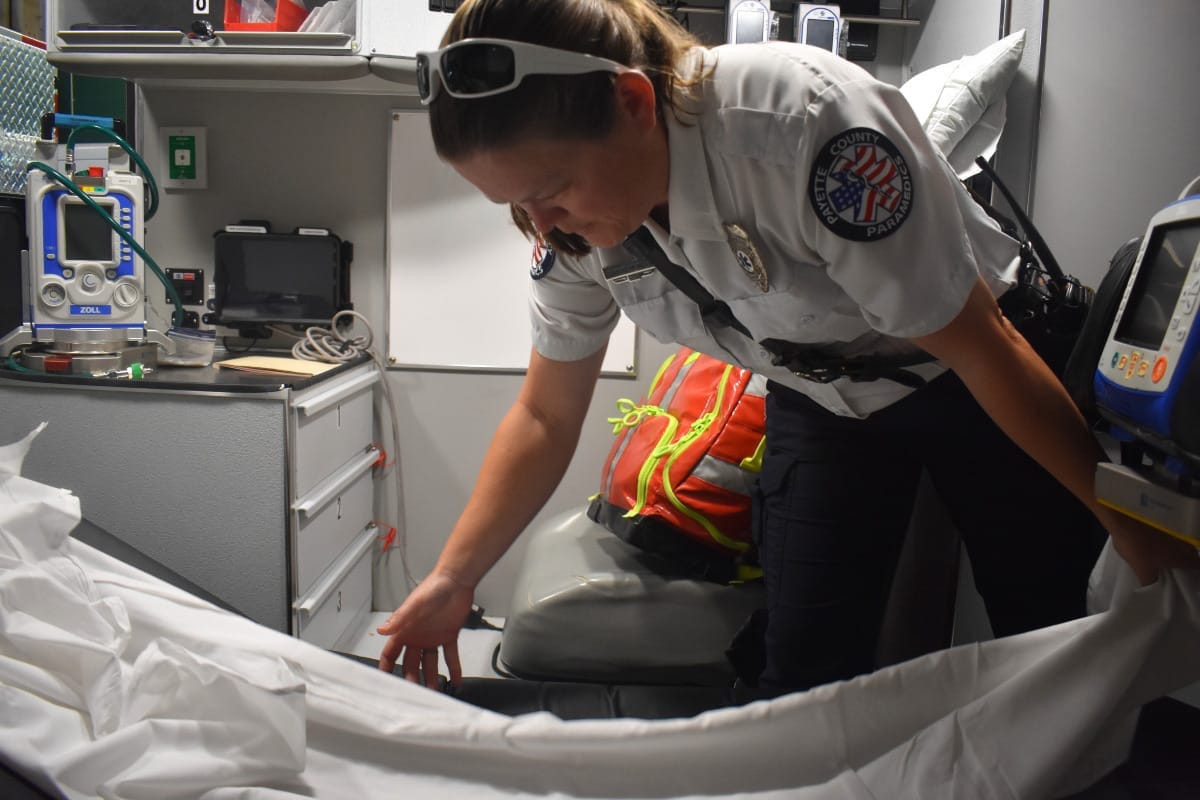
Payette County Paramedics, along with at least two other ambulance districts in Idaho, asked voters in May to approve property tax increases, known as levy overrides, in order to help with budget constraints. Only one of them passed, while the ballot measure in Payette County failed.
Funk and other providers have pushed Idaho lawmakers for years to make emergency medical services an essential service alongside police and fire departments, which would also require the state to fund it. An independent state auditor also recommended the same in its 2010 report, which found most counties did not have the funding to maintain adequate response times. Then in 2021, the auditor surveyed EMS providers and found the same result, that the service was underfunded and at risk of longer response times if the state didn’t provide funding. But their requests have failed to garner support from a majority of lawmakers.
Now some state officials hope the federal government can fill in the gap, but EMS agency chiefs say federal grants aren’t a long-term solution.
President Donald Trump’s One Big Beautiful Bill Act promises to pour $500 million in federal funding into rural healthcare in Idaho over five years. Idaho Bureau of Emergency Services Bureau Chief Wayne Denny said there is “unease” in the Legislature about how much it would cost the state to designate EMS an essential service, but believes the millions of dollars the state will receive from the bill is part of the solution.
“I have really turned our focus to the Rural Healthcare Transformation Grant,” said Denny, referring to the federal grant.
Funk said Payette County Paramedics already has the equipment, like ambulances, that grants typically pay for. What the agency really needs is long-term funding to pay its workers.
“The grant does look like it would help to get funding for ambulances and maybe some workforce development, but what we really need is help with operations,” Funk said. “If we don’t get something to maintain staffing levels, the system is going to fail. We are already seeing that.”
On a recent Tuesday morning, after checking the supplies in the ambulance, Morris asked his partner, paramedic Christy McMillan, what she wanted for breakfast.
“Biscuits and gravy?” she asked. He got started on breakfast in the team’s modest kitchen, inside a portable trailer that’s equipped with two bedrooms. But then a call came across the radio. He stopped, turned off all the burners and rushed to the ambulance with McMillan to drive to a nearby assisted care facility. There, they found an elderly man with lower back pain who needed to be taken to the hospital.
It’s one of the more common types of calls the EMS agency receives: transporting someone from an assisted care facility to the hospital.
“We're like a spare tire,” Morris said. “You don't think about us until you absolutely need us.”


On the left, an exterior view of the city hall in Fruitland, Idaho. On the right, Owyhee Produce, a wholesale produce company, advertises fresh asparagus off U.S. 95 in Fruitland. (Rachel Spacek/InvestigateWest)
Nationwide, state funding for EMS varies widely. According to a 2024 study from the Centers for Disease Control and Prevention, just three states spend more than $10 per person on funding for statewide EMS offices. The study found that funding problems hit rural EMS agencies harder than their urban counterparts: Rural agencies relied more on volunteers and part-time staff, their response times were longer and their paramedics were certified to provide lower levels of care.
At least 21 states and Washington, D.C., have passed laws deeming emergency medical services an essential service. Those laws establish requirements for data reporting and response times, while some also provide funding, according to the National Conference of State Legislatures.
In Idaho, EMS agencies rely on billing insurance companies or Medicaid and property taxes for funding. But that’s not enough: Reimbursement rates are much lower than the cost of services, and the property tax revenue they can get is capped by local laws to limit tax increases, making it an unreliable solution.
Rural areas also have smaller tax bases, forcing many of those providers to still rely on volunteers. In the 2021 study, the Idaho Office of Performance Evaluations found that four out of 10 EMS workers in the state were volunteers, and in rural areas that jumps to seven in 10.
While relying on volunteers may have worked in the 1960s when many EMS agencies first popped up in Idaho, today fewer people are willing to volunteer. EMS personnel are now required to perform intensive medical procedures instead of simply transporting people to the hospital, which requires medical certifications that many volunteers don’t have. Volunteers can often provide only immediate care on scene to stabilize patients, like CPR. But intermediate and advanced life support — like administering IVs, medication, chest compressions and airway management to help someone experiencing cardiac arrest or respiratory failure — require a higher level of training and care.
More than 30 years ago, when Michael Stowell, chief of the Canyon County Paramedics, started his career as a volunteer EMT, he spent up to three hours each day transporting patients. But that is nothing compared to the volume of calls that EMS agencies, even rural ones, get today.
In Canyon County, he said call volume has gone “through the roof,” increasing by nearly a fifth since 2020. The populations of Ada and Canyon counties, Idaho’s most populous, have grown by 150,000 people since then “but our funding didn’t,” said Stowell. According to the agency’s website, about 30 percent of its budget comes from property taxes, while the remainder of its budget is funded by fees and reimbursements.
The Office of Performance Evaluations surveyed EMS officials in 2021, and heard back from about half of Idaho’s agencies. Nearly two-thirds of the agency directors reported that a lack of staff delayed responses to calls by more than 15 minutes or kept them from responding entirely. More recent data provided by the Idaho EMS Bureau to InvestigateWest, based on numbers self-reported by local agencies, also shows a number of Idaho counties still lag in their average response times.
National standards suggest that, in most instances, an ambulance should be on scene within eight minutes, but 61% of Idaho counties had average response times longer than that in 2025. The national average for response times in rural areas nearly doubles to 14 minutes, according to a 2017 study by researchers and the U.S Department of Health and Human Services. Camas, Custer and Benewah counties had the longest average response times in 2025, with Camas taking 21 minutes to respond and Custer and Benewah an average of 17 minutes. All three are some of Idaho’s lowest populated counties.
Even counties that, on average, met those national benchmarks reported instances in which their response was delayed by as long as four hours.
Some of Idaho’s fastest growing counties, like Ada, Canyon and Kootenai, saw a surge in their longest reported response times between 2023 and 2025, according to the EMS Bureau data. Canyon County's longest response time in 2023 was 55 minutes. Both of the following two years included calls that the county reported had response times stretching longer than four hours.
Funk, in Payette, cautioned that the reports offer a limited snapshot of an agency’s performance and don’t take into account when EMS agencies have to call in support from outside agencies, which he said happens every shift. In the 2024-2025 fiscal year, other agencies took nearly 11 percent of total calls, according to Payette County Paramedics’ website.
Responding to what officials deem “time sensitive emergencies,” which include heart attacks, strokes and seizures, in under an hour are crucial. For patients who suffer heart attacks, paramedics have to get them to the hospital for care within an hour to save their lives, Funk said. And Stowell added that even if a person's life isn’t at risk, getting them to the hospital quickly can improve their health outcomes.
Since 2020, Stowell said Canyon County has shut down ambulances every day because they didn’t have enough people to staff them — each ambulance has to have at least two people on board. The station had nine ambulances, but they could regularly staff just six.
Stowell said his agency is consistently losing staff to fire departments, which are able to pay more and offer better benefits because of state funding that EMS does not receive. Nationwide, the average salary for an EMS employee was $34,300 in 2024, according to the CDC.
Payette County pays its EMTs, who can provide basic levels of care, $14 an hour, while paramedics start at $20. That’s at least $5 to $6 per hour behind most other EMS agencies in the state, Funk said.
Katlyn Wake, who has worked as an EMS worker in Idaho for the past eight years, has seen staffing shortages get worse. She works part-time for agencies in Elmore and Payette counties, which have struggled to fill open roles.
“Eight years ago we were getting paid the exact same that we are now,” Wake said. “But the cost of everything has gone up, so we frequently lose people to better jobs, different careers and different counties who can pay more.”
Idaho lawmakers, wary of spending any more money on government services, have thus far resisted measures to increase funding for EMS.
In 2024, the last time the Idaho Legislature heard a proposal to do so, a swath of Republicans pushed back on the added costs to the state — $2.2 million for EMS agencies for the first year of funding — and argued it would result in a loss of local control over emergency medical services. While the bill passed the Senate, it never got a hearing in the House.
Former Sen. Chris Trakel, R-Caldwell, said during the Senate debate that he had “a hard time increasing the size of government” if taxpayers are still paying out of their own pockets for ambulance services.
“If I still utilize an ambulance, this can still cost me anywhere from $500 depending on the ambulance ride,” Trakel said.

Instead, the following year lawmakers passed a measure to move the Idaho EMS Bureau from the Department of Health and Welfare to the Idaho Military Division, which they said would help to better coordinate the state’s emergency management system.
In an emailed statement to InvestigateWest, Idaho Gov. Brad Little said he supported the transfer and said it marked “the first step in a multi-year process to enhance Idaho’s emergency response.” The Governor’s Office did not answer questions about what that response would look like and what funding mechanisms he would support.
Denny, the state EMS bureau chief, hopes the federal Rural Health Transformation Grant will help EMS agencies hire more staff, “at least for the short term.”
According to budget estimates, the state plans to spend around $60 million of the grant on emergency medical services. The state’s grant application said it aims to have one full-time EMS position in every Idaho county by 2030.
The Department of Health and Welfare said it will prioritize rural agencies with volunteer-only and part-time staff for funding. Then, “possibly if there is funding still available,” the state will consider helping agencies with full-time staff add community health workers who help patients make follow-up appointments after their emergency to try to reduce repeat 911 calls, according to AJ McWhorter, a spokesperson for the department.
The state plans to open applications for funding within the next two months, McWhorter said.
The Idaho Legislature would need to change state law in order to fund emergency medical services. But with state lawmakers unlikely to do that soon, county EMS agencies are relying on their one option to increase funding: property taxes.
Canyon County Paramedics was able to bump up salaries over the past year thanks to a voter-approved levy override — a temporary property tax increase — that passed in 2025.
Although the measure is just a two-year funding source, Stowell said it was life-changing for Canyon County Paramedics. It allowed the agency to increase staff pay and build their first new station in 23 years.
“That was a turning point, literally, for us in the history of the ambulance district,” he said.
But support for a tax increase is difficult to get in Idaho.
It was the agency’s third attempt to get a levy passed. Canyon County tried twice to get a permanent levy override, which requires a two-thirds majority to pass, but failed to get enough support.
In May, Blaine County managed to get a majority of votes for a temporary two-year property tax increase. But ambulance districts in Washington and Payette Counties didn’t get the two-thirds support needed for a permanent levy override. The ballot measure in Payette did not even receive a majority of support, with just 42% of voters supporting it.
The levy override would have been a lifeline for Payette County Paramedics, but Funk said he knew it would be a big ask for taxpayers in the rural county.
“Unfortunately, right now, which I think is incredibly unfair, this is all put back on the taxpayers of Payette County,” he said. “The problem with that is I have Interstate 84 out here, and we see a lot of crashes of residents in other counties and even other states. It isn’t right that we have to put this back on the county residents.”
That is why he thinks state legislators should help foot the bill.
“I think we could come up with something,” he said, “if we had some legislators that were willing to work with us.”

The story you just read is only possible because readers like you support our mission to uncover truths that matter. If you value this reporting, help us continue producing high-impact investigations that drive real-world change. Your donation today ensures we can keep asking tough questions and bringing critical issues to light. Join us — because fearless, independent journalism depends on you!
— Jacob H. Fries, executive director
DonateCancel anytime.

Shereef Elnahal, who has served as president since August, said the hospital needs to stabilize its finances before it can resume the project

The state announced the new assistance as federal Medicaid cuts are expected to reduce Oregon’s program by $11 billion over five years

Nurses say more babies are being squeezed into rooms in the 30-year-old unit

Former residents of one of Oregon’s largest homeless encampments say they lost cars, work tools, irreplaceable family photos and other items

Gov. Bob Ferguson has rejected everyone the state board recommended for commutation

At the same time, Adult Protective Services workers say they’re under growing pressure to close investigations quickly.

After Isaac Berger overdosed, his mother gave hospital staff the pills she found in his room. She says it became the biggest regret of her life.

Advocates and experts say that reflects the challenges rural families have getting health and social safety net services
Subscribe to our weekly newsletters and never miss an investigation.
Our work has inspired new state laws, exposed government failures and impacted local communities in powerful ways. These stories wouldn't be told without InvestigateWest, and we couldn't do it without our generous supporters.
Cancel anytime.