

Prison overcrowding is keeping Idaho women behind bars even after they’re granted parole
State agencies don’t know how many inmates face more prison time because they couldn’t access programs prescribed by parole commissioners
State agencies don’t know how many inmates face more prison time because they couldn’t access programs prescribed by parole commissioners

Newsroom staffers tell InvestigateWest and RANGE that concerns about Curley’s leadership festered until his August suspension — weeks before the paper was set to transfer to his nonprofit


The board of 5Rock Ranch nearly shut it down more than a decade ago, but former residents say harmful practices continue

Washington was the first to enact “Don’t Pass the Trash” legislation two decades ago

In 2004, Washington became the first state in the country to enact a “Don’t Pass the Trash” law, seeking to prohibit public school districts from allowing K-12 teachers accused of sexual misconduct from quietly resigning and moving on to teach elsewhere.
The law requires school districts to request information from previous employers regarding an educator’s past sexual misconduct, and it bans school districts from entering into contracts or agreements that hide related information. The legislation became a model for other states. As of October 2024, 18 states have enacted similar legislation.
But recent reporting by InvestigateWest has shown how some Washington K-12 public schools and higher education institutions have circumvented that and other state laws meant to prevent educators accused of misconduct from teaching elsewhere. Districts have allowed teachers to resign without formal discipline on their records, have utilized confidentiality clauses and settlement agreements that kept misconduct quiet, and have failed to conduct employment checks for past sexual misconduct.
In the Everett school district, for example, a teacher was allowed to resign after engaging in an inappropriate relationship with a student and refusing to participate in a third-party and police investigation, as reported by InvestigateWest and The Daily Herald. A loophole in a 2020 higher education bill modeled after the 2004 law allowed him to be hired later by Shoreline Community College.
State Rep. Gerry Pollet, D-Seattle, an attorney and adjunct professor at the University of Washington, had spearheaded that 2020 law, which required higher education institutions to include sexual misconduct findings in an employee’s personnel file and disclose it when asked by other institutions. He told InvestigateWest he was “disturbed” by the recent reporting.
“I absolutely intend to work on legislation to fix the gap between the K-12 and higher [education] laws,” he said.
Terri Miller, the board president of the National Center to Stop Educator Sexual Abuse, Misconduct & Exploitation, said that Washington has been seen as a pioneer in these types of laws for more than 20 years.
“To see that there are people out there working the system to protect and aid and abet a person who has offended a child is beyond comprehension,” she said. “This is a clear failure to protect students, and it needs to be fixed.”
Here's how local and national experts say Washington could take action to close some of the existing gaps.
Lawmakers could clarify the 2004 law by specifying what kind of separation agreements districts can work out with teachers accused of sexual misconduct, and make sure districts that try to hide allegations are reprimanded.
State law says that a K-12 job applicant’s current and past employers can say whether the teacher engaged in sexual misconduct — which the law defines as any sexual advances, physical contact, grooming behaviors or indecent exposure — and those employers can release related documentation. A teacher applying for a new job is also required to self-disclose any misconduct. And the law prohibits a school district from entering into any contracts that have “the effect of suppressing information” about abuse or sexual misconduct, or from “expunging information” from personnel files.
However, there is no language in the law defining what contract language would conceal or cover up misconduct.
InvestigateWest has identified what appears to be several examples of school districts attempting to prevent information about alleged misconduct from reaching the public. In December 2023, Mercer Island School District placed Gary "Chris" Twombley on paid leave while he was under investigation for an inappropriate relationship with a high school student. The school board worked to keep the allegations against him quiet, allowing him to ultimately resign and receive 14 months of paid leave.
Another Mercer Island teacher, Eric Aryault, resigned in 2019, in the middle of an investigation, which resulted in “no finding,” according to documents reviewed by InvestigateWest. He had previously been reprimanded for violating school policies, including maintaining professional staff-student boundaries and sexual harassment. The misconduct was not reported to law enforcement or the state education officials, and he went on to teach at seven schools in Colorado and California, according to his LinkedIn.
And earlier this month, InvestigateWest and The Daily Herald reported on a teacher named Kevin Kukla who was hired by Shoreline Community College amid investigations into an inappropriate relationship he engaged in with a student at Everett’s Henry M. Jackson High School.
The former physics teacher’s separation agreement stated that the Everett school district “shall provide only the dates of employment and positions held, and will otherwise be truthful in responding to any questions” in response to inquiries from future employers. It also stated that the teacher agreed not to “affirmatively publicize this matter and acknowledge that any such action will constitute a breach of these terms and conditions.”
Ashton Dennis, a personal injury lawyer and partner with the Washington Law Center who specializes in cases related to child sexual abuse, said it’s not clear if any of those separation agreements directly violate the 2004 law. But they might leave enough wiggle room for school districts to avoid disclosing sexual misconduct in practice.
For example, if a future employer inquired about Aryault’s misconduct, the school district could factually say that he did not commit sexual misconduct because the halted investigation resulted in “no finding.”
Dennis is more concerned with the fact that the accused teachers received months — at times over a year — of paid leave even after they were found to have committed misconduct. He sees it as no different than a settlement, which is supposed to be banned under the 2004 law.
“Why are we giving any benefit whatsoever to teachers that are accused of sexual misconduct and that are resigning?” he said.
Dennis, who recently won a $4.5 million settlement on behalf of a student who was sexually abused by a Washington teacher, said the paid leave payments are not just a “golden parachute” for teachers but for school districts, too, because it allows them to avoid public scrutiny.
Rep. Pollet took issue with the Everett school district’s agreement with Kukla, arguing it flouts state law and can’t be enforced.
“That’s a nondisclosure agreement that is void and against public policy,” Pollet told InvestigateWest.
Pollet, also a licensed attorney, became dedicated to improving Washington’s “Don’t Pass the Trash” laws after reading a Seattle Times story in June 2019 about a star volleyball player at the University of Washington who was sexually assaulted by a senior administrator in the athletic department.
The university pressured the student to sign a nondisclosure and settlement agreement, releasing them from liability, and the administrator, Roy Shick, quietly resigned and was hired elsewhere.
Pollet spearheaded legislation in 2020 to prohibit higher education institutions like the University of Washington from “passing the trash.” In addition to banning the use of confidentiality agreements and requiring colleges and universities to add any findings of sexual misconduct to an employee’s personnel file and disclose it when asked by other institutions, the law also requires job applicants to sign a statement declaring if they were the subject of any substantiated findings of sexual misconduct, are currently under investigation, or left while under investigation.
In Kukla’s case, Pollet was shocked when he read that the community college had not reached out to Everett Public Schools for a reference check, though current law only requires them to call other higher education institutions to inquire about sexual misconduct.
Pollet said he wants to close that loophole to require employers to check with an applicant's previous educational institutions, regardless of whether it's K-12 or higher education. He also thinks lawyers who help school districts enter into secretive agreements should be held accountable.
“This whole system was built around covering up harassers and assaulters,” Pollet said. “It’s just like the Catholic Church or the Boy Scouts.”
“But instead of the church moving them, the abuser, onto another assignment, the person just went off on their own and got a new assignment,” he added. “But everyone is still part of the system covering it up.”
Teachers accused of misconduct have a simple way to avoid scrutiny: by voluntarily surrendering their K-12 teaching license. Some advocates don’t think that should be allowed.
A 2005 law states that an investigation initiated by the Office of the Superintendent of Public Instruction, the state’s education oversight agency, must be completed if the teacher has resigned from their position or allowed their teaching license to expire. But the law doesn’t mandate that investigations continue if someone voluntarily surrenders. And the state’s public-facing database doesn’t include files of misconduct investigations after a teacher gives up their license, only the teacher’s name.
An InvestigateWest investigation published in February 2025 showed that nearly 45% of all teachers who appear in the database since 2015 voluntarily surrendered their licenses. In Seattle Public Schools, all but four of the 15 educators recorded in the database voluntarily surrendered their license.
“By surrendering the license, this is again a form of concealment, because now they got hired in another state that could not find out that this person is not a safe person that should be working with children,” Miller, the national advocate, said.
In Kukla’s case, emails obtained by InvestigateWest show that an investigator with the state’s education oversight agency “offered” that Kukla could voluntarily surrender his K-12 teaching license to halt the state’s investigation.
The Office of the Superintendent of Public Instruction reports all voluntary surrenders to a national database, the NASDTEC Educator Identification Clearinghouse, to flag to other states that the teacher forfeited their license. But if an investigation wasn’t completed, documentation of the alleged misconduct might be limited.
Asked why state education officials limit the documentation they disclose in these circumstances, chief strategy officer Katy Payne wrote in an email: "It is completely understandable why more information would be seen as better. The record of a complaint investigation is a useful byproduct of, but not the primary purpose for, an educator misconduct investigation.”
The primary purpose of the voluntary surrender is to safeguard students by removing a teacher from the classroom, Payne said, adding that future employers can find out more about alleged misconduct through background checks and employment references.
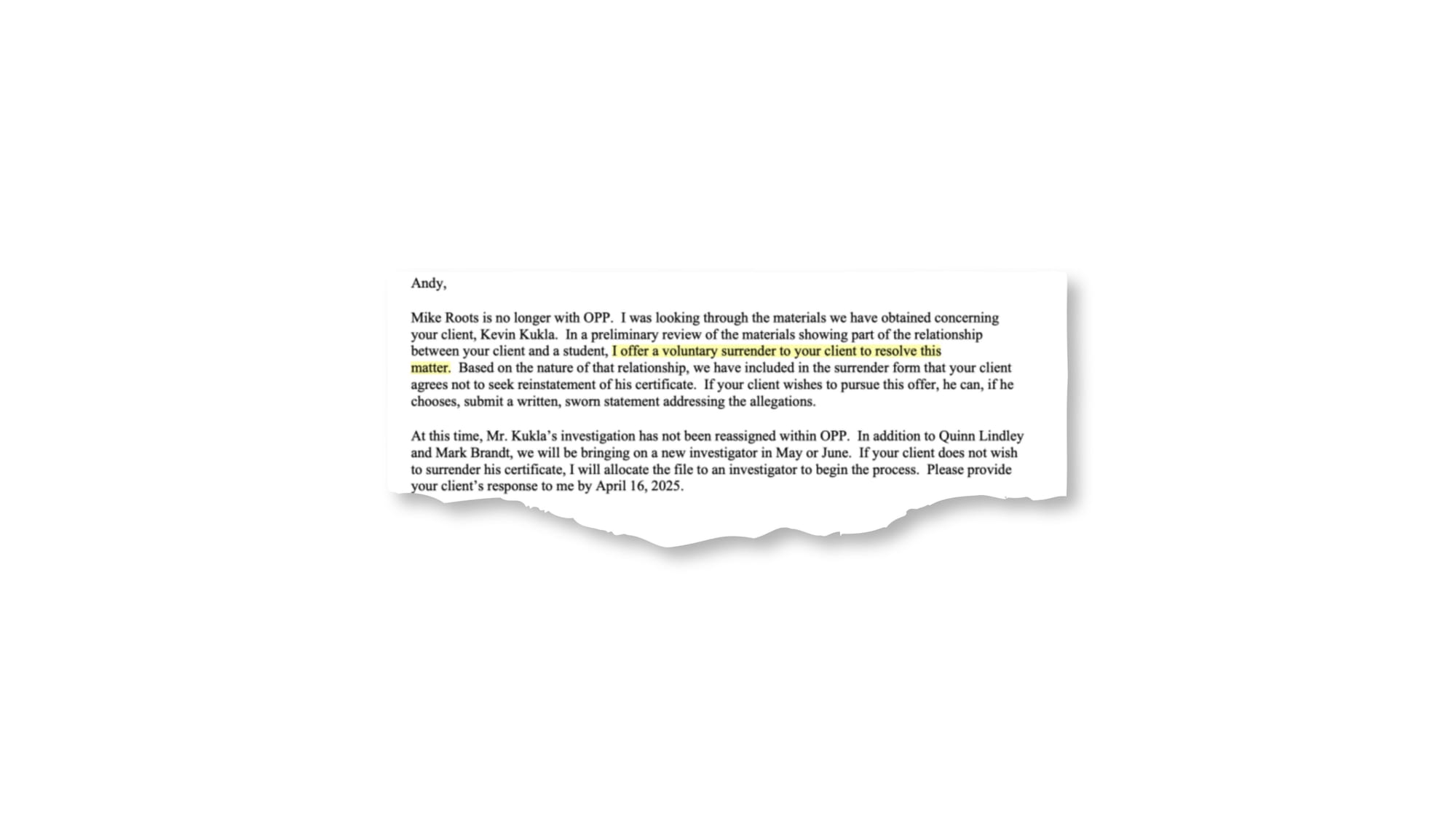
Dennis doesn’t think the state or school district should be allowed to halt an investigation if someone resigns or voluntarily surrenders their K-12 teaching license.
“They are like, ‘Oh, they’ve resigned. It’s no longer in our purview.’ But it also prevents any analysis as to how we can prevent this in the future,” Dennis said.
Joel Levin, the co-founder and director of programs for the Seattle-based nonprofit Stop Sexual Assault in Schools, wants to see Washington K-12 schools mandate more comprehensive training for staff and students on how to spot grooming behaviors. Levin’s organization created a training on educator abuse, which is geared towards helping young people recognize the signs.
“Sometimes other teachers may be suspicious of the behavior of a colleague and hear rumors and all this, but they say, ‘Well, I'm not sure about this and (don’t) want to get this teacher in trouble.’”

Charol Shakeshaft, an emeritus professor at Virginia Commonwealth University who has studied school employee sexual misconduct since the 1980s, said school districts must remind staff that they are legally mandated to report suspected abuse.
“You say, ‘If you don't report and you've seen something, you're part of this,’” said Shakeshaft, who frequently serves as an expert witness in court cases involving sexual misconduct in schools and recently published a book titled “Organizational Betrayal” about how schools enable sexual misconduct and how to stop it.
Elizabeth Jeglic, a clinical psychologist and professor at John Jay College of Criminal Justice in New York City who specializes in sexual violence prevention, said that school districts must be better at documenting grooming behaviors and boundary violations in a teacher’s employment file.
She said that while a lot of schools have Title IX and mandatory reporter training for staff, they often fall short. “They kind of watch their 20-minute video and they check it off the box,” Jeglic said.
She’d like to see training for staff, students and parents that discusses teachers as potential perpetrators.
“Often students themselves see it,” she said. “They know somebody's doing something to their friend, but they don't know that they should be telling somebody, or how to tell, or what to do in those situations.”
Jeglic pointed to a national study published in 2025 that showed that many youth-serving organizations, including well-known organizations like the YMCA and the Boy Scouts of America, have successfully reduced the rate of sexual abuse within their organizations by implementing prevention policies and training.
But that’s not been the reality for K-12 schools, she said.
“Educator sexual abuse has actually increased because schools are very slow to the uptake,” she said. “There's not a centralized organization. The Department of Education has gone away, largely, and each state has its own thing, and then each district has its own thing.”
Washington could join a growing number of states that have passed laws defining and criminalizing grooming behaviors in order to give law enforcement and prosecutors more ways to address teacher sexual misconduct.
“It's a psychological manipulation of the child. And that, in and of itself, can cause harm even if contact, sexual abuse, doesn't happen,” Jeglic said.
There’s been some general skepticism of the push to criminalize grooming, Dennis said. Many of the behaviors –– such as gift giving, mentorship or special attention –– can be present in appropriate teacher-student relationships. Ultimately, a prosecutor would have to prove that the teacher intended to engage in sexual contact, which can be difficult.
Instead of passing new laws, Dennis would like to see existing laws related to mandatory reporting be better enforced. In Washington, failing to report suspected abuse, neglect or harm is classified as a gross misdemeanor, punishable by up to a year in jail and/or a $5,000 fine.
“I think that if we did a quick Google search of the number of mandatory reporters that have been prosecuted for failing to report, it would be nominal, like maybe none,” Dennis said. “And yet, a lot of our cases hinge on the fact that someone didn't report when it's clearly a reportable offense.”

The story you just read is only possible because readers like you support our mission to uncover truths that matter. If you value this reporting, help us continue producing high-impact investigations that drive real-world change. Your donation today ensures we can keep asking tough questions and bringing critical issues to light. Join us — because fearless, independent journalism depends on you!
— Jacob H. Fries, executive director
DonateCancel anytime.

The school board said state law limits the district from taking action against the former principal, despite community demands to fire him.

The changes, which would expand the state’s investigatory abilities, still need approval from the governor-appointed Professional Educator Standards Board

Records show administrators left a teacher in an elementary school classroom despite repeated concerns about his inappropriate behavior with students

Curtis Johnston was allowed to voluntarily surrender his teaching license after the superintendent told a state investigator that no investigations existed, records show

State agencies don’t know how many inmates face more prison time because they couldn’t access programs prescribed by parole commissioners

Newsroom staffers tell InvestigateWest and RANGE that concerns about Curley’s leadership festered until his August suspension — weeks before the paper was set to transfer to his nonprofit

The board of 5Rock Ranch nearly shut it down more than a decade ago, but former residents say harmful practices continue

Under the banner of “Dig, Baby, Dig,” the Trump administration is supercharging an already powerful mining industry. What will happen to vulnerable plants and animals?
Subscribe to our weekly newsletters and never miss an investigation.