

An Oregon Christian ranch promises refuge to people in crisis. Former residents say they were harmed instead
The board of 5Rock Ranch nearly shut it down more than a decade ago, but former residents say harmful practices continue
The board of 5Rock Ranch nearly shut it down more than a decade ago, but former residents say harmful practices continue

Under the banner of “Dig, Baby, Dig,” the Trump administration is supercharging an already powerful mining industry. What will happen to vulnerable plants and animals?
Gov. Bob Ferguson has rejected everyone the state board recommended for commutation

The board of 5Rock Ranch nearly shut it down more than a decade ago, but former residents say harmful practices continue

Michelle Caswell still recalls the nights when her boss prayed beside her bed, kneeling so close she could feel his warm breath on her face and she worried he’d try to kiss her.
Caswell was 31, working and living at 5Rock Ranch, a Christian ministry that promises refuge and spiritual guidance for single mothers, “the fatherless and the floundering.” Fresh out of drug rehab, she was hired as the women’s ministry director, but her boss, Michael “Scott” Bradley, quickly urged her to think of him as her father, she says. Caswell recalls how Scott claimed that she had stopped maturing at a young age due to multiple personality disorder, and that as her father, it was appropriate for her to sit on his lap, and for him to kiss her on the cheek and pray at her bedside each morning and night.
It’s been 15 years since Caswell left 5Rock Ranch in 2011. When she thinks back on those nights, it’s with a mixture of disgust, anger, and compassion for that young woman trying to fall asleep. How did she ever get used to that?
Scott Bradley and his wife, Christy, have led the nonprofit operation in Yamhill, Oregon, since 2006. Though neither holds a license or certification in mental health, social work or drug counseling, they’ve welcomed hundreds of people, mostly women, seeking relief from addiction, shelter from domestic violence or a fresh start after an arrest. At 5Rock, the Bradleys say worldly problems find solutions that are “undeniably God.” In a state where both domestic violence shelter and residential drug treatment beds are in short supply, the offer of a cost-free safe haven has made it an attractive place for vulnerable people seeking a new chapter and who may have few other options.
Some who came and went from 5Rock Ranch say its promises were kept. Their lives were improved by the rules, the mandatory Bible study and the couple’s leadership.
But 15 former residents, including Caswell, told InvestigateWest the ministry exploited their vulnerabilities rather than healed them, and their calls for accountability have failed to help protect residents who came after them. Most said they want to see the ranch shut down or operating under different leadership, citing a culture of strict but inconsistent rules, shame tactics, and dismissiveness toward the serious needs of those who came there. But without the government oversight that’s typical for licensed treatment facilities, former residents say they’ve been unable to change 5Rock’s practices.
A few said they were denied permission to seek professional mental health support or drug treatment off the ranch. Others said Scott’s counseling made things worse by keeping them dependent on leaders and isolated from their families. One mom said Scott had her daughter “forgive” her father for sexual abuse. Two people described unwanted touching and kissing by Scott, while six said Scott pressured them to share explicit details about their sexual traumas, either in private counseling sessions or at events. InvestigateWest identified four people who went to 5Rock Ranch on probation, to satisfy a condition of drug treatment or anger management. Six former residents said they were abruptly kicked off for disagreements or infractions, while others had a hard time leaving because they had given up jobs and donated their cars and savings to the ranch.
“If you don’t comply, they throw you out with the trash,” said Megan McCarty, who spent nine months at 5Rock in 2018 and 2019 recovering after being held captive on a cannabis grow. The Bradleys had repeatedly denied McCarty permission to leave the ranch for trauma counseling or family support. After reaching a crisis point and checking herself into a hospital, McCarty returned to the ranch to find her belongings piled in trash bags on a porch and a false rumor that she wasn’t allowed to return because she had used drugs.
Back in 2012, a mediator hired by the nonprofit’s board of directors investigated residents’ complaints, concluding that Scott was not a “sexual predator” but that reports of sexual harassment and inappropriate touch were “significant” and would be grounds for firing at other ministries. While some found healing through 5Rock’s “ministry to the fatherless,” the mediator said it caused “dissonance and trauma” for others who came to the ranch in a vulnerable state. A number of residents also said Scott would justify decisions by saying God had made him the leader. “Very difficult to argue with God,” the mediator wrote in a report.
But in the years since that investigation, the ranch’s residents have continued to speak out about similar issues. 5Rock continues to recruit new residents, raise money for renovations and host community events. Even years later, McCarty and others wrestle with the effects of what they say was manipulation, shame and shunning — and they worry other vulnerable people could still be at risk.
“I just want this place to stop hurting people,” McCarty said. “I’m not the only one.”
In a brief phone interview, Scott called former residents’ complaints “lies” that were all previously investigated and debunked. He wouldn’t respond to specific allegations of misconduct.
“We have some disgruntled people, but we have way, way, way more people that their lives have been changed,” he said. “We do invite people to come see it for themselves rather than just listen to vicious rumors.”
He declined a request from InvestigateWest to visit the ranch for an interview.
People arrive at the sprawling, 108-acre property in Yamhill County searching for all kinds of things.
They come for stability and a new start. For healing and for answers. Like a fisherman’s lure, the idyllic ranch nestled in the foothills of Oregon’s coastal mountain range draws the abused, the recently incarcerated, the addicted, and the spiritually hungry.
Caswell was no different. She came to 5Rock in 2007 wanting to maintain her sobriety and rebuild her relationships with her two sons. And after years of waitressing, bartending and selling Mary Kay products, she wanted to work in women’s ministry.
“I went from addicted to drugs and guys to addicted to Jesus and ministry,” Caswell said.
It felt like her whole life was finally coming together. At the same time, “(I was) scared that I was gonna mess up again,” Caswell said.
While many like Caswell are drawn to 5Rock’s faith community, others come simply for help. Some who came seeking support to end their substance use said the ranch was attractive because it accepted them quickly and it was free. Despite efforts to boost supply, Oregon still has a shortage of drug treatment beds. Those fleeing abusive relationships face similar barriers; research has shown that housing and emergency shelter are the most frequent types of unmet service for domestic violence in Oregon.
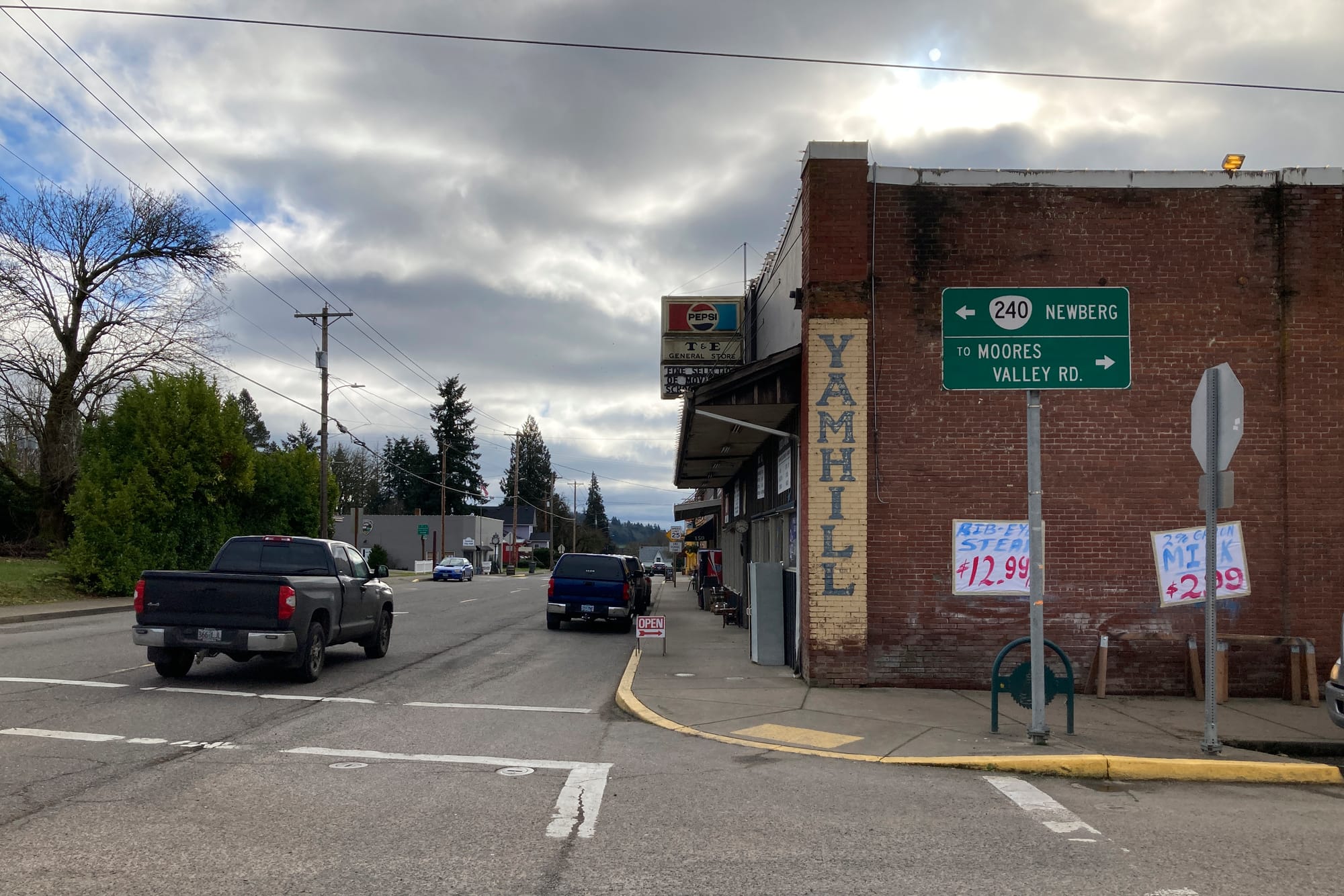
For decades, the property, 10 miles from the nearest town, was a working ranch owned by a prominent local family. A wealthy couple, John and Marilyn Duke, bought the land in 2006 and leased it to the Bradleys for $1 per year. Last year they handed the property — which county assessor’s records value at $3.4 million — to the nonprofit for $0. The North Yamhill River curves through the wooded ranch, where residents stay in cabins or the big lodge, also the site of communal meals and events.
Residents don’t pay to stay at 5Rock; the nonprofit is funded through grants and donations. The cost of attendance is commitment to the facility’s rules. Residents begin each day with prayer and Bible study based on ranch-approved curriculum. They spend afternoons helping run the place — from chores and maintenance to the cleaning, cooking, setup and teardown for events, weddings and retreats. They agree not to leave the ranch or host guests without permission from the Bradleys, and almost all of them forgo outside jobs, cellphones and internet, except for limited access to the ranch’s phones and computers.
The Bradleys say their rules are in line with other Christian-based addiction programs and safe houses, and keep people focused on their journey without distractions. Residents agree to abide by the rules before they move there, Scott said.
5Rock has one central mission: ministry to the “fatherless and the floundering.” Scott links struggles with addiction, mental health and trauma to a national crisis of fatherlessness, citing rising rates of children being raised in single-parent households. Growing up in Southern California in the 1970s, many of his friends grew up without fathers, Scott has said, so he would invite them to share his own parents and join them at church. After he and Christy were married, the couple started taking “runaways” into their home, he told an Albany church in 2023.
“We know the impact (fatherlessness) makes on a man, because they learn how to be a man from their dad,” Scott said in a recent podcast interview, while daughters learn about “intimacy” from their fathers.
But former residents said Scott would tell them they had absent or “incestuous” fathers even when they had loving and present dads. Despite being close with her dad, Caswell said those conversations led her to distance herself. Within a few months, she came to view Scott as a replacement.
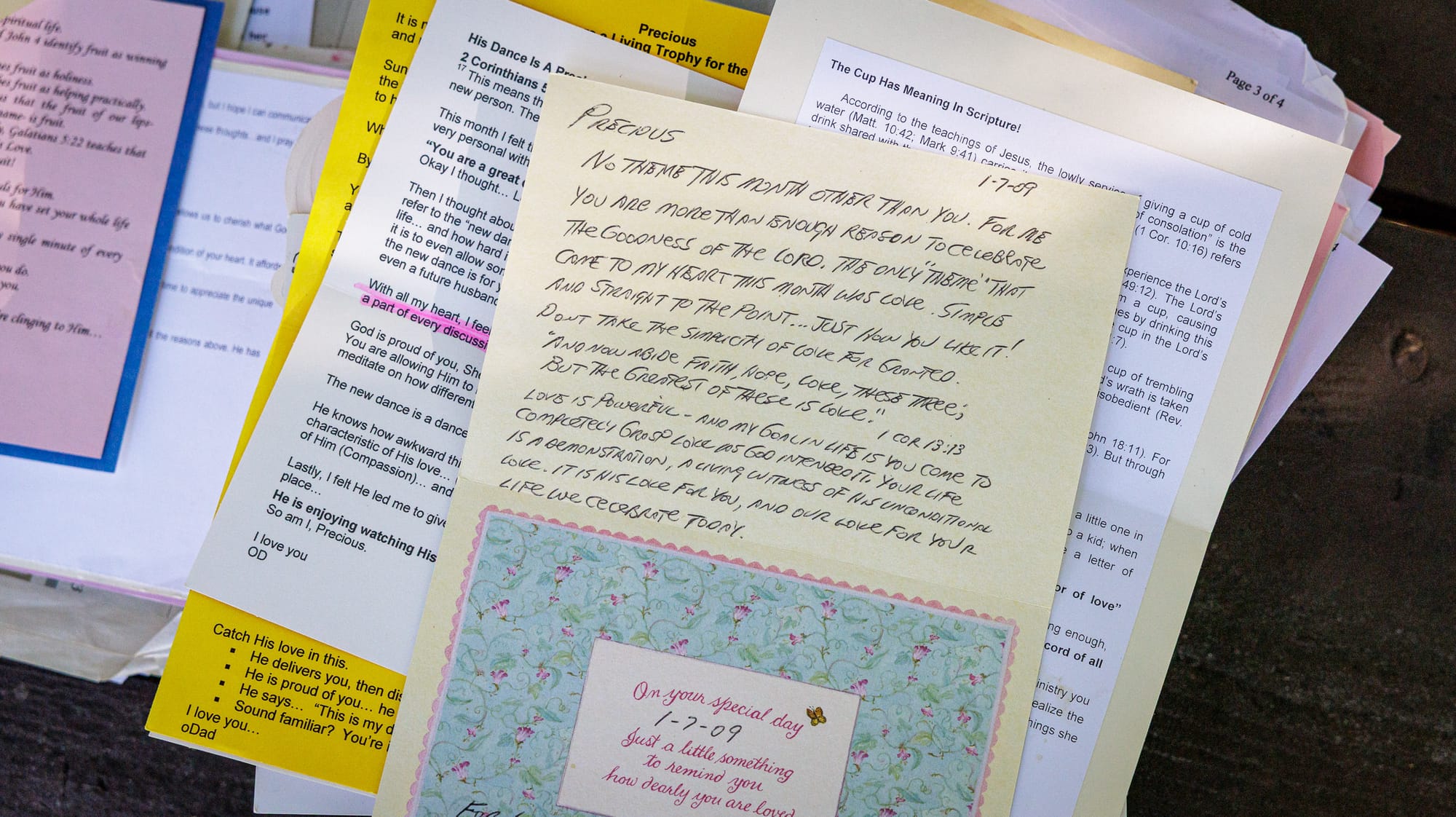
The “father-daughter” relationship with Scott also quickly became the basis for increased physical contact and emotional intimacy, Caswell said. Their counseling sessions sometimes stretched on for hours as she confessed every trauma, doubt or sexual experience, crying so hard she would get a headache. Scott called her by nicknames like Shell or Precious, and told her he was training her to take over the ministry when he was too old. Physical touch increased, too: Putting his arm around her became hugging and then kissing on the cheek.
When Caswell told him she was uncomfortable, Scott said she was misreading his intentions because of her past trauma, or that she was being spiritually attacked. After he told her she had multiple personality disorder, she questioned her judgment and leaned more on Scott’s.
“Before I knew it, I’m saying it to myself,” she said. “‘This isn’t weird. I just feel like it’s weird because it’s just my past. He’s not being inappropriate. It’s me that feels like it’s inappropriate because of where I come from.’”
But the nagging feeling never fully quieted.
Caswell realized how wrong things were at the ranch while leading a women’s group one evening. By that time, she had been there nearly four years, and the number of residents had grown from fewer than 10 to more than 100.
One woman brought up a resident who made her uncomfortable with repeated physical contact, sparking a discussion about boundaries. For Caswell, it was the key that unlocked a trove of repressed memories.
She suddenly reflected on all the times Scott had pushed past her objections to their bedtime prayers, kisses and hugs, and his insistence during their counseling sessions that she offer more detail about past sexual encounters.
After the meeting, she ran into the woods, panicked and confused. For the first time in months, she called her dad.
“I was like, ‘You were right,’” Caswell said. “This guy’s weird. The whole place is weird. I think I’m in a cult. Oh my gosh. I need help. I need help. I gotta get out of here.”
Caswell began planning her exit strategy, while quietly warning other residents to make their own preparations. Together, with the support of two pastors whose churches financially supported 5Rock, in late 2011 she and four other residents wrote to 5Rock’s board of directors and the property owners.
“Please know my heart breaks writing this letter,” she wrote. “I wouldn’t do it, if I didn’t feel compelled by the Lord to send it to you.”
Aside from its water system, which is overseen by Yamhill County, 5Rock Ranch is not regulated by Oregon public health or child welfare authorities. Most of its staff aren’t licensed to provide mental health or substance use care, though its women’s ministry director has an expired certification as a recovery mentor for addiction. The nonprofit holds no government contracts, and InvestigateWest found no record of it receiving public money.
Some former 5Rock residents and volunteers have asked government agencies to examine the ranch’s practices, but they’ve mostly hit dead ends. They’re left with the nonprofit’s board of directors as the only potential recourse for accountability.
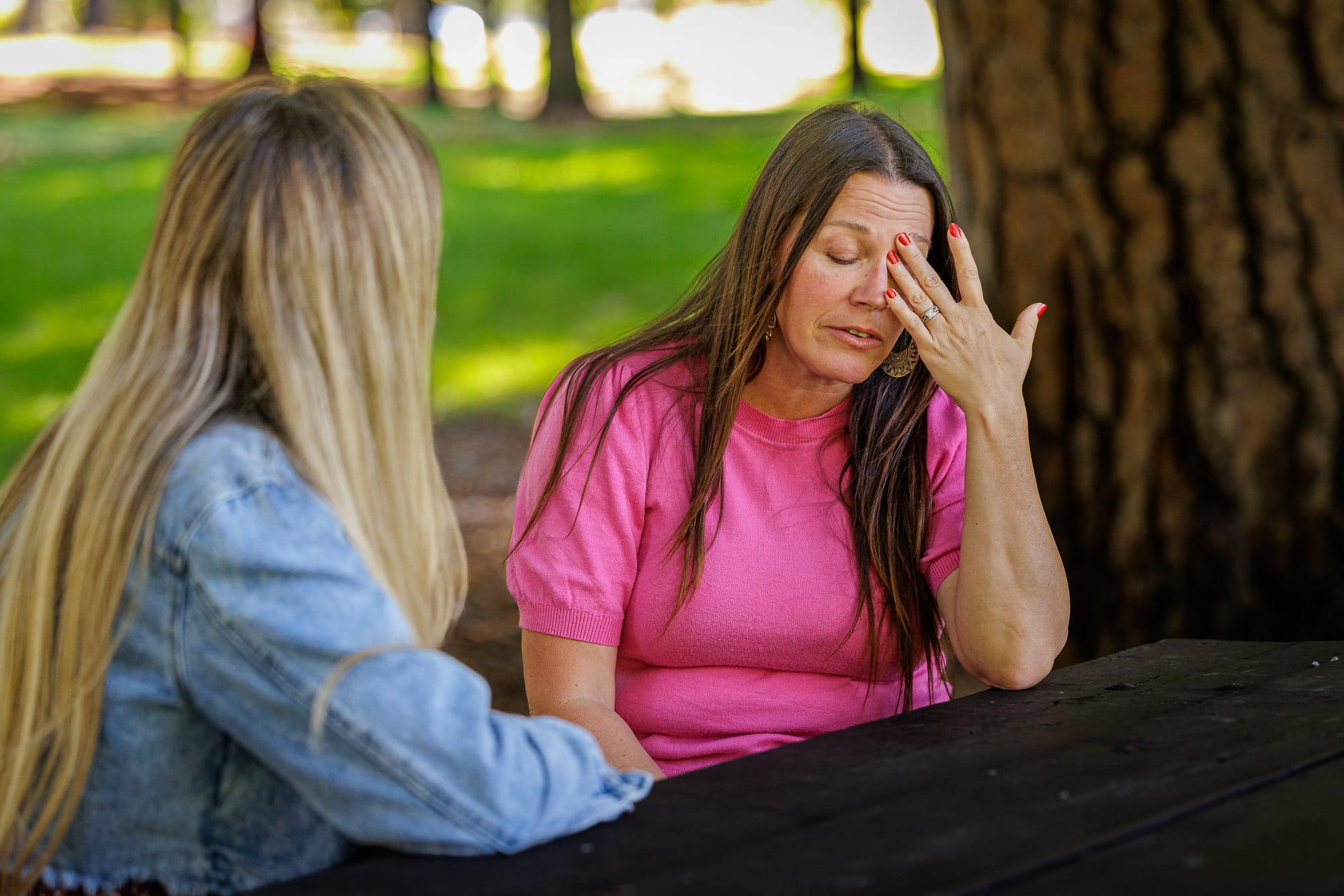
In a December 2011 letter to the board, Sharon Smith said Scott encouraged her 15-year-old daughter, Rosemary, to confront her father in person days after Rosemary told Caswell that her dad had sexually abused her — the first time she had disclosed the abuse to anyone. Before bringing her father to the ranch, Scott met with Rosemary and pressed her for vivid detail about the abuse, Smith said. When her father arrived the next day, she said, Scott pushed Rosemary to tell him she loved and forgave him. No one called law enforcement until after that confrontation. The father pleaded guilty to first-degree child molestation in April 2011.
“I let Scott talk me into doing something I knew was not right,” Smith wrote. She said Rosemary should have been allowed to work through the abuse at her own pace, and the meeting “caused more distress and definitely not any steps toward healing.”
In the weeks after the meeting, Rosemary, who asked to be identified by her middle name because she has not discussed the abuse publicly, became suicidal and left the ranch for inpatient psychiatric care. Even today, she said discussing the ranch makes her heart start racing and her body shake.
Smith said Scott had assured her that a psychologist, a consultant for the ranch at that time, signed off on the meeting. The psychologist, Dr. Steven Spotts, wrote a letter to the board saying he only knew about the meeting after reading Smith’s letter, and “never would have agreed” with the decision. It wasn’t the only time he feared he’d been used “as cover for treatment decisions I had no part in.”
A mediator hired by the board to investigate affirmed most of the residents’ stories in a 17-page report, which recommended Scott immediately stop any “father/daughter relationships” on the ranch and urged 5Rock to better define its mission since “the needs of some residents can and did quickly overwhelm” it. He also recommended 5Rock develop a clearer path for residents to leave the ranch.
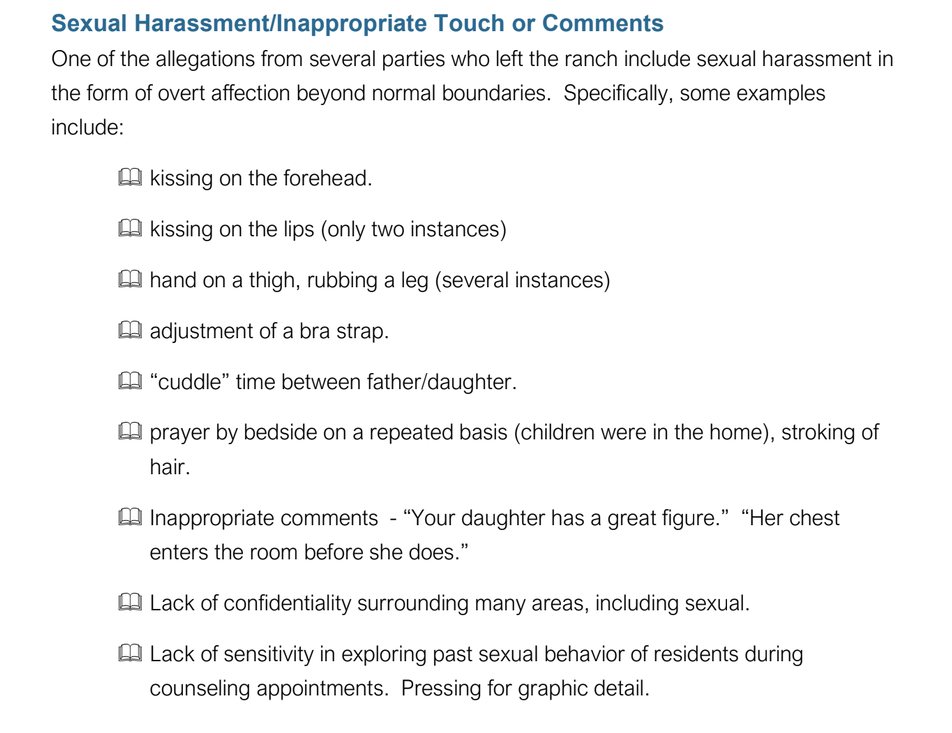
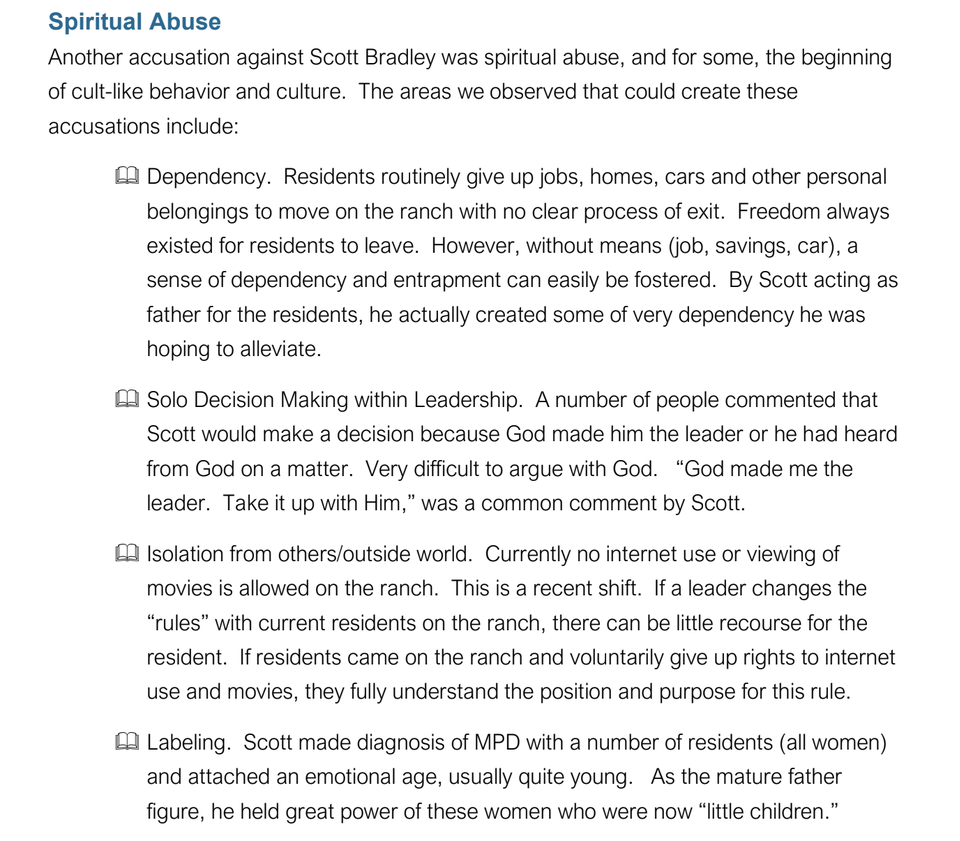
Excerpts from a 2012 report by Dr. Randall Kinnison summarizing allegations of sexual harassment and spiritual abuse by leaders of 5Rock Ranch, a Christian ministry in Yamhill, Oregon. The organization's board of directors, which commissioned the report, prepared to shut down the nonprofit but never followed through.
Board members appeared to take the report to heart. They told concerned residents that they would close down the nonprofit and help remaining residents move off ranch, according to emails reviewed by InvestigateWest. But they also said they would leave it to the Bradleys and the couple who owned the property to determine the future of the 5Rock ministry.
In a draft letter to Scott, the board said it believed he had “made decisions and taken actions that have caused harm and hurt to a number of people.”
“Based on the nature of those decisions and actions … we believe that Scott can and likely will repeat these actions,” the board said.
But board members didn’t stick around to see through the closure. Instead, each one resigned before the process was complete. Maddy Knutz, one of those members, said it was not a board decision to continue the nonprofit and she only learned later that their plan was reversed. The other two members from that time did not respond to requests for comment. One rejoined the board of directors in 2018.
By fall 2012, six new people had joined the board. The ranch began a new era of growth, increasing its scope and resources.
McCarty was in bad shape when she arrived at 5Rock in August 2018. Her captivity on the cannabis grow had involved sexual assault, malnourishment and forced drug use.
McCarty wasn’t a religious person, but she had prayed for rescue shortly before it came. Scott liked that story, she said, recalling how he had pressed her for descriptive detail about the sexual assault.
Ranch life wasn’t what McCarty expected. She wasn’t the only one in recovery; some residents were navigating long-term substance use, mental health disorders and trauma. The Bradleys pushed residents to focus on the Bible rather than treatment for support, she says. McCarty, struggling with what has since been diagnosed as post-traumatic stress disorder, hated her assigned job working in the kitchen, since going into the confined walk-in refrigerator made her panic and have flashbacks. She was denied a reassignment. Worst of all, she says, the Bradleys also denied her requests to leave the ranch for medical appointments or therapy, and even to go out with her family for her 30th birthday. The Bradleys insisted that she needed to stay on the ranch to find healing, she said.
Those restrictions felt “sort of like being held captive all over again,” McCarty said.
Her breakdown came after weeks of rising stress. She started to have “blackouts” where she would dissociate and huddle in a fetal position. A 5Rock staff member drove McCarty to the hospital days before a ceremony for those who completed the “Journey” — the ranch’s signature nine-month Bible study program for adults.
Sarah Spencer, a volunteer who also lived at 5Rock, had been tasked with packing up McCarty’s things. She worried about the residents who had come to 5Rock on probation, who faced potential jail time for running afoul of the Bradleys. (The Oregon Department of Corrections said 5Rock isn’t on its list of approved probation programs, but courts aren’t required to send people to vetted programs).
It also didn’t make sense to her that people who needed intensive care for mental health and substance use issues were mixing so much with moms and children.
“We would have our communal meals together, so kids could be in the room when maybe someone would have an outburst,” she said. “You kind of gaslight yourself, like, ‘Maybe it’s just me,’ because everybody goes along with the behavior.”
At least four former residents who broke a rule or refused an instruction described being kicked off, or put on a two-week “time-out” period with less than a day’s warning. Each person was dropped off at a nearby town’s homeless shelter. The ranch often didn’t lay out plans to help residents move on to new jobs and living situations, and several said they were discouraged from doing so. Some, like Angelica Vasquez, a single mother living on the ranch in 2019, had donated their cars. Lack of outside jobs and transportation made leaving more difficult.
Like other residents before them, McCarty and another former resident who spoke to InvestigateWest said Scott pressed them for details about their sexual histories and traumas in private conversations.
None of them knew about the 2012 board investigation into Scott’s conduct and the plan to shut the nonprofit down. But eventually, in 2019, McCarty, Vasquez and Spencer decided to write to the board about their concerns.
Spencer and Vasquez had both been banned from the ranch. Speaking out on behalf of McCarty and other residents had led to accusations that they were slandering 5Rock leaders and being “bad house guests” they said.
“People are unique and need to be treated with a level of care and concern that I did not see from Scott during my stay there,” Vasquez wrote in her letter. “Please, please, please – PAY ATTENTION.”
Two board members met with Vasquez and Spencer. Months of silence followed. After sending a follow-up message in April 2020, the women received an email from Tiffany Davidson, an attorney who said she represented 5Rock Ranch. A single sentence in her letter summed up the response to their complaints.
“We assure you that your concerns have been addressed internally,” Davidson wrote.
During a podcast appearance this spring, Scott described the ranch as a thriving and safe community for trafficking victims, moms fighting to keep custody of their children and people leaving jail. He said he and other staff work with child welfare officials, local courts and law enforcement regularly.
“We don’t work in isolation,” he said. “That’s a big misconception. If you’re called a cult, that gives you that feeling like it’s a closed society. We’re everything but that. We’re not a closed society at all.”
Jake Sunderland, spokesperson for Oregon’s Department of Human Services, which oversees foster care and child welfare, said the agency does not refer people to the ranch. Some people receiving services from DHS have gone to live at 5Rock Ranch, but those scenarios led only to “minimal and limited contact” between agency officials and ranch staff, Sunderland said.
It’s not clear how many people are living at 5Rock today, or if the years of complaints from residents have sparked any changes in how it operates. But three single mothers who lived on the ranch between 2020 and 2026 said they dealt with instability and shame tactics, too. One said 5Rock staff threatened to call child welfare on her for not walking her daughter to the bus stop — eventually, they kicked her off the property instead. Lesli Lucier left the ranch this February with $8 in her bank account, after the Bradleys revoked permission for her to keep a cell phone, which she needed in order to communicate with her teenage son who wasn’t living on the ranch.
Except for Scott, none of 5Rock’s eight current board members agreed to an interview. One said InvestigateWest was “only getting one side of the story” but declined to answer questions. John Duke, who leased the ranch with his wife to the Bradleys for 19 years, declined to comment.
Around 20 former residents have connected through Caswell, many over the last year, as she shared her experiences at 5Rock on social media.
Caswell said she was “flabbergasted” when she learned that another group had gone to the board in 2019 with no result.
McCarty said that revelation was defeating. But she and other former 5Rock residents hope that, by sharing their experiences, vulnerable people looking for help can consider another side to the 5Rock story.
“I just want to help so other women and children don’t get hurt,” McCarty said. “That’s the only reason I’m doing this.”
The story you just read is only possible because readers like you support our mission to uncover truths that matter. If you value this reporting, help us continue producing high-impact investigations that drive real-world change. Your donation today ensures we can keep asking tough questions and bringing critical issues to light. Join us — because fearless, independent journalism depends on you!
— Jacob H. Fries, executive director
DonateCancel anytime.

State lawmakers wary of government spending have turned down bills to fund emergency medical services

Shereef Elnahal, who has served as president since August, said the hospital needs to stabilize its finances before it can resume the project

The state announced the new assistance as federal Medicaid cuts are expected to reduce Oregon’s program by $11 billion over five years

Nurses say more babies are being squeezed into rooms in the 30-year-old unit

Under the banner of “Dig, Baby, Dig,” the Trump administration is supercharging an already powerful mining industry. What will happen to vulnerable plants and animals?

Gov. Bob Ferguson has rejected everyone the state board recommended for commutation

At the same time, Adult Protective Services workers say they’re under growing pressure to close investigations quickly.

After Isaac Berger overdosed, his mother gave hospital staff the pills she found in his room. She says it became the biggest regret of her life.
Subscribe to our weekly newsletters and never miss an investigation.