

She brought fentanyl to the hospital to save her son. Idaho treated him as a trafficker.
After Isaac Berger overdosed, his mother gave hospital staff the pills she found in his room. She says it became the biggest regret of her life.


After Isaac Berger overdosed, his mother gave hospital staff the pills she found in his room. She says it became the biggest regret of her life.

Advocates and experts say that reflects the challenges rural families have getting health and social safety net services

The school board said state law limits the district from taking action against the former principal, despite community demands to fire him.

The Western U.S. is experiencing its longest continuous streak of dry years since 800 A.D.

Across the West, state leaders are bracing against the long-term impacts of aridification. In late April, Oregon Gov. Kate Brown added four additional counties to the ‘drought emergency’ tally — now, half the state is in a state of emergency. Further south, Metropolitan Water District of Southern California, which gets water to millions of city dwellers, restricted outdoor water use for the first time ever. In Colorado, the U.S. Department of Agriculture designated the entire state a “primary natural disaster area” due to the threat of drought — also considered an ‘unprecedented’ move. The Southwest, as a whole, has been hit hard with dry conditions: Utah and New Mexico both issued separate emergency declarations, one for water scarcity and the other for wildfire.
The political designations unlock resources and expand powers for states and counties to navigate the extreme water scarcity, making available, among other things, relief aid for the agriculture industry. Westerners will undoubtedly need it this summer, and — as the drought likely continues — future summers.
Shrinking snowpacks, parched topsoil and depleted reservoirs are symptoms of the West’s longest continuous streak of dry years since 800 A.D. There is also a significant likelihood the streak continues. A study published in Nature Climate Change in February predicted a 94% chance the drought stretches through 2023; the chances of it persisting through 2030 are 75%, when factoring in continued impacts of a warming climate.
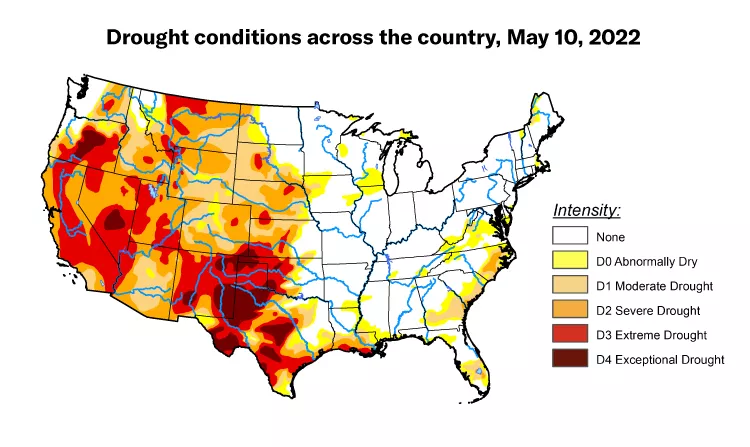
According to the U.S. Drought Monitor, most of the West is in “moderate” to “severe drought.” Certain regions, like eastern and southwestern Oregon, California’s Central Valley, southern Nevada and eastern New Mexico are in “extreme” to “exceptional” drought.
Here are a few numbers and notable coverage to understand how the drought is impacting the West:
THE SOUTHWEST
THE PACIFIC NORTHWEST
CALIFORNIA
Theo Whitcomb is an editorial intern at High Country News. Email him a theo.whitcomb@hcn.org or submit a letter to the editor. See our letters to the editor policy.

The story you just read is only possible because readers like you support our mission to uncover truths that matter. If you value this reporting, help us continue producing high-impact investigations that drive real-world change. Your donation today ensures we can keep asking tough questions and bringing critical issues to light. Join us — because fearless, independent journalism depends on you!
— Jacob H. Fries, executive director
DonateCancel anytime.

Stella-Jones, a wood treater fined $1 million by state regulators, is appealing the penalty


Mayor Harrell promised law would get Seattle “back on track,” but new street-tree planting data raises doubts

The penalty comes days after InvestigateWest found regulators investigating the pollution didn’t take steps to immediately stop it

After Isaac Berger overdosed, his mother gave hospital staff the pills she found in his room. She says it became the biggest regret of her life.

Advocates and experts say that reflects the challenges rural families have getting health and social safety net services

The school board said state law limits the district from taking action against the former principal, despite community demands to fire him.

Emails show how Canyon County probation officers are helping immigration authorities — including making a list of foreign-born individuals
Subscribe to our weekly newsletters and never miss an investigation.
Our work has inspired new state laws, exposed government failures and impacted local communities in powerful ways. These stories wouldn't be told without InvestigateWest, and we couldn't do it without our generous supporters.
Cancel anytime.