

Toxic chemicals, customer service and a toaster oven: Elon Musk’s SpaceX disputes a WA state fine
A two-day hearing focused on a $6,000 fine for Starlink lab that exposed unsuspecting workers
A two-day hearing focused on a $6,000 fine for Starlink lab that exposed unsuspecting workers

The Curley-founded nonprofit meant to take ownership of the newspaper said the deal won’t move forward after rejecting Cowles Company's condition to get rid of Curley as part of the transfer


As federal Medicaid changes force cuts, Oregon health officials are planning to cut back special Medicaid benefits approved under the Biden administration

A two-day hearing focused on a $6,000 fine for Starlink lab that exposed unsuspecting workers

Elon Musk’s multitrillion-dollar company is fighting with Washington state over a $6,000 labor fine, fending off allegations of an unsafe workplace.
In November 2024, the Washington Department of Labor and Industries opened a chemical exposure investigation at the Redmond headquarters of Starlink, the division of SpaceX that makes satellites.
The state had received complaints stating the customer service department was connected to an engineering lab that didn’t have proper ventilations. Workers were experiencing eye irritation and headaches and dust was accumulating on their desks.
Unlike the lab workers, the customer service department didn’t wear protective equipment, according to a complaint. The two teams shared a breakroom.
The complaints weren’t news to SpaceX management. Customer service workers had filed dozens of internal complaints alleging chemical exposure symptoms that stemmed from an adjacent production lab. Management did not act until Labor and Industries opened its investigation, InvestigateWest reported.
The agency’s inspection took place in an unassuming office complex in Seattle-area suburbia. Tenants of the building included a pediatric clinic, a pediatric dentistry office, a “holistic” medical clinic, a mortgage lender and the Starlink customer service department, which adjoined two small Starlink labs.
After detecting a high level of lead on a work bench, the state issued SpaceX a violation and the $6,000 fine.
The department issued a second violation because SpaceX had not evaluated their employees’ potential exposure to chemicals. For that, there was no fine.
The third violation was unexpected.
In the middle of the investigation, a state compliance officer received multiple photos of a toaster oven. Cooking inside of it was a small piece of metal laying on top of aluminum foil. Workers feared anyone who used the toaster oven might have been exposed to harmful chemicals.
The officer issued a third violation for not keeping eating areas “safe and healthy.” No fine.
SpaceX is contesting all three violations. After Labor and Industries rejected the initial appeal, SpaceX appealed again.
The matter is now before a judge with the Board of Industrial Insurance Appeals, a quasi-judicial agency independent of Labor and Industries. Potential outcomes range from affirming the fine and the three violations to vacating them, with numerous variations in between.
On Nov. 18 and 19, during a trial-like hearing conducted over Zoom, SpaceX attorney Skylar Sherwood and Assistant Attorney General Diane Cornell examined witnesses familiar with the investigation. Judge Magda Baker presided.
Haley Laing, former SpaceX environmental health and safety manager who was subpoenaed for testimony, described the layout of the customer service department as a “very open space” with two labs conducting lead-based work adjoining one side.
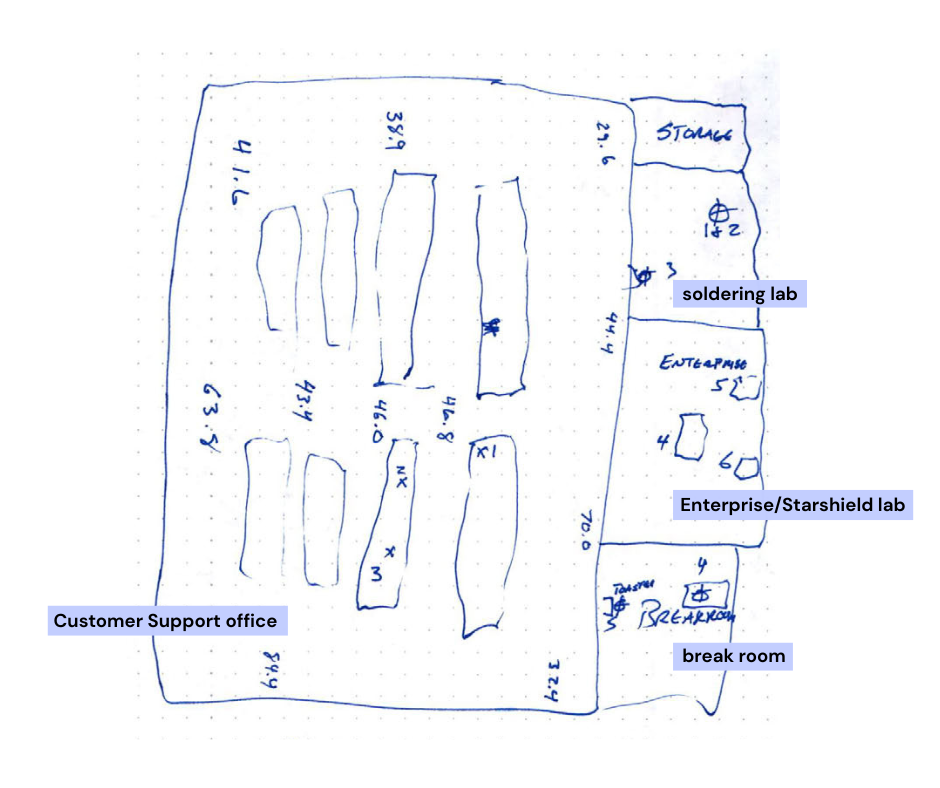
The labs were former conference rooms. They had windows and the doors were not airtight. SpaceX did not post signage to caution workers that toxic substances were used inside, Laing said.
The state compliance officer, Richard Caldwell, was not permitted to photograph inside the labs; SpaceX had a contract with “DARPA,” the federal government’s Defense Advanced Research Projects Agency, he said during testimony. To some employees, the labs were known as ‘Starshield,’ a type of satellite made for national security, InvestigateWest reported.
The labs’ proximity to the customer support department was supposed to be temporary; the compliance officer said he was told they would be moved to another site in 2025. It’s not clear whether that happened.
One lab was about the size of a storage closet, “probably 80 to 100 square feet,” Laing said. The other, “probably 250 square feet.” Inside, lab technicians cured parts in industrial ovens and assembled hardware onto circuit boards.
In December 2023, a year before the state investigated and prior to Laing’s employment, SpaceX safety employees reported a lab in the customer service building did not have “proper ventilation” for lead soldering and that lab workers had to “keep the door open.” They recommended ordering a fume extractor.
It didn’t happen immediately. During testimony, Laing said SpaceX installed the fume extractor fix in late 2024 “in direct response to” the state’s inspection, after the compliance officer alerted her to ventilation concerns.
Melissa Kiss worked as a customer support representative at Starlink from 2023 to 2025. Appearing via Zoom and under questioning from Cornell, the state’s attorney, she recalled the moment she witnessed something odd inside the employee breakroom.
A small metal part — described as a ‘connector’ in inspection files — was cooking in a toaster oven shared by more than 200 workers in the building, according to InvestigateWest.
“So, when you were in the break room, when you observed this, there was someone from the lab?” Cornell asked.
“Yes,” Kiss said.
“And in speaking with an employee from the lab, what’s your understanding of what’s in the (oven)?”
“It was my understanding that it was some part from the lab and they were drying the part and that they did this often.”
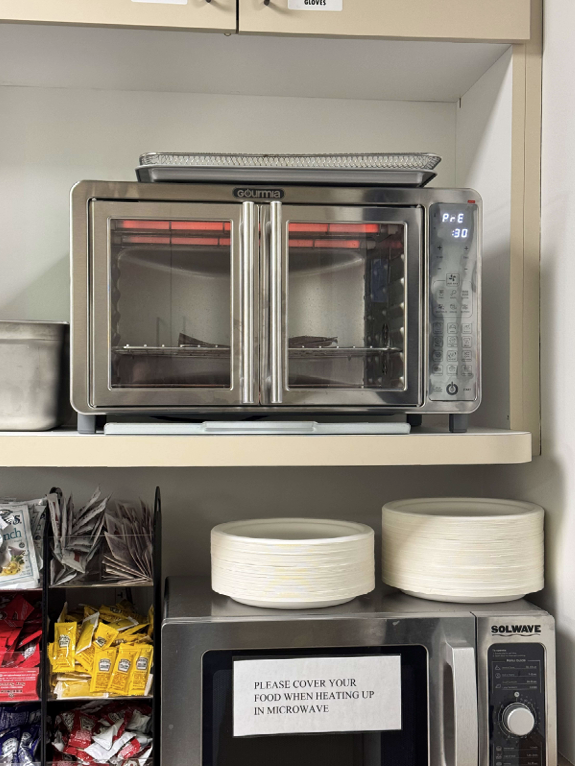
Laing, the SpaceX manager, sent an email to all employees in the building months after the breakroom incident. She said the lab technician was drying off water and that the temperature of the toaster oven wasn’t high enough to “off-gas” or “volatilize” parts of the connector, according to an email obtained in a public records request.
One lab worker told Caldwell, the compliance officer, that his team was under a mandate to “triple production."
Sherwood, who is a partnering attorney with Fox Rothschild, one of the highest grossing law firms in the country, tried to underline Laing’s argument during the Wednesday hearing.
“You never saw or handled that part that was pictured in the toaster oven, correct?” Sherwood asked Caldwell.
“I did not.”
“And you don’t know whether the part had contacted any solvent or chemical?”
“You can’t put work parts in the employee break room toaster oven at all.”
“That’s not my question, Mr. Caldwell.”
“Uh, because the material,” Caldwell said, stammering. “We don’t know what’s on – the material is made of, the part is made of, I don’t know —”
“Your honor,” Sherwood interrupted. “He’s going way off script.”
Testifying the next day, Laing, the former safety manager, said the lab worker used the toaster oven because the industrial oven in the lab was occupied.
SpaceX is relying on the state’s vague description of how surfaces should be “as free as practicable of accumulations of lead” to argue against the first violation.
Labor and Industries argues that the lead found on a work bench in the small soldering lab was 18 times greater than the allowable limit.
According to state rules, surfaces should be kept “as free as practicable of accumulations of lead.” There’s no hard number, no scientific unit of measurement.
Instead, Caldwell said in testimony, the state relies on “industry leading standards” from the U.S. Housing and Urban Development and the U.S. Environmental Protection Agency.
“When there’s a small regulatory gap like this, you are supposed to go to industrial standards, industry leading standards,” the compliance officer said.
He went on to explain that lead is especially harmful for children, but also for anyone.
“Lead attacks the brain, the central nervous system, the kidneys and the reproductive system,” Caldwell said.
“Were employees exposed to lead?” asked Cornell, the state attorney.
“Yes they were.”
“And how many employees were exposed to lead based on your inspection?”
“Two directly in the lab, but depending on how that dust migrates, it could be the entire customer service area.”
“Does it matter if the exposure is direct or indirect?”
“No,” Caldwell said. “Because you haven’t controlled the dust, and again, we don’t know where that dust is migrating.”
Attorneys for the two sides have until January 15 to submit briefs. After that, the judge will decide whether SpaceX kept areas as free as practicable of lead, whether SpaceX conducted an employee exposure evaluation and whether SpaceX kept eating areas “safe and healthy.”
If SpaceX ends up paying the fine, the money will go into a Labor and Industries account that supports families whose loved ones died at work.
Judge Baker said the ruling would take time.
“It’s gonna be a complicated decision to write,” Baker said.
The story you just read is only possible because readers like you support our mission to uncover truths that matter. If you value this reporting, help us continue producing high-impact investigations that drive real-world change. Your donation today ensures we can keep asking tough questions and bringing critical issues to light. Join us — because fearless, independent journalism depends on you!
— Jacob H. Fries, executive director
DonateCancel anytime.

Overcrowding, electrical hazards, and dirty kitchens and bathrooms are some of the most common violations over the last five years

Newsroom staffers tell InvestigateWest and RANGE that concerns about Curley’s leadership festered until his August suspension — weeks before the paper was set to transfer to his nonprofit

As crews continue to work through hazardous conditions, company and government officials say it’s too early to know what might have caused the implosion in Longview that killed 11 people.

Workers say exposure caused serious health issues including a hospitalization and a miscarriage

The Curley-founded nonprofit meant to take ownership of the newspaper said the deal won’t move forward after rejecting Cowles Company's condition to get rid of Curley as part of the transfer

As federal Medicaid changes force cuts, Oregon health officials are planning to cut back special Medicaid benefits approved under the Biden administration
Overcrowding, electrical hazards, and dirty kitchens and bathrooms are some of the most common violations over the last five years

The state began withholding the records following a 2025 InvestigateWest series about sexual misconduct by prison staff
Subscribe to our weekly newsletters and never miss an investigation.