

Washington has few paths to early prison release. Advocates fear Gov. Ferguson has closed off a critical one
Gov. Bob Ferguson has rejected everyone the state board recommended for commutation


Gov. Bob Ferguson has rejected everyone the state board recommended for commutation

At the same time, Adult Protective Services workers say they’re under growing pressure to close investigations quickly.

After Isaac Berger overdosed, his mother gave hospital staff the pills she found in his room. She says it became the biggest regret of her life.


While mounting evidence suggests that wildfire smoke is bad for all humans, not everyone is equally at risk.
It’s not just the young, the old and those with respiratory impairments who stand out — where you live, the work you do, how much money you make, whether you have long-term and flexible employment, and the health care you have matter a lot, too.
Thanks to centuries of housing, education and economic discrimination, African-Americans and Latinos are more likely to be poor, more likely to live in substandard housing that can easily let smoke in, more likely to be homeless, more likely to rely on jobs that require them to work outside, less likely to have paid time off, and less likely to have health insurance. (For example, 70% of farmworkers, who are over 90% Latino in California, go without health insurance in the heart of the state’s wine country.)
Those vulnerabilities are on top of “decades of environmental justice research that minority populations are at higher risk of exposure to higher environmental hazards, not just smoke,” says Anjum Hajat, a University of Washington epidemiologist who studies social and environmental disparities.
People of color are more likely to live near polluted areas and to be exposed to pollution, even though whites are more likely to be responsible for creating it. Increased pollution exposure appears to be linked to higher rates of cancer, asthma, and neurological and development disorders. And higher rates of respiratory illness, in part from environmental exposures, in turn makes such communities more vulnerable to wildfire smoke. “We know that some groups are more likely to be impacted by all sorts of pollution than others—immigrants, non-Native English speakers, low-income people,” says Hajat. With wildfire smoke, “racial equity is at the forefront again.”
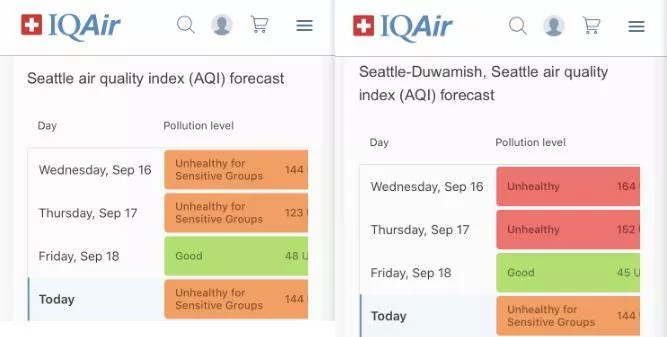
Unequal economic and social structures also mean that poorer people of color may be less able to protect themselves than their wealthier, whiter counterparts. Health departments tell people to buy a portable air cleaner, which regularly go for hundreds of dollars, or install A/C systems to keep unhealthy air out, which can cost anywhere from several thousand dollars to over $10,000.
“People with resources can do these things, but they’re just not an option for everyone,” says Hajat.
Research has started to show the health effects of these racial and economic divides. A 2017 study found that, among the elderly, women, Black Americans and people living in counties with poor education were more likely to be exposed to smoke than those in wealthier, whiter and better educated areas. Another found that Black Americans and mobile home dwellers in the South are more likely to be exposed to soot from wildfire smoke than other populations, with a study of wildfire smoke exposure in North Carolina finding that poorer communities were more likely to have negative health impacts.
Longstanding health disparities owing to historic inequalities are thrown into even starker relief now, as exposure to tiny particulates like the kind in wildfire smoke is considered a risk factor for dying of COVID19. Already, people of color are disproportionately impacted by coronavirus, with farmworker communities in Yakima and San Joaquin County, California, facing some of the highest rates in each state. Wildfire smoke is just another toxic hazard thrown into the mix.
It’s as yet unclear how exposure to wildfire smoke in particular may impact coronavirus illness and death: King County warns that “poor air quality caused by wildfire smoke may make it even harder for people to fight COVID-19 since both have the potential to affect the lungs, and other overlapping parts of the immune system.” The impacts may not be seen until long after exposure, as suggested by a new study showing that air pollution from Montana’s wildfire season was linked to a spike in flu cases months later.
All told, it’s clear that communities of color are hit with an onslaught of competing factors that together make them vulnerable to both wildfire smoke and other pollution that carries tiny particulates: chronic stress and poverty, living in polluted areas, limited access to health care, limited paid time off and few workplace protections. In rattling off evidence that low-income people of color are more likely to bear the brunt of all types of pollution, researcher Hajat makes it clear that there are significant health disparities. “What to actually do about it,” she says, “is less clear.”
Editor's note: Wildfires are growing in frequency and intensity, threatening our landscape, our lifestyle and our health. This story is part of InvestigateWest's “Smoky Skies, Altered Lives” series probing how the upsurge in fire and smoke fueled by climate change puts us at risk, and how restoring the health of our forests could make a difference.

The story you just read is only possible because readers like you support our mission to uncover truths that matter. If you value this reporting, help us continue producing high-impact investigations that drive real-world change. Your donation today ensures we can keep asking tough questions and bringing critical issues to light. Join us — because fearless, independent journalism depends on you!
— Jacob H. Fries, executive director
DonateCancel anytime.

Mayor Harrell promised law would get Seattle “back on track,” but new street-tree planting data raises doubts

Forest collaboratives formed in the wake of the Pacific Northwest’s “Timber Wars” have become major power players operating largely out of the public eye

Analysis shows fewer than 3% of “protected” trees were actually preserved under the city’s controversial 2023 ordinance

In a webinar hosted by regional transmission authorities, data centers were called a “major challenge” for the energy industry, as well as extreme weather

Gov. Bob Ferguson has rejected everyone the state board recommended for commutation

At the same time, Adult Protective Services workers say they’re under growing pressure to close investigations quickly.

After Isaac Berger overdosed, his mother gave hospital staff the pills she found in his room. She says it became the biggest regret of her life.

Advocates and experts say that reflects the challenges rural families have getting health and social safety net services
Subscribe to our weekly newsletters and never miss an investigation.
Our work has inspired new state laws, exposed government failures and impacted local communities in powerful ways. These stories wouldn't be told without InvestigateWest, and we couldn't do it without our generous supporters.
Cancel anytime.