School leaders received numerous reports that former high school English teacher Curtis Johnston was “dating” a student but failed to intervene, complaint says
A northwest Oregon town is stepping up testing of the river that supplies some of its drinking water, prompted by InvestigateWest’s reporting that a local wood treater released stormwater tainted with toxic preservatives into the waterway while regulators kept it quiet.
The Sheridan City Council has instructed staff to consult with environmental researchers and state regulators on a new plan to test water samples from the South Yamhill River for chemicals used in recent years by Canadian company Stella-Jones. The proposed tests are separate from standard monitoring for contaminants in city drinking water that Sheridan is required by state law to regularly conduct.
“It would be nice to know what's there, since we do have someone upstream dumping water that does have a chemical in it,” Sheridan Mayor Cale George said in an interview. “Unless we're testing, we don't know for sure.”
Council members said they were unaware of the impacts to the South Yamhill until InvestigateWest reported on Stella-Jones’ nearly four-year history of chemical spills and polluted stormwater releases into the river, which has spurred state and federal penalties reaching nearly $1.5 million. That included a $250,000 criminal fine after the company pleaded guilty to state charges of unlawful water pollution in August.
New data from the U.S. Environmental Protection Agency also shows chemicals found in soil and water near the Stella-Jones site have reached high enough levels to potentially harm wildlife, including crayfish, fish and birds.
Sheridan City Council President Jim Buckles said he was particularly concerned about a town resident’s August 2023 report to state regulators about the absence of crayfish in the South Yamhill River downstream from the Stella-Jones site.
“I have a pretty strong concern about when something as simple as crayfish suddenly disappears from our water,” Buckles said. “That's not a good sign. Because not only do we have an intake on the river that we get part of our city drinking water from in the summer, (but) kids go out and play in it, and people on their canoes and kayaks.”
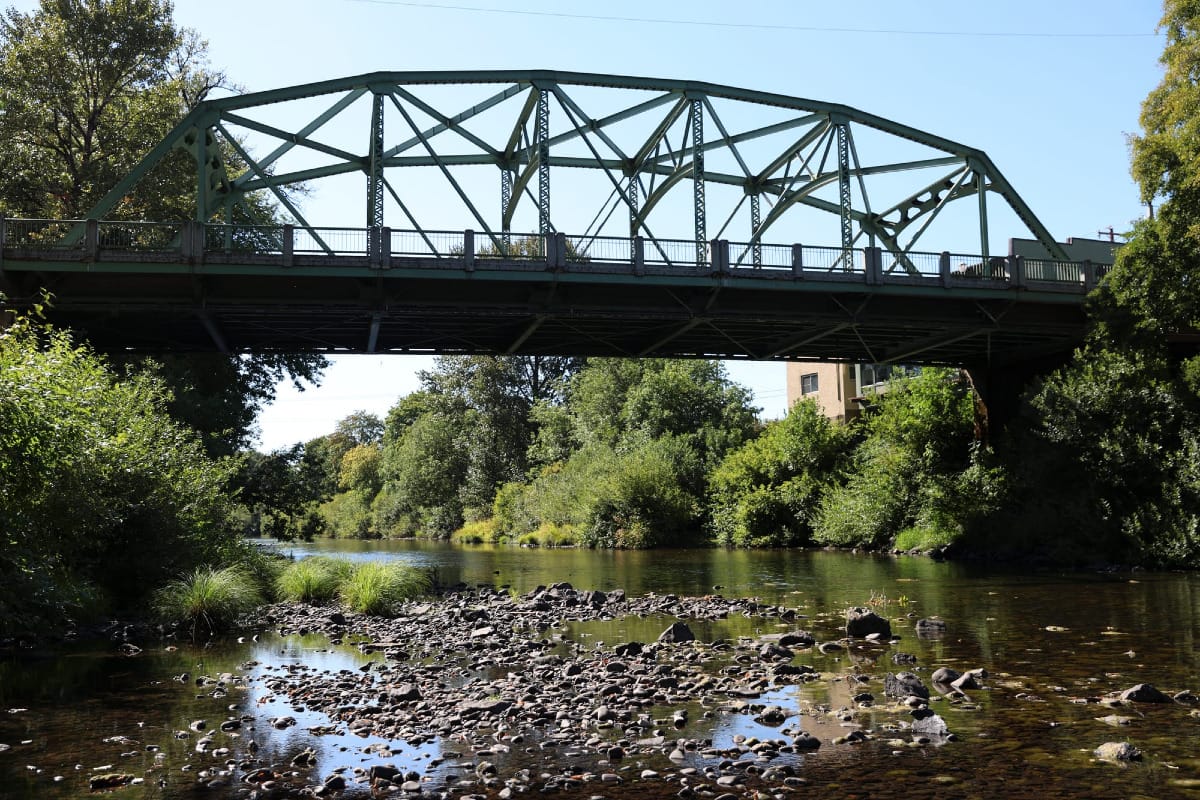
The Sheridan Bridge over the South Yamhill River in Sheridan, Ore. (Amanda Loman/InvestigateWest)
Stella-Jones is appealing the largest fine: a $1 million penalty from the Oregon Department of Environmental Quality that was announced in September. In its appeal, the company argued DEQ has misapplied laws governing hazardous waste and failed to credit the company for corrective actions taken over the years to mitigate environmental harm. It also places blame for excessive chemicals in its stormwater on the state and EPA, arguing they’ve shirked their responsibility to manage contaminated groundwater on-site that predated Stella-Jones’ ownership of the property.
The EPA has monitored this contamination in concert with DEQ since 2001, when federal regulators designated a Superfund there and completed a cleanup over several years. A plume of groundwater on the property that is polluted with pentachlorophenol — a likely carcinogenic wood preservative used for decades at the site — is supposed to be contained within an underground wall maintained by the EPA. But in 2022, the agency reported that the plume was escaping containment and needed to be investigated.
Stephanie Corrente, a Stella-Jones spokesperson, said in a statement that well before the state fined the company, Stella-Jones had made “significant investments in the facility’s operations, plant leadership, and employee training as part of the company’s ongoing improvements at the site.
“This important work at the Sheridan facility has continued while Stella-Jones has been working to resolve outstanding legal and factual issues with (the Department of Environmental Quality) and EPA,” Corrente said.
If the Department of Environmental Quality and Stella-Jones fail to reach a settlement, the appeal will go before an administrative law judge. Few appeals reach that point, said Erin Saylor, interim manager of DEQ’s compliance and enforcement office, but the Stella-Jones penalty is “a complicated case and we don’t know how long it will take to reach an agreement.”
The dispute over the state penalty comes as the EPA has finalized a 1,600-page report investigating pollution on and around the Stella-Jones property. The report concluded that some contamination is likely attributable to Stella-Jones’ operations, while other spots are being impacted by the migrating groundwater. It flagged pentachlorophenol, copper, and other toxic and carcinogenic byproducts such as dioxin as the main pollution sources posing risks to wildlife.
For example, dioxin levels in some sediment samples taken from the South Yamhill and Rock Creek, an adjacent waterway that flows to the river, were higher than the EPA’s screening value “by at least two orders of magnitude, suggesting the potential for population level effects to benthic invertebrates” such as crayfish, worms or insect larvae.
EPA officials said the contamination is relegated to “a small footprint” near each of the drainage ditches where Stella-Jones discharges water into the South Yamhill River and Rock Creek. Agency officials are working on a plan to clean up that pollution and other contaminated areas on the property. That report is expected to be published “in the second half of 2026,” EPA spokesperson Alice Corcoran said.
The EPA and DEQ banned the use of pentachlorophenol at the site during the Superfund cleanup but reauthorized its use in 2011. Stella-Jones acquired the site in 2013 and was first cited by DEQ for excessive pentachlorophenol in its stormwater in 2015.
Since early 2023, the company has exclusively used another less toxic preservative, known as DCOIT, and no longer uses pentachlorophenol.
Sheridan officials have said they want to test for both DCOIT and pentachlorophenol in their new sampling plan. Although the EPA report is publicly available, City Manager Preston Polasek and several city councilors said they had not read it and couldn’t say how the city’s testing might differ from the agency’s methodology.
“It’s noble to be concerned about the resource of the river, but there’s no evidence to question the health of our drinking water,” Polasek said. He described the plan to test the river as a way to give “peace of mind” to worried city councilors.
“I don’t need that,” he said. “The councilors do. That’s fine.”
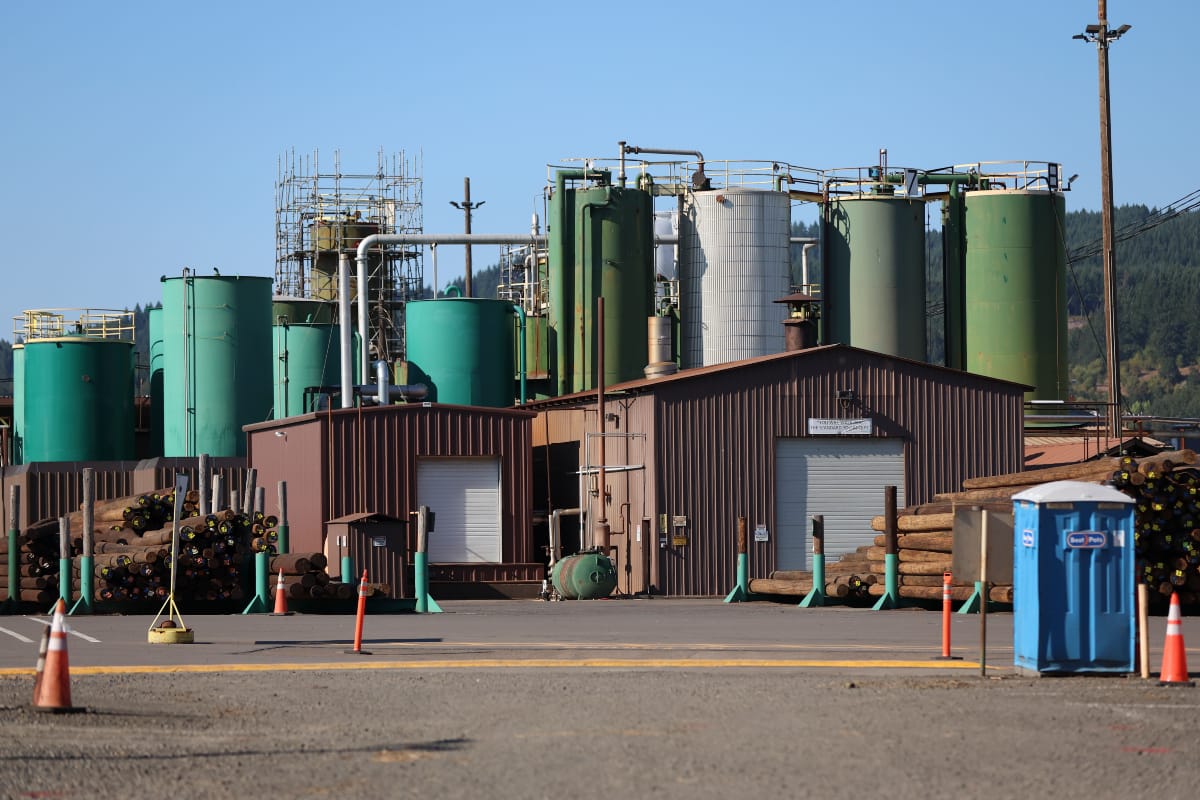
A sign along Highway 18 outside Sheridan, Ore. (Amanda Loman/InvestigateWest)
Pentachlorophenol is one of a group of synthetic organic chemicals for which public drinking water systems are required to test every three years under Oregon law. Chronic exposure to pentachlorophenol by ingestion, inhalation or skin contact is linked to higher cancer risk and problems with liver, kidney and blood health. The city completed its most recent tests for those contaminants in September and October and found no reportable level of pentachlorophenol in the water.
In its sampling of river water in August 2024, the EPA noted high levels of pentachlorophenol in sediment samples close to the drainage ditches, but did not find pentachlorophenol present in surface water. The chemical tends to accumulate in soil and sediments more easily than water, though factors like acidity and temperature can impact whether it dissolves in water.
Polasek said the city has been in touch with a researcher at Oregon State University about the plans for additional sampling, and the city is looking to test the water in the summer. The summer months are when Sheridan is more likely to draw drinking water from the river, but also when Stella-Jones does not release water into the river. He estimated the cost to be around $6,000.
Nina Bell, an attorney and founder of Northwest Environmental Advocates, an environmental law firm that has sued the EPA and state over Clean Water Act claims, said Sheridan’s testing plan won’t necessarily shed light on other impacts to fish and organisms that spend their life in the river.
“It would be unfortunate, I think, if it were determined that drinking water is not hazardous and they then cease to be concerned about the rest of the contamination,” she said. “Because, obviously, there are high levels of toxics that are going to affect something, even if they don't affect the drinking water.”
Stella-Jones, meanwhile, has not violated its water permit since DEQ handed down its penalty. The company brought in extra storage to prevent untreated rainwater spills during atmospheric river events in December, and is planning upgrades to its stormwater treatment system that will “enhance treatment” and increase its capacity to handle big storms without spills.
As part of its plea agreement to settle the criminal charges, Stella-Jones also agreed to remove sediment in the drainage ditch flowing to the South Yamhill where high levels of chemical contamination were noted. It is required to submit a progress report to state prosecutors by March.
Kaylee Tornay is InvestigateWest's reporter covering labor, youth and health care. A reporter since 2017, she has dedicated herself to rigorous, revelatory journalism that scrutinizes power and equips local communities with knowledge they can use.
The story you just read is only possible because readers like you support our mission to uncover truths that matter. If you value this reporting, help us continue producing high-impact investigations that drive real-world change. Your donation today ensures we can keep asking tough questions and bringing critical issues to light. Join us — because fearless, independent journalism depends on you!
School leaders received numerous reports that former high school English teacher Curtis Johnston was “dating” a student but failed to intervene, complaint says
If you cover criminal justice in the Pacific Northwest — or want to — we’re hosting a free virtual training that may be useful to you and your newsroom
Get the inside scoop in your inbox, free.
Subscribe to our weekly newsletters and never miss an investigation.