

Idaho Legislature passes bill to expand prison sex abuse law
The bill, inspired by InvestigateWest reporting, is awaiting Gov. Brad Little’s signature
The bill, inspired by InvestigateWest reporting, is awaiting Gov. Brad Little’s signature

Minimal oversight of court investigators makes it difficult for parents to challenge flawed reports without risking damage to their cases

Recent court rulings show how ICE is citing missed immigration check-ins — often without evidence — to detain asylum seekers

Advocates say boosting insurance pay would help expand programs for vulnerable pregnant people

As an obstetrician specializing in addiction medicine, Wendy Smith knows pregnancy presents a unique opportunity for mothers to access treatment.
Pregnancy can make a person eligible for certain drug treatment programs or admittance to a hospital to get started on medication for opioid use disorders. And for parents, a pregnancy can be a powerful motivating factor to end their substance use.
“It’s a period where people experience differences that can lead to better outcomes,” Smith said. “And we’ve gotta take advantage of it.”
But Smith said she’s too often seen missed opportunities. Many times when she’s read through a patient’s chart, she has found a history of emergency room visits that ended without a connection to medication, prenatal care or a drug treatment program. Homelessness, stigma and a lack of awareness of resources are common barriers that keep people from getting plugged into care.
Smith spoke at a Jan. 28 community roundtable event InvestigateWest hosted in Portland to explore how Oregon can improve its support for pregnant people who are most vulnerable to poor outcomes. A 2025 state report found substance use and mental health disorders are leading drivers of maternal deaths, and InvestigateWest found access to effective programs combining maternal health and drug treatment is uneven around the state. Doulas and lactation consultants, who play key roles in supporting the mental well-being of pregnant and postpartum people, also still struggle to get paid by Medicaid and private insurers.
The dozen people who attended the event, including doulas and peer support specialists, a lactation consultant, doctors and a residential drug treatment provider, shared about their work to surround pregnant people with robust mental and behavioral health support. Oregon has over the years made incremental investments to boost rates of pay for doulas and help expand a program called Project Nurture, which integrates drug treatment with prenatal care. Those integrated programs operate in a handful of counties including in the Portland area, but many other areas of the state don’t have that kind of care available.

Sarah Bovee, a doula and peer support specialist with Project Nurture, said she has seen momentum in the last year to build these programs out. As a peer support specialist, Bovee draws on her personal experience with opioid addiction and stigma to help guide other parents through childbirth. She said birth workers and maternal health advocates are looking for ways to collaborate, and she attributes the increased engagement to both the work of advocates and to the “Momnibus” package, a slate of bills introduced in the 2025 legislative session that sought to boost support for perinatal health and housing. Two of those bills passed into law, including one that sought to increase access to doula and lactation care.
“Everybody is now wanting to sit at the table and figure out how we can do this together,” Bovee said. “And when I started working with this (population), it wasn’t like that.”
Several hospitals and organizations across Portland are deploying new programs and initiatives to improve care for pregnant people dealing with substance use disorders and mental health needs.
At Oregon Health and Science University, Smith is co-running a new clinic focused on caring for pregnant patients with substance use disorders. It opened in January. Tina Bialas, director of a Portland residential substance treatment center for pregnant and postpartum women called the Letty Owings Center, said her organization is launching a pilot program to bring doulas onsite to provide care to clients. She’s aiming for a start date this spring. Providers at Legacy Health have shifted away from ordering urine tests when they think a pregnant person may be using illicit substances, since the tests can be invasive, inaccurate and increase stigma. Now, providers do a verbal screening to determine if someone might be exposed to drug use before they potentially order a test, said Rachael Waas Shull, a labor and delivery nurse at Legacy’s Randall Children’s Hospital.
 Kaylee Tornay
Birth workers and providers also discussed the barriers that continue to stymie the growth of existing resources. Bialas said residential programs struggle to expand because they don’t make enough money to break even. Letty Owings provides 28 of the approximately 100 residential treatment beds statewide dedicated to pregnant people and parents — “a very large slice of a very small pie,” she said. The Oregon Health Plan’s daily reimbursement rate for Medicaid patients has increased in recent years but still doesn’t cover the cost of providing that care.
“That’s problematic,” Bialas said. “You can’t survive that way, but somehow, there’s been this expectation societally that we will somehow just continue to kind of scrape along, especially in substance use disorder treatment.”
Immigration enforcement is also keeping people from accessing maternal health, attendees said. Mothers have missed prenatal appointments while detained or skipped them to avoid encountering immigration officers, Smith said.
Julie Bennette, a peer support specialist and doula with Project Nurture, said she has had to look for new ways to help pregnant clients navigate addiction and recovery while also managing the stress around the immigration crackdown.
“We just come up with skills that we can use to get through it, to stay in our recovery through it,” Bennette said. “I’m already teaching people how to advocate for themselves and stand up for themselves and be aligned in what they have power over and what they don’t.”
 Kaylee Tornay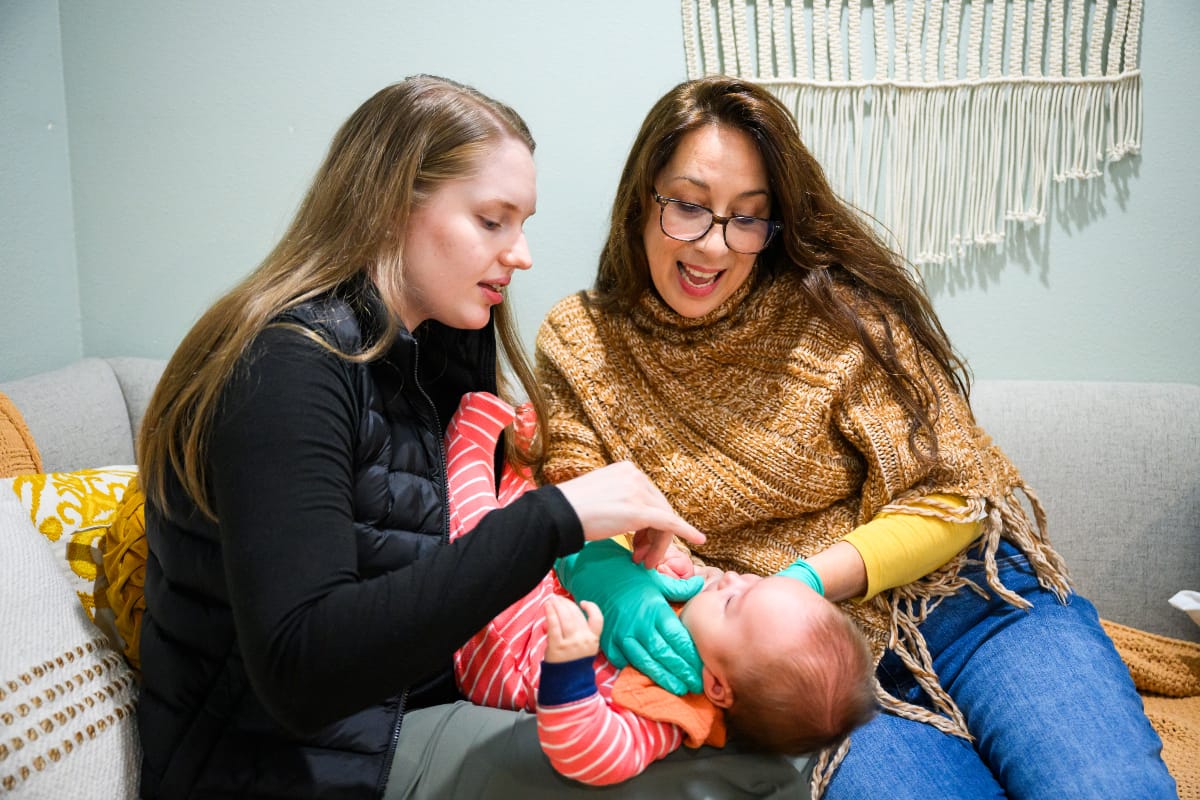
This month, Oregon lawmakers are also revisiting a law aimed at increasing Medicaid and private insurance coverage of doula and lactation services that was passed as part of the Momnibus package in 2025. That law sought to bring additional lactation workers into the Medicaid system and boost the maximum reimbursement rate for doulas. But birth workers have said it hasn’t addressed long-standing issues they face getting paid through the Oregon Health Plan.
In response, a new bill would push back the timeline to add lactation workers and implement the new coverage requirements for Medicaid and insurance plans. Instead of going into effect starting in 2026, the changes wouldn’t take effect until 2028, said Dana Hepper, director of policy and advocacy at Children’s Institute, a Portland nonprofit that advocates for children and parents.
Hepper said the delay is due to a hiring freeze at the Oregon Health Authority, which is tasked with implementing most of the new law. The agency’s hiring freeze is a response to expected budget shortfalls related to the passage of the Trump administration’s federal tax and spending package, referred to as the “One Big Beautiful Bill.”
Policymakers also want to make sure the latest changes address concerns from doulas and lactation workers rather than creating more confusion, she said.
“What I’ve heard consistently is, ‘We’d rather this be done right than quickly,’” Hepper said.

The story you just read is only possible because readers like you support our mission to uncover truths that matter. If you value this reporting, help us continue producing high-impact investigations that drive real-world change. Your donation today ensures we can keep asking tough questions and bringing critical issues to light. Join us — because fearless, independent journalism depends on you!
— Jacob H. Fries, executive director
DonateCancel anytime.


If patients can’t say anything nice, some doctor paperwork mandates, they can’t say anything at all

The bill, inspired by InvestigateWest reporting, is awaiting Gov. Brad Little’s signature

Minimal oversight of court investigators makes it difficult for parents to challenge flawed reports without risking damage to their cases

Recent court rulings show how ICE is citing missed immigration check-ins — often without evidence — to detain asylum seekers

The independent probe will look into “systemic failures” detailed in InvestigateWest series
Subscribe to our weekly newsletters and never miss an investigation.