School leaders received numerous reports that former high school English teacher Curtis Johnston was “dating” a student but failed to intervene, complaint says
Allegations against Washington gender-affirming surgeon stir fears of backlash for trans patients
Former employees and patients describe ethical lapses, shoddy records and worse at cosmetic surgery clinic — raising concerns about oversight in the booming industry
Cosmetic surgeon Dr. Geoffrey Stiller is beloved by many in the trans community for his work on gender-transition surgeries, but a recent lawsuit raises ethical and safety concerns about his practice. (James Dawson/Boise State Public Radio)
A Report for America corps member, reporter Daniel Walters can be reached at daniel@investigatewest.org.
Cosmetic surgeon Dr. Geoffrey Stiller operated on the cutting edge.
In 2017, the Spokane-area doctor began offering surgeries that he said nobody else was performing in Washington, Idaho or Montana. Vaginoplasties with penile inversions — removing most of a transgender person’s penis and constructing a vagina in its place — helped put Stiller on the map.
When Stiller faced conservative backlash at a small-town hospital, the Washington Post wrote a glowing story about his compassion for trans patients. When he was picked as the surgeon to perform a gender-transition operation on an Idaho prisoner, public radio profiled him at length. And when the number of gender-transition surgeries almost tripled from 2016 to 2019, the New York Post illustrated the story with Stiller’s picture.
Yet in the past five years, running clinics in Spokane and Moscow, Idaho, Stiller has been sued for malpractice four times. The latest suit was filed earlier this year by Ashley Miller, both a patient and later an employee, who alleged a series of ethical lapses by Stiller, including involving an unlicensed staff member in a procedure, reusing implants, sexually harassing staff, keeping shoddy medical records, and potentially performing surgery while intoxicated.
In one instance, a front office supervisor with no medical training assisted with removing part of a trans patient’s penis — an event captured in a photograph presented to her as a gag gift during an employee’s birthday party, Miller’s lawsuit claims.
“Doctor Stiller, for a long time, has been able to operate with a certain level of impunity,” said Court Hall, Miller’s attorney. The lawsuit, filed in May, is ongoing.
Although Stiller, who did not respond to multiple interview requests, denies the bulk of Miller’s accusations in court documents, InvestigateWest corroborated many of Miller’s most alarming claims with another former employee and several other dissatisfied patients.
Together, the allegations paint a portrait of a talented surgeon whose ethical lapses and errors put the safety and dignity of patients and employees at risk. If true, it would hardly make Stiller an outlier. Medical experts say the financial incentives and lack of meaningful guardrails in outpatient clinics enable bad actors in the cosmetic surgery industry to flourish.
“In the wild, wild west of cosmetic surgery, sometimes ethics — doing the right thing for your patients — takes a backseat,” said C. Bob Basu, president of the American Society of Plastic Surgeons, an advocacy and educational organization representing over 10,000 board-certified plastic surgeons.
Social media and evolving beauty standards have helped cosmetic surgery grow to a $17 billion industry in the United States. But increasing demand has created fertile ground for abuse, allowing doctors with little training or few ethical constraints to manipulate online reviews, fake medical records or show up for surgery hungover.
Dr. C. Bob Basu, president of the American Society of Plastic Surgeons, recommends patients find a doctor certified by the American Board of Plastic Surgery, but warns many doctors cite less rigorous credentialing boards. (Photo courtesy of the National American Society of Plastic Surgeons)
After all, any physician, regardless of specialty or surgical training, can call themselves a cosmetic surgeon. While states like California have banned cosmetic surgeons like Stiller from calling themselves “board certified” without more training, Washington and Idaho haven’t followed suit. And with state regulators often slow or reluctant to act, bad surgeons can get away with cutting corners for years.
In Stiller’s case, the stakes are different. Gender-transition surgeries are under political attack, and some patients worry that each high-profile failure erodes public trust in legitimate reconstructive and gender-affirming care.
Hexe Fey, a trans man in the Seattle-area whom Stiller operated on last year, worries that Stiller could inadvertently fuel opposition to the kinds of surgeries trans people seek out.
“He has done a lot of good,” Fey said of Stiller. “But even people who intend to do good can do harm.”
‘Cream of the crop’
By the time he was 38, Stiller had gone from being a prep schooler in a tiny town in Pennsylvania coal country to an award-winning surgical resident in South Philadelphia to the chief of surgery at Mountain Home Air Force Base in Idaho to owning his own cosmetic surgery clinic in North Carolina.
That was where, in 2009, bodybuilder William Colson came to get a hair transplant from Dr. Stiller. The Samson Hair Restoration Company had advertised that the company relied on the best board-certified surgeons to perform their transplants and that Stiller was the “cream of the crop.”
At that time, Stiller’s curriculum vitae shows that his formal cosmetic surgery-focused training was mostly limited to a yearlong fellowship at a Seattle-area cosmetic surgery and hair restoration clinic.
Shortly after Colson’s surgery, a foul-smelling soup of blood and fluid began leaking out of his head and onto his pillow, according to a lawsuit Colson filed in federal court.
“My scalp immediately started to die and literally rot within the next few days,” Colson testified in court documents.
Stiller relocated to Washington state and shelled out a $450,000 settlement to Colson. Of the procedures listed on his website today, hair transplants isn’t one of them.
The experience didn’t tamp down Stiller’s ambitions. He set his sights on performing vaginoplasties, and he sought out a urologist from Los Angeles to get trained in the procedure. Gender-transition surgeries come with their own controversy. He told the Washington Postin 2017 that he’d lost 20 pounds because of the stress from the backlash. But he was also riding a growing wave. By 2021, the number of gender-transition surgeries being performed nationwide had nearly quintupled in five years.
“In the trans community, he’s a king to most of them,” said Brandy Spangler, a former front desk manager at the Spokane location of Stiller Aesthetics. “The way I saw him behave towards that community is very beautiful.”
Brandy Spangler (left), a former employee at Stiller Aesthetics, has echoed allegations raised by a lawsuit that include sexual harassment, partying the night before surgery, keeping inaccurate medical records, and letting untrained staff amputate penises. (Brandy Spangler photo)
Many of these patients were on Medicaid, she noted, meaning they paid a lot less than other cosmetic procedures. But gender surgery was only a portion of Stiller’s workload. He also does facelifts, breast implants, tummy tucks, Brazilian Butt Lifts and “mommy makeovers” — procedures that can be incredibly lucrative.
Divorce records this year hint at Stiller’s level of wealth — he and his wife owned five houses, not counting a Florida timeshare — and Spangler recalled him being wildly generous with it. He would not only pay hefty salaries to his staff, she said, but also help some of them pay off debts, get expensive dental work and even buy a house.
Spangler, who worked with Stiller for 16 months, said that all that money had given him a sense of impunity.
“He very much has the idea that he can get himself out of anything with money,” she said.
Deceptive advertisements
You could begin the history of modern cosmetic surgery with the first silicone breast implant in 1962. By 1989, the industry had grown infamous enough that Congress launched an eight-month investigation into the spate of scams and abuses in the industry.
That year, then-U.S. Rep. Ron Wyden of Oregon began a congressional hearing by declaring that the lack of regulations had led to modern “snake oil salesmen” that “maimed and disfigured” too many Americans.
Decades later, the same concerns remain. Untrained doctors. Misleading advertisements. Inadequate oversight at unsupervised outpatient clinics.
Yet the cosmetic surgery market keeps growing. The number of procedures leaped 25 percent between 2019 and 2023, and those are just procedures from officially board-certified plastic surgeons. Many practitioners don’t have that level of training.
“Whether you’re a pediatrician, whether you’re a dermatologist, whether you’re an OB-GYN, you can put up your shingle and say you’re a ‘cosmetic plastic surgeon,’” said Basu with the American Society of Plastic Surgeons. “That’s legal in all 50 states.”
One market research firm projects the cosmetic surgery market may grow by nearly 70 percent in the next decade.
“Unfortunately, there’s no shortage of headlines of patients that are being harmed when they go to providers who are taking shortcuts,” Basu said. “This problem is only getting worse.”
Consumers are often left to sift through Instagram videos, Reddit comments and Yelp reviews to try to figure out who’s qualified. But the internet isn’t always reliable.
Last year, Seattle-area cosmetic surgeon Javad Sajan agreed to pay more than $5 million after the state Attorney General’s Office found he’d been flooding the internet with fake reviews, bribing patients for positive reviews and forcing them to sign nondisclosure agreements barring them from leaving negative ones.
As attorney general, Bob Ferguson alleged Allure Esthetic and its owner, Dr. Javad Sajan, illegally forced patients to sign non-disclosure agreements before getting treatment. (Elaine Thompson/The Associated Press)
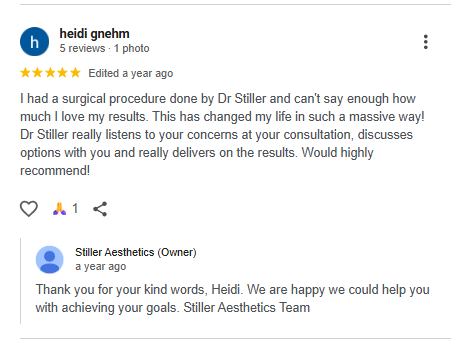
Even though Stiller Aesthetics has plenty of real positive reviews to draw on, InvestigateWest identified multiple rave reviews on Google that declined to mention that the reviewers were current Stiller Aesthetics employees.
It’s why Basu said it’s so important to look at a doctor’s credentials.
“Make sure your surgeon is certified by the American Board of Plastic Surgery,” said Basu. “Accept no imitations. Don’t fall for fancy titles.”
The American Board of Plastic Surgery is one of 24 boards established by the American Board of Medical Specialties, the organization that has set the gold standard for the most rigorous medical-credentialing process in the last century. Sientra, one of the four major manufacturers of silicone gel breast implants, won’t even sell to doctors without a Board of Plastic Surgery credential.
Stiller doesn’t have one. Instead, when he advertises himself as a “board-certified” cosmetic surgeon, he’s talking about the American Board of Cosmetic Surgery — an endorsement not approved by the American Board of Medical Specialties or recognized by the Washington Medical Commission.
To be clear, an American Board of Cosmetic Surgery endorsement is not nothing. It requires a year-long fellowship, the completion of 300 cosmetic surgeries, and passing an exam. But that’s the fraction of the more than six years of training the American Board of Plastic Surgery requires.
Research suggests that experience matters. A 2022 study found that American Board of Cosmetic Surgeons’ doctors were three times as likely to have disciplinary actions from state medical boards than those fully credentialed with the American Board of Plastic Surgery.
Some states have taken action. In 2018, the state medical board of California banned cosmetic surgeons from advertising as “board-certified” without a Board of Plastic Surgery certification. The Washington Medical Commission hasn’t done the same.
“That’s for the profession to sort out, not the regulator,” said Micah Matthews, deputy executive and legislative director for Washington’s commission.
While the Attorney General’s Office will sometimes intervene in consumer protection issues, the medical commission is the primary body tasked with investigating accusations and leveling penalties, including stripping doctors of their licenses because of misconduct. But Matthews said the bar is very high, requiring “clear, cogent and convincing evidence that the person can never be remediated.”
A rave review on Google that appears to have been written by a current Stiller Aesthetics employee. (Google screenshot)
An investigation by the medical commission is only one stage in a very lengthy process. Nearly three years after the Attorney General’s Office brought charges against Sajan — the cosmetic surgeon sued for faking his way to more positive reviews — the commission has not yet ruled on what the penalty should be. A hearing is scheduled for March.
Meanwhile, Sajan put out a press release last month that appeared on sites like Yahoo Finance, declaring himself the “best plastic surgeon in Seattle.”
Try, try, try again
In the midst of the pandemic, cracks began to appear in Stiller’s cultivated public image.
In July 2021, an Idaho sheriff’s deputy pulled Stiller over in Latah County, south of Spokane. Through slurring words, he claimed he’d only had “one beer,” records state. But he blew a .21 on a Breathalyzer, more than twice the legal limit. It meant two days in jail, a suspended license, an ignition interlock installed in his vehicle, and nearly a year of probation.
After his arrest for driving under the influence in July 2021, cosmetic surgeon Geoffrey Stiller spent two days in jail and had an ignition interlock installed on his vehicle until November 2022. (Latah County Sheriff’s Office)
The years ahead would bring a divorce, lawsuits and a number of complaints to the Washington Medical Commission.
He completed his court-mandated alcohol education training class in February 2022, the same month that a woman named Ashley Miller first walked into Stiller’s office for a surgical consultation. Stiller’s team convinced her to grow her breast size by 2½ times.
Five days after her first surgery, the implant had come loose and was jutting up near her collarbone, causing one breast to swell dramatically, Miller alleged in court records.
Many cosmetic surgeons offer free revisions when clients are unhappy. Tonya Berrueta, who sued Stiller in 2021, got three revisions from Stiller before giving up.
“I had to say, ‘Enough is enough,’” Berrueta said. “I trusted you once. Twice. Three times. Four times. Not doing a fifth time.’”
Miller, however, kept going back to Stiller and kept having problems. A painful lump popped up in one breast. Blood and fluid leaked from her veins and pooled under her skin. The surgical mesh Stiller used repeatedly came loose. A breast turned purple and black, accompanied by a fever. One implant ruptured.
Hall, Miller’s attorney, said that Stiller had operated on Miller 10 times within two and half years, representing “a pretty direct line to conclude that something went wrong.”
To start with, the lawsuit alleges Stiller had used a surgical disinfectant, even after Miller told him she was allergic to it. He’d misdiagnosed the painful lump on her breast as a mere cyst, allowing what was actually one of his loose stitches to drift around her body for months. He’d allegedly been reusing her same implants, as opposed to discarding them and starting fresh.
For minor tweaks to recent surgeries, reusing the same implant is fine, Basu said, but any time there are worries about infections or scar tissue, most doctors recommend they get replaced.
“If in doubt, change it out,” he said.
By November 2023, Miller started raising the possibility of going to another doctor for a second opinion. Stiller countered with a job offer.
According to the lawsuit, Stiller told her that she was Stiller Aesthetics’ “favorite client” and that they wanted to make her happy. Working for Stiller would not only let her get one free surgery a year, but the proximity would make it easier for Stiller to provide her medical care.
“She was frustrated with what was happening to her body. She was concerned about the care she was receiving,” Hall said. “But she still trusted Dr. Stiller.”
Miller was hired as Stiller’s “patient care representative” in January 2024.
“She did not realize it was such a horrible place until she got on the inside,” Hall said.
The lawsuit alleges that Stiller admitted to Miller he “previously had multiple sexual relationships with other Stiller Aesthetics’ employees,” and that Miller’s new co-workers relentlessly spread false rumors that she was his latest conquest.
Stiller did little to stop the harassment, the suit states, and “made it clear that he viewed women as sexual objects and playthings.”
Photos of Miller’s “nude and discolored breasts” she’d provided to the clinic for a medical assessment had ended up on an employee’s personal cellphone. Other patients’ pictures were on the phone, too. She alleges identifiable video footage of her body in surgery was uploaded onto Stiller Aesthetics’ Instagram page without her permission.
Miller was horrified, her lawsuit said, by the cavalier way that patient rights were treated. Both she and her husband had been there when a photo was presented at a birthday party showing a front-office supervisor participating in a penis amputation. Stiller’s reaction, according to the lawsuit: “That’s awesome.”
Spangler, the former front desk supervisor, said on multiple occasions while she worked there, untrained employees were given the chance to deal with their anger toward men by cutting off penises during surgical procedures.
“You know, a joke,” Spangler said. “A freaking joke.”
Being an employee also gave Miller inside information into what may have gone wrong with her own surgery: In her complaint, Miller said, she was told by the clinic director that Stiller had previously performed surgeries while under the influence of alcohol, including Miller’s first surgery in May 2022. Stiller’s attorneys repeatedly deny he was drunk during that surgery.
At that time, he was on probation from his 2021 drunk driving arrest, barred from entering a bar or consuming alcohol until the middle of October 2022.
But Spangler said that when she joined the staff in August 2022, she got a firsthand look at the culture of sexual harassment, the fallout from Stiller’s affairs, and Stiller’s frequent use of alcohol.
“We were partying right out of the gate,” Spangler said. “Work nights. Week nights.”
She said she’d see Stiller drink until 2 or 3 a.m. and then show up at the clinic the next day at 6 a.m. ready to operate. She said she knows of one botched face-lift in particular that came after a night of hard drinking.
A 2011 study tested Irish medical students and experienced doctors on their surgical skills the morning after a bout of heavy drinking and found that performance continued to suffer as late as 4 p.m. the next day.
It represents another hole in the regulatory system: While the Federal Aviation Administration tries to protect passengers from pilots influenced by alcohol by implementing a “bottle to throttle” rule — requiring that pilots wait at least eight hours to fly after drinking — there’s no equivalent rule for surgeons.
Private matters
Even after hearing that Stiller’s drinking habits may have contributed to her disastrous surgery, Miller didn’t quit.
Instead, one of the perks of the job was turned against her, she alleges. After taking advantage of the free-surgery-a-year offer for Stiller Aesthetics employees — getting a rhinoplasty along with another breast implant revision — she was pressured to sign a contract stipulating that if she left the job before the year was up, she’d have to pay full price. While California recently banned most of these “stay or pay” contracts, Washington state and Idaho still allow them.
After Miller was fired in November 2024, she suddenly found herself owing her boss thousands of dollars.
“They wanted to hold this debt over her head — I believe in an effort to get her to shut up and not talk about what was happening,” said Hall, Miller’s attorney.
When Spangler was ultimately fired in January 2024 — with little explanation other than she was not correctly performing “job-related duties” — she said she was also told she’d have to pay back a generous cash gift that Stiller had given her.
Stiller’s attorneys have already won one major motion in court: They’ve convinced the judge to split Miller’s lawsuit into two separate cases, one focusing on the workplace allegations and the other focusing on the medical malpractice claims. Medical malpractice suits are typically decided in favor of the doctor. Stiller’s attorney argues that Miller consented to her treatment, assumed the risk of her potential injuries, and was potentially to blame for any suffering she incurred.
Miller plans to also complain to the Washington State Medical Commission. In the past year, there have been four complaints about Stiller or his office. At least two have concerned inaccurate medical records.
“He does not keep his medical records correct,” Spangler said. “The state should be interested in that.”
Spangler said that Stiller would sometimes delay writing up his surgical notes for months, and would sometimes copy and paste notes from different surgeries with different patients. The Washington Medical Commission warns that using cut-and-paste functions for medical records can raise concerns about fraudulent billing and “represents significant risks to patient safety.”
Fey, the trans patient, came to Stiller late last year for a nipple-sparing mastectomy, a surgery where a patient’s breast tissue is removed, but the original nipple remains attached. Stiller’s records state Fey got a different procedure, with extensive details about how Stiller had cut off his nipples and then sewed them back on. Either he’d been given the wrong surgery — a mistake that could have ramifications on nipple appearance and sensitivity — or the medical records were wrong.
While Stiller’s office insisted that the records were correct, Fey sought out another surgeon, who confirmed that the records were in error.
The surgery itself, Fey concluded, was well done. But he felt like he’d been gaslighted — repeatedly lied to in a way that pretended he was the crazy one.
“I don't know if I want to get too into how mad I am right now,” Fey said.
Transgender surgeries are under fire right now. This year Stiller was sued for medical malpractice by a Texas-based law firm created solely to represent those they say have been harmed by “gender-affirming care.”
The plaintiff, a woman who no longer identifies as transgender, accused Stiller and a number of other doctors of disregarding “numerous red flags” about her mental condition before “rushing” her down the path of several permanent gender-transition surgeries. Her attorney argues that Stiller in particular botched her surgery, alleging the patient experiences “severe and debilitating pain in her arms to this day” because of the operation.
It raises the possibility that mistakes made by cosmetic surgeons could be used to whittle away the rights of trans people to get those surgeries to begin with. Stiller is one of the only gender-transition surgeons in the state who takes Medicaid, Fey said.
There are lots of ways that a surgeon screwing up can hurt people, Fey said, and lots of reasons for anti-trans crusaders to want doctors like Stiller to screw up.
The story you just read is only possible because readers like you support our mission to uncover truths that matter. If you value this reporting, help us continue producing high-impact investigations that drive real-world change. Your donation today ensures we can keep asking tough questions and bringing critical issues to light. Join us — because fearless, independent journalism depends on you!
School leaders received numerous reports that former high school English teacher Curtis Johnston was “dating” a student but failed to intervene, complaint says
If you cover criminal justice in the Pacific Northwest — or want to — we’re hosting a free virtual training that may be useful to you and your newsroom
Get the inside scoop in your inbox, free.
Subscribe to our weekly newsletters and never miss an investigation.